
To reconstruct crypto cost basis, gather every available exchange history, wallet transaction, bank record, prior tax report, and custodian statement, then reconcile purchases, transfers, sales, and unknown transactions into one timeline. Because the IRS generally treats digital assets as property, each disposal needs an acquisition date and cost to calculate gain or loss. A qualified tax professional should review the result before you rely on it for a return.
What Cost Basis Reconstruction Means
Cost basis is what you paid to acquire an asset, plus acquisition costs, used to measure gain or loss when you dispose of it. Reconstruction is the process of rebuilding that record when the original purchase data is incomplete or scattered across exchanges, wallets, and years of activity. The goal is a defensible acquisition date and dollar cost for every lot, supported by source records rather than a guess. This page is the step-by-step methodology that the What If I Cannot Prove My Crypto Cost Basis? and What to Do If Crypto Tax Records Are Missing pages point to for the actual work.
Reconstruction Steps
- List every exchange, wallet, custodian, broker, and app you have used, including ones that have since closed.
- Export full transaction histories (CSV or API) from each, back to your first transaction.
- Identify the wallet addresses you control so on-chain activity can be traced through a block explorer.
- Match deposits against withdrawals across accounts so one asset is not counted twice.
- Separate transfers from sales: moving crypto between wallets you own is generally not a taxable disposal, while a sale or swap usually is. The mechanics are covered in How to Separate Crypto Transfers From Taxable Sales.
- Locate fiat purchase records (bank or card statements) to fix the original cost and date.
- Review prior tax filings to stay consistent with basis and lots already reported.
- Flag missing data and note the gaps instead of guessing a number.
- Document the assumptions and method used for any estimated basis, including the accounting convention applied (for example, FIFO or specific identification).
- Prepare a clean support file for the CPA: the timeline, the source records, and the open questions. The How to Prepare Crypto Records for a CPA page outlines what to hand over.
Data Sources to Pull
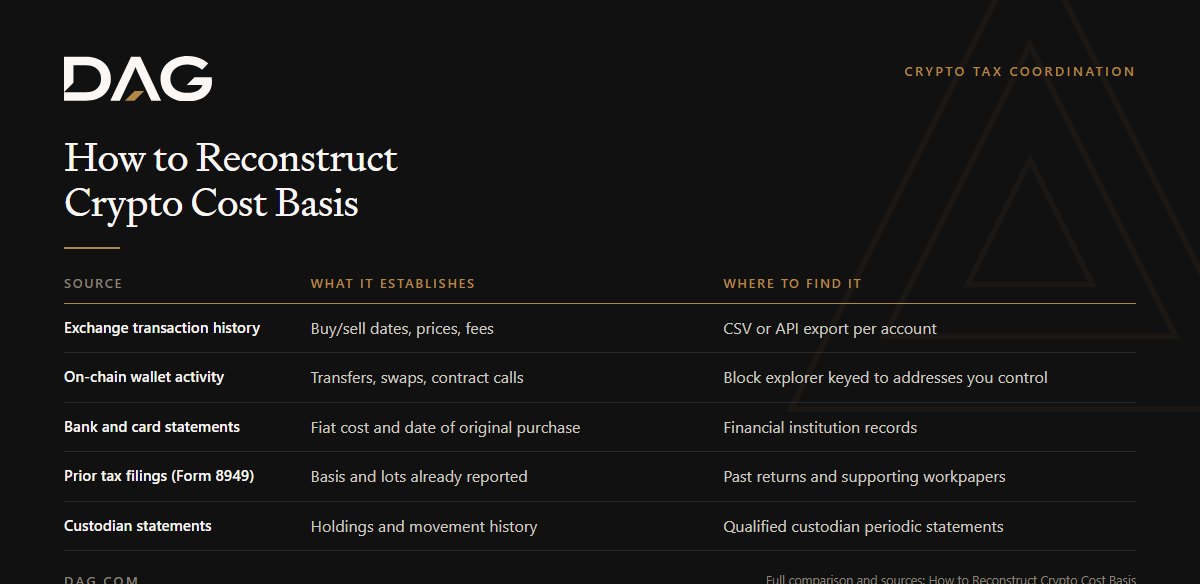
| Source | What it establishes | Where to find it |
|---|---|---|
| Exchange transaction history | Buy/sell dates, prices, fees | CSV or API export per account |
| On-chain wallet activity | Transfers, swaps, contract calls | Block explorer keyed to addresses you control |
| Bank and card statements | Fiat cost and date of original purchase | Financial institution records |
| Prior tax filings (Form 8949) | Basis and lots already reported | Past returns and supporting workpapers |
| Custodian statements | Holdings and movement history | Qualified custodian periodic statements |
Form 1099-DA reporting from brokers is phasing in, so newer activity may arrive with basis already populated; older activity usually will not. See What Is Form 1099-DA? for how that reporting works.
Common Problems
Closed exchanges, lost or old wallets, missing CSV exports, DeFi activity, staking rewards, airdrops, and wallet-to-wallet transfers all make reconstruction harder. Most have a workaround: block explorers for on-chain history, third-party tax reports, or a reasonable, documented estimate where records genuinely cannot be recovered. The records and the reasoning behind any estimate matter as much as the final number, because a tax position is only as strong as the support behind it.
This methodology sits inside the broader Crypto Tax Records Hub, which covers the surrounding recordkeeping and reporting workflows.
Related Questions
Can I estimate crypto cost basis if records are missing?
Sometimes. Where records genuinely cannot be recovered, a reasonable estimate built from block explorer data, historical price references, and documented assumptions may be defensible. The basis of zero is a fallback that generally increases taxable gain. Document the method and have a qualified professional review it; outcomes depend on the specific facts.
Is moving crypto between my own wallets a taxable event?
Generally no. Transferring crypto between wallets you control is typically not a disposal, so it usually does not trigger gain or loss. The transfer still belongs in your timeline so the same coins are not double-counted as sales. Confirm the treatment of any fees with a tax professional.
Who should review reconstructed cost basis before filing?
A qualified tax professional, such as a CPA or enrolled agent familiar with digital assets, should review the timeline, the source records, and any estimate before it supports a return. Reconstruction produces a working position, not a final answer, and the review is where gaps and assumptions get stress-tested.
Sources
- IRS: Digital assets
- IRS: Frequently asked questions on digital asset transactions
- IRS: About Form 8949
Compliance Note
This article is educational and does not provide legal, tax, accounting, investment, or custody advice. Cost basis reconstruction should be reviewed with qualified tax professionals.