
Crypto tax reporting for LLCs means matching an LLC's digital asset records to its legal ownership, wallet activity, entity classification, and federal tax obligations. An LLC does not automatically simplify crypto taxes; it can improve organization only when the records are clean and the entity is administered as a separate person. How transactions are reported generally depends on the facts.
What Crypto Tax Reporting for an LLC Means
The core term covers how an LLC documents and files the tax consequences of its digital asset activity. The IRS generally treats digital assets as property, so each disposal by the LLC can be a taxable event with its own cost basis and holding period. How the LLC reports those events depends on its tax classification and the underlying records, which is why clean entity bookkeeping sits at the center of crypto tax planning for HNW investors.
Records a Crypto LLC Should Keep
A crypto LLC should preserve a complete trail that ties each on-chain action back to the entity:
- Wallet addresses controlled by the LLC, separated from any personal wallets.
- Exchange and custodian statements, ideally from a qualified custodian where assets are held.
- Transaction IDs (hashes) for every transfer and disposal.
- Purchase and sale records with date, asset, quantity, and USD value.
- Transfers between LLC-controlled accounts, labeled as non-taxable movements rather than taxable sales.
- Cost basis support, including the method used (for example, specific identification).
- Staking or reward records, with the fair market value at receipt.
- Fees and expenses under a written policy.
- Operating agreement, member contributions, and distribution records.
Entity Classification Matters
How an LLC is taxed shapes how its crypto is reported. A single-member LLC is generally a disregarded entity by default, so its activity usually flows onto the owner's return; a multi-member LLC is generally treated as a partnership; an LLC may also elect S- or C-corporation treatment. Each path changes which form the gains and losses land on. A qualified tax professional should confirm the classification before filing, since the same wallet activity can be reported differently depending on the election. Family-office structures add another layer covered in crypto tax reporting for family offices.
Personal vs. LLC Reporting
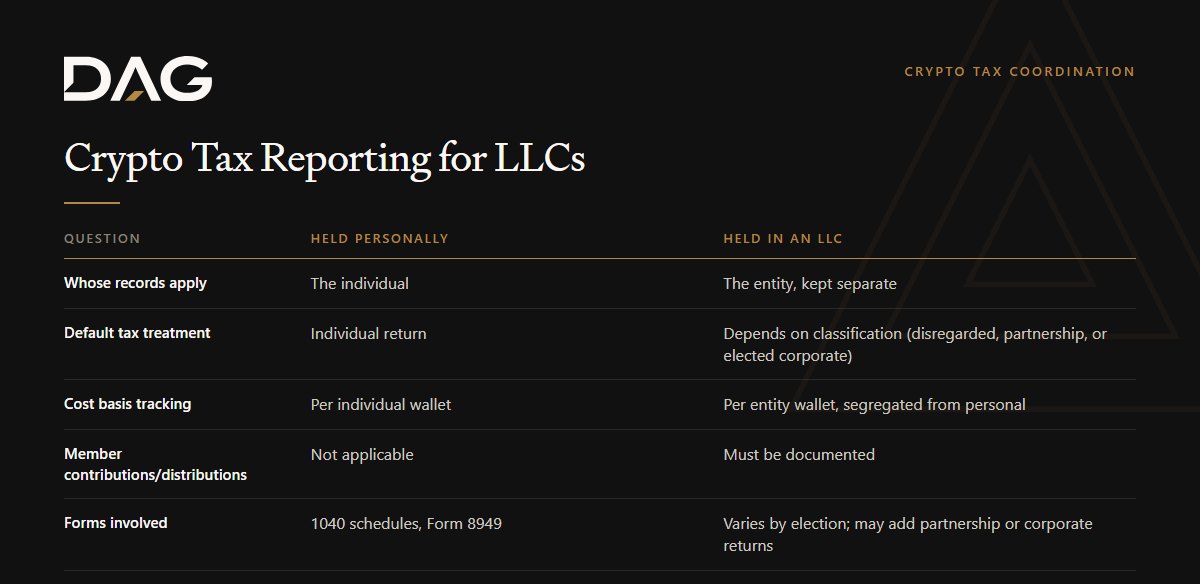
| Question | Held personally | Held in an LLC |
|---|---|---|
| Whose records apply | The individual | The entity, kept separate |
| Default tax treatment | Individual return | Depends on classification (disregarded, partnership, or elected corporate) |
| Cost basis tracking | Per individual wallet | Per entity wallet, segregated from personal |
| Member contributions/distributions | Not applicable | Must be documented |
| Forms involved | 1040 schedules, Form 8949 | Varies by election; may add partnership or corporate returns |
Putting crypto in an LLC does not change the IRS property treatment or remove market, custody, or tax risk; it changes the recordkeeping and reporting path. Holding assets through an entity does not by itself guarantee charging-order protection or tax savings, and any structure should be reviewed against the specific facts.
Common Problems
- Mixing personal and LLC wallets, which blurs ownership.
- Missing cost basis, a recurring issue addressed in common crypto tax record mistakes.
- Treating internal transfers as sales without review.
- No written expense policy.
- No documentation of member contributions or distributions.
Related Questions
Does an LLC reduce crypto taxes?
Not by itself. An LLC changes how activity is reported, not the underlying IRS property treatment. Whether it helps depends on classification, state law, and the facts, so confirm any expected benefit with a qualified tax professional.
How are transfers between an LLC's own wallets treated?
Moving assets between wallets the same LLC controls is generally not a sale, but it must be documented so it is not mistaken for a taxable disposal. Clear labeling and transaction IDs help separate transfers from sales.
Which tax form does a crypto LLC use?
It depends on the entity's classification. A disregarded single-member LLC generally reports on the owner's return, a partnership files its own return, and an elected corporation files accordingly. A tax professional should confirm the correct forms before filing.
Sources
- IRS: Digital assets
- IRS: Frequently asked questions on digital asset transactions
- IRS: About Form 1099-DA
Compliance Note
This article is educational and does not provide legal, tax, accounting, investment, or custody advice. Crypto LLC reporting should be reviewed with qualified tax professionals.