
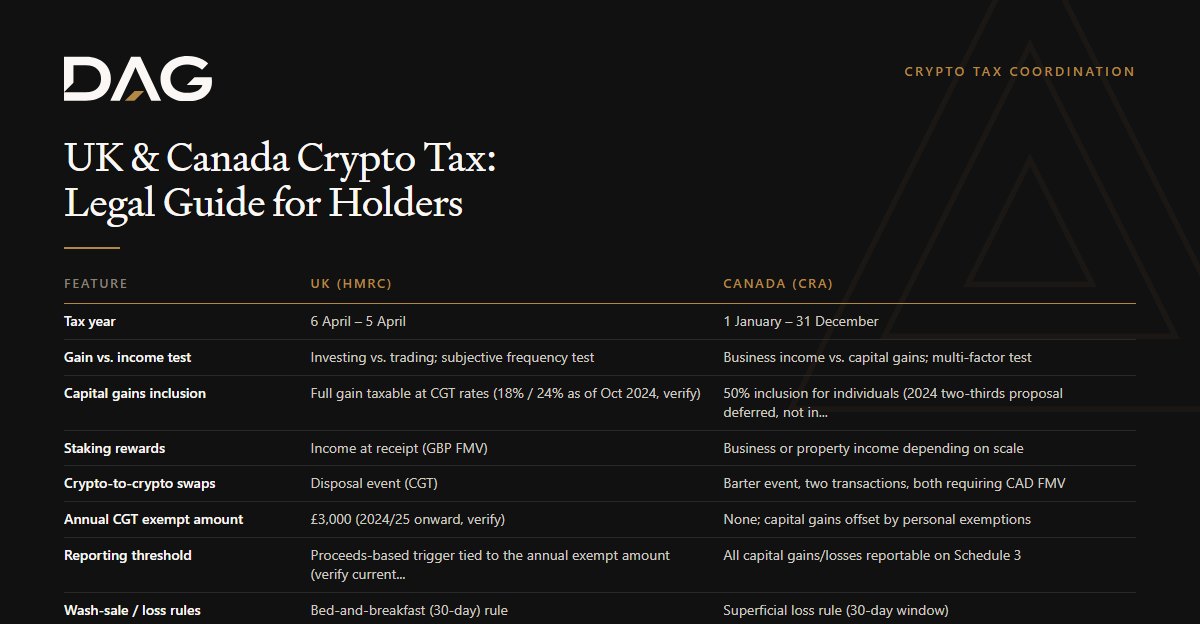
International crypto tax for UK and Canada holders differs materially from US guidance. HMRC taxes staking as income at receipt and wants transaction-level GBP records; CRA's central question is whether activity is business income or capital gains. Both have anti-avoidance rules that can neutralize offshore structures built for US investors. Verify all figures against current HMRC and CRA guidance. For the broader cross-border wealth planning framework, see the international crypto wealth hub.
What does "international crypto tax" mean for UK and Canadian holders?
International crypto tax, in this context, refers to the body of obligations that apply when a crypto holder resides in the UK or Canada, whether or not they also have US filing requirements. HMRC and CRA each have distinct definitions of what constitutes a taxable event, how crypto income is classified, and what records must be kept. Strategies designed for US tax law often do not translate, and in some cases produce worse outcomes when applied in these jurisdictions.
Educational content only, not legal, tax, or investment advice. DAG coordinates administrative and documentation workflows; it does not provide UK or Canadian tax advice. Consult a qualified tax adviser in the relevant jurisdiction. Rules and thresholds cited are as of the dates noted and subject to change.
How does HMRC tax cryptocurrency?
HMRC has published specific crypto guidance (see Sources), but gray areas remain.
Capital gains vs. income. HMRC distinguishes investing from trading. Buying and holding generates Capital Gains Tax (CGT) liability on disposal. Frequent trading or operating a crypto business produces income tax, which runs to higher rates. The dividing line is subjective. HMRC examines the pattern of activity, the holder's intent, and the sophistication of the approach. No fixed transaction-frequency threshold exists.
Staking rewards. Treated as income at the time of receipt. The GBP sterling value on the receipt date becomes both taxable income and the cost basis for those tokens. A later disposal of staked rewards triggers CGT calculated from that basis.
Airdrops. Unsolicited airdrops (forks, promotional distributions where no action was required) are typically treated as capital assets with near-zero cost basis. Airdrops earned by completing tasks or holding qualifying tokens are treated as income.
DeFi activities. HMRC has not issued comprehensive DeFi guidance as of this writing. Liquidity pool deposits, yield farming, and governance token claims each require judgment calls by a qualified UK tax adviser applying general principles.
Record-keeping. HMRC expects transaction-level detail: date, transaction type, crypto amount, GBP value at the time, and wallet addresses involved. Gaps in records invite adverse assumptions on audit.
CGT rates. Following changes that took effect in October 2024, the UK's main Capital Gains Tax rates rose to 18% (basic-rate band) and 24% (higher-rate band) for most assets, including crypto. Verify the current rates against HMRC guidance before relying on them.
CGT annual exempt amount. For the 2024/25 tax year onward, the annual CGT exempt amount is £3,000 (reduced from prior years). Treat this figure as dated and verify it against current HMRC publications. Disposing of enough crypto each year to use the allowance can reduce total tax over time.
Reporting threshold. Crypto disposals may need to be reported even when gains fall below the exempt amount, based on a proceeds-based trigger tied to a multiple of the annual exempt amount. The exact threshold and reporting mechanism (Self Assessment versus the real-time CGT service) have changed in recent years, so confirm the current figure and method against HMRC guidance rather than relying on a fixed number.
How does CRA tax cryptocurrency?
CRA's treatment parallels the UK in some areas and diverges significantly in others.
Business income vs. capital gains. This is the primary determination for Canadian holders. Capital gains receive favorable treatment: the capital gains inclusion rate is 50%, meaning one-half of a realised capital gain is included in income for individuals. The 2024 federal budget proposed raising the inclusion rate to two-thirds on individual gains above $250,000 per year, but the federal government subsequently deferred the proposed effective date, and the increase has not become law as of this writing. Holders should treat the 50% inclusion rate as the current rule and not plan around the two-thirds proposal.
Business income is fully taxable at the marginal rate. CRA looks at: frequency of transactions, holding periods, knowledge of markets, time spent, financing arrangements, and whether the activity was promoted. A software developer mining crypto as a side business, or a holder trading on technical analysis, may find CRA characterising their activity as business income. A holder who bought Bitcoin years ago and has not transacted may clearly be in capital gains territory. The middle ground requires a qualified Canadian tax adviser's judgment.
Staking, mining, and lending. Generally treated as business income or property income depending on scale. Mining at commercial scale is business income. Passive staking of a small ETH position may be property income. No bright-line rule exists.
Barter transactions. Trading one crypto for another is treated as two transactions: a deemed sale of the first asset at its CAD fair market value, followed by a purchase of the second. Every swap is a taxable event requiring a FMV calculation in Canadian dollars.
Record-keeping in CAD. Every transaction requires CAD values at the time of execution. Holders transacting on non-Canadian exchanges must convert USD or other currency prices to CAD using the exchange rate on the transaction date.
GST/HST. Holders running a crypto business above the registration threshold may need to register for and collect GST/HST. This obligation is frequently overlooked until an audit.
Superficial loss rules. A capital loss is denied if the same or identical property is reacquired by the holder or an affiliated person within 30 days before or after the sale. This affects tax-loss harvesting strategies borrowed from US practice.
UK vs. Canada: Key Rules at a Glance
| Feature | UK (HMRC) | Canada (CRA) |
|---|---|---|
| Tax year | 6 April to 5 April | 1 January to 31 December |
| Gain vs. income test | Investing vs. trading; subjective frequency test | Business income vs. capital gains; multi-factor test |
| Capital gains inclusion | Full gain taxable at CGT rates (18% / 24% as of Oct 2024, verify) | 50% inclusion for individuals (2024 two-thirds proposal deferred, not in force, verify) |
| Staking rewards | Income at receipt (GBP FMV) | Business or property income depending on scale |
| Crypto-to-crypto swaps | Disposal event (CGT) | Barter event, two transactions, both requiring CAD FMV |
| Annual CGT exempt amount | £3,000 (2024/25 onward, verify) | None; capital gains offset by personal exemptions |
| Reporting threshold | Proceeds-based trigger tied to the annual exempt amount (verify current figure/route) | All capital gains/losses reportable on Schedule 3 |
| Wash-sale / loss rules | Bed-and-breakfast (30-day) rule | Superficial loss rule (30-day window) |
| DeFi guidance | Limited; adviser judgment required | Limited; adviser judgment required |
| Record currency | GBP | CAD |
| Anti-avoidance (offshore) | Transfer of Assets Abroad rules | Foreign Accrual Property Income (FAPI) rules |
What cross-border issues arise for holders in both jurisdictions?
US obligations persist for US persons. A US citizen or green card holder living in the UK or Canada retains US filing obligations: FBAR, Form 8938, and worldwide income reporting. FATCA also continues to apply. US tax treaties with the UK and Canada predate crypto; treaty treatment of staking rewards or DeFi yield is not definitively resolved.
Currency conversion on the same transaction. The same disposal may need to be reported in USD, GBP, and CAD, using exchange rates on the transaction date. The same economic outcome can produce different reported gain or loss amounts in each currency.
Residency and timing mismatches. The UK and US tax years do not align. Moving mid-year creates partial-year filing obligations under different rules in each country. Where tax residency falls requires detailed fact analysis under treaty tie-breaker provisions.
Entity structuring across borders. A UK limited company holding crypto pays corporation tax on gains; there is no individual CGT allowance at the corporate level, and extracting profits triggers dividend or salary tax. Canadian corporate structures carry similar extraction costs. Trust structures in the UK and Canada are governed by different rules than US trust taxation, do not assume US-designed trust strategies transfer.
Offshore anti-avoidance. HMRC's Transfer of Assets Abroad rules and CRA's FAPI rules both target arrangements designed to shelter income in offshore entities. Using an offshore vehicle to avoid UK or Canadian tax can produce worse outcomes than paying the underlying tax, and may trigger disclosure obligations.
For crypto trust structures used across jurisdictions, the legal framework in each country where the trust, its assets, or its beneficiaries are located will affect the result.
What are the most common mistakes UK and Canadian crypto holders make?
Applying US rules. Most online crypto tax content is US-focused. US CPAs and US tax software reflect US law. A Canadian holder using US-centric guidance risks mischaracterising income, misapplying cost basis methods, and missing jurisdiction-specific reporting obligations.
Tracking values in the wrong currency. HMRC requires GBP values; CRA requires CAD values, at transaction time, not converted after the fact from USD. Reconstructing this retroactively is time-consuming and error-prone.
Ignoring small transactions. Every swap, staking reward, and airdrop is potentially taxable. A $50 governance token claimed in a prior year still belongs on the return.
Failing to make the business-vs-capital determination early. Canadian holders especially should establish their characterisation before building significant transaction history. Retrospective reclassification creates cascading adjustments.
Missing reporting thresholds. The UK's proceeds-based reporting trigger catches holders who assume gains below the CGT allowance require no filing.
Mixing business and personal activity in the same wallet. When some activity is business income and some is capital gains, separate wallets and records are required. Commingled records are difficult to untangle on audit.
For a broader view of what can go wrong across all areas of crypto tax records, see common crypto tax record mistakes.
What role does DAG Wealth play?
DAG coordinates the administrative and documentation workflows for international compliance. This means:
- Organising transaction records in formats that work across multiple jurisdictions (GBP, CAD, and USD values for the same transactions)
- Tracking filing deadlines across jurisdictions and coordinating with tax preparers
- Maintaining records of cross-border asset movements and their tax characterisation in each location
- Facilitating introductions to qualified UK or Canadian tax advisers where needed
- Coordinating custody arrangements that satisfy multi-jurisdiction audit trail requirements
DAG Wealth does not provide UK or Canadian tax advice and does not determine the actual tax treatment of transactions in those jurisdictions. That determination rests with a qualified local adviser.
DAG Wealth is a US-based firm. Its affiliated registered investment adviser is registered with the U.S. Securities and Exchange Commission and holds no FCA (UK), CIRO, or Canadian provincial securities registration. For UK and Canadian clients, DAG Wealth's role is limited to administrative coordination and introductions to qualified local advisers, not licensed local tax or investment advice.
For a full view of international wealth planning coordination, the Crypto Wealth Management Hub covers the broader framework.
Related Questions
Does Canada's capital gains inclusion rate affect crypto differently than other assets?
No, the inclusion rate applies to all capital gains, not crypto specifically. The current inclusion rate is 50%, and it treats a large crypto disposal the same as a comparable real estate or securities gain. The 2024 budget proposal to raise the rate to two-thirds on individual gains above $250,000 was deferred and has not become law as of this writing, so the 50% rate remains the operative rule. Canadian holders with large unrealised crypto positions should review the timing of any planned disposals with a Canadian tax adviser.
Can a UK or Canadian resident use a Wyoming LLC or US trust structure for their crypto?
In limited circumstances, but the cross-border implications are significant. A US LLC owned by a UK resident may create US tax filing obligations without providing the CGT or corporation tax efficiencies the structure was designed for. A US trust with UK or Canadian beneficiaries can produce unexpected UK Income Tax or Canadian trust attribution results. For holders weighing crypto trust structures, the jurisdiction of residence and the location of assets both affect the analysis, local counsel in each country is required.
What happens if a UK or Canadian holder missed reporting crypto in prior years?
Both HMRC and CRA operate voluntary disclosure programs that can substantially reduce penalties for holders who come forward proactively. HMRC's Worldwide Disclosure Facility and CRA's Voluntary Disclosures Program (VDP) generally require full disclosure of all outstanding years, payment of tax owed, and in some cases interest. Waiting for an audit notice eliminates the voluntary disclosure benefit. A UK or Canadian tax adviser should be consulted before initiating any disclosure.
How should UK or Canadian crypto holders approach tax-loss harvesting?
With caution. The UK has a "bed-and-breakfast" rule that denies a capital loss if the same asset is reacquired within 30 days. Canada's superficial loss rule operates on a similar 30-day window and extends to affiliated persons. Both rules prevent the straightforward sell-and-repurchase strategy used in US tax-loss harvesting. Timing of disposals and reacquisitions must be structured with local rules in mind. See crypto tax planning for HNW investors for broader tax planning context.
Related Resources
For multi-jurisdictional crypto holders, these pages address adjacent planning considerations:
- Crypto wealth planning for Bitcoin millionaires, coordinating large single-asset positions across wealth, tax, and estate planning
- Crypto estate planning for high-net-worth families, cross-border inheritance and succession considerations for crypto wealth
- Digital asset wealth management for high-net-worth families, institutional coordination and family wealth architecture
Sources
- HMRC, Cryptoassets Manual (CRYPTO10000 onwards), updated periodically, https://www.gov.uk/hmrc-internal-manuals/cryptoassets-manual
- HMRC, Capital Gains Tax rates and allowances, 2024/25, https://www.gov.uk/capital-gains-tax/rates
- HMRC, Self Assessment: Capital Gains Summary (SA108), https://www.gov.uk/government/publications/self-assessment-capital-gains-summary-sa108
- Canada Revenue Agency, Guide for cryptocurrency users and tax professionals (last updated 2024), https://www.canada.ca/en/revenue-agency/programs/about-canada-revenue-agency-cra/compliance/digital-currency/cryptocurrency-guide.html
- Canada Revenue Agency, IT-479R Transactions in Securities, https://www.canada.ca/en/revenue-agency/services/forms-publications/publications/it479r.html
- Canada Revenue Agency, Voluntary Disclosures Program (VDP), https://www.canada.ca/en/revenue-agency/programs/about-canada-revenue-agency-cra/compliance/voluntary-disclosures-program-overview.html
- Canada Revenue Agency, Superficial loss, https://www.canada.ca/en/revenue-agency/services/tax/individuals/topics/about-your-tax-return/tax-return/completing-a-tax-return/personal-income/line-12700-capital-gains/completing-schedule-3/superficial-losses.html
- Department of Finance Canada, 2024 Federal Budget. Capital Gains Inclusion Rate Proposal (proposal subsequently deferred; not enacted as of this draft), https://budget.canada.ca/2024/report-rapport/anx3-en.html
Compliance Note
This page is educational content only. It does not constitute legal, tax, or investment advice and should not be relied upon as such. Tax rules, rates, thresholds, and filing requirements in the UK and Canada change periodically and may differ from the information presented here. Verify all figures and rules with primary sources (HMRC, CRA) and consult a qualified tax or legal adviser licensed in the relevant jurisdiction before making any decisions based on this content.
DAG provides administrative coordination and documentation workflows for clients; it does not provide regulated tax or legal advice in the UK or Canada. DAG Wealth's affiliated registered investment adviser (DAG Wealth) is registered with the U.S. Securities and Exchange Commission and is not registered with the FCA, CIRO, or any Canadian provincial securities regulator. Nothing in this page should be construed as an offer of regulated investment advisory services in the United Kingdom or Canada. Registration does not imply a certain level of skill or training.