
International crypto wealth covers the cross-border questions digital-asset holders face when residency, citizenship, and holdings span more than one country, worldwide taxation, foreign reporting, offshore structures, and conflicting national rules. US persons are taxed on worldwide income and carry US reporting duties regardless of where they live, so these topics are educational and should always be reviewed with qualified counsel in each relevant jurisdiction.
What International Crypto Wealth Is
International crypto wealth describes digital assets held across borders, by US citizens abroad, by non-US residents in the UK, Canada, the EU, or Dubai, or by families whose entities, custodians, and beneficiaries sit in different countries. The hard part is rarely the crypto; it is that each jurisdiction has its own tax, reporting, and entity rules, and they frequently overlap or conflict. For the foundations these cross-border questions build on, see what is crypto wealth management and the Crypto Wealth Management Hub.
Core Questions
- Are US citizens taxed on crypto held outside the United States?
- Can non-US residents in the UK, Canada, the EU, or Dubai use a US adviser?
- How do the GILTI rules affect a US person who uses an offshore corporation?
- How does Canada's capital-gains inclusion rate work?
- What is the Section 85 rollover, and when does it apply?
- What do offshore asset-protection trusts actually do, and not do?
- How are crypto holdings regulated for UK investors?
US Persons and Worldwide Income
A US citizen or green-card holder is taxed on worldwide income and must report foreign accounts and assets, no matter where they live or where the crypto sits, there is no offshore structure that removes that obligation. The Americans-abroad version of this is covered in detail in US expat crypto tax, which walks through FBAR and Form 8938 thresholds and why the foreign earned income exclusion does not shelter capital gains. A related trap is the GILTI rules that affect US citizens using offshore corporations, which can pull foreign-corporation income back into a US return. For the broader US framework these cross-border issues attach to, review crypto tax planning for HNW investors and the Crypto Tax Records Hub.
Canadian Holders
Canada taxes capital gains by including a portion of the gain in income; the long-standing inclusion rate is 50%, and a proposal to raise it to two-thirds for larger gains was not enacted. Walk through the mechanics in how Canada's capital-gains inclusion rate works. Canadians weighing corporate structures often start with the Section 85 rollover and how it lets Canadians move crypto into a corporation, and larger holders look at tax-rate planning for Canadians with $10M in digital assets. These are Canadian-law questions and belong with a Canadian tax professional.
UK and Non-Resident Holders
UK and other non-resident holders operate under their own regulators and tax authorities. Start with crypto regulations for UK investors and the broader legal considerations for international crypto holders in the UK and Canada. For a side-by-side regulatory map across multiple countries, crypto regulations by jurisdiction compares the UK FCA, Canada's CSA/OSC, Australia's ASIC, and the EU's MiCA framework. On the service question itself, can non-US residents in the UK, Canada, Australia, Europe, or Dubai use these services explains why a US-registered firm provides education and coordination, while licensed local advice has to come from counsel in your own jurisdiction. For residents weighing the Gulf, crypto wealth structuring UAE Dubai covers the UAE's zero personal-tax regime, free-zone entities, and VARA licensing, and why a US person keeps US worldwide-tax duties even after relocating.
Offshore Structures and Custody
Offshore trusts and custody are often misunderstood as secrecy or tax-avoidance tools; for US persons they are neither, because worldwide income and foreign-asset reporting still apply. Review offshore asset-protection trusts in the Cook Islands, Cayman, Bermuda, Nevis, and Panama and the guide to offshore trusts for crypto privacy for what these vehicles can and cannot do. On custody and tax-residency questions, see the pros and cons of offshore custody for US crypto investors and crypto tax-haven strategies for US residents, which explain the reporting that follows US persons across borders. The most common US-territory residency play gets its own deep dive in Puerto Rico Act 60 crypto, including the built-in-gain trap that keeps pre-move appreciation US-taxable. For domestic structuring this often interacts with, see the Crypto Trust Structures Hub.
Cross-Border Coordination
Cross-border families usually need their US, foreign, and local professionals working from the same facts. When residency or citizenship spans two countries, crypto tax treaty implications explain how the US-UK, US-Canada, and US-Germany treaties allocate taxing rights on gains and break residency ties, and why the saving clause keeps US persons taxed regardless. International partnerships for offshoring crypto assets covers how coordination and local-partner referrals tend to work in practice. Because crypto custody, entity rules, and tax reporting differ by country, the workable plan is generally a coordinated one, a US-registered firm handling education and US-side coordination, with licensed local counsel and tax advisers owning the advice in each jurisdiction.
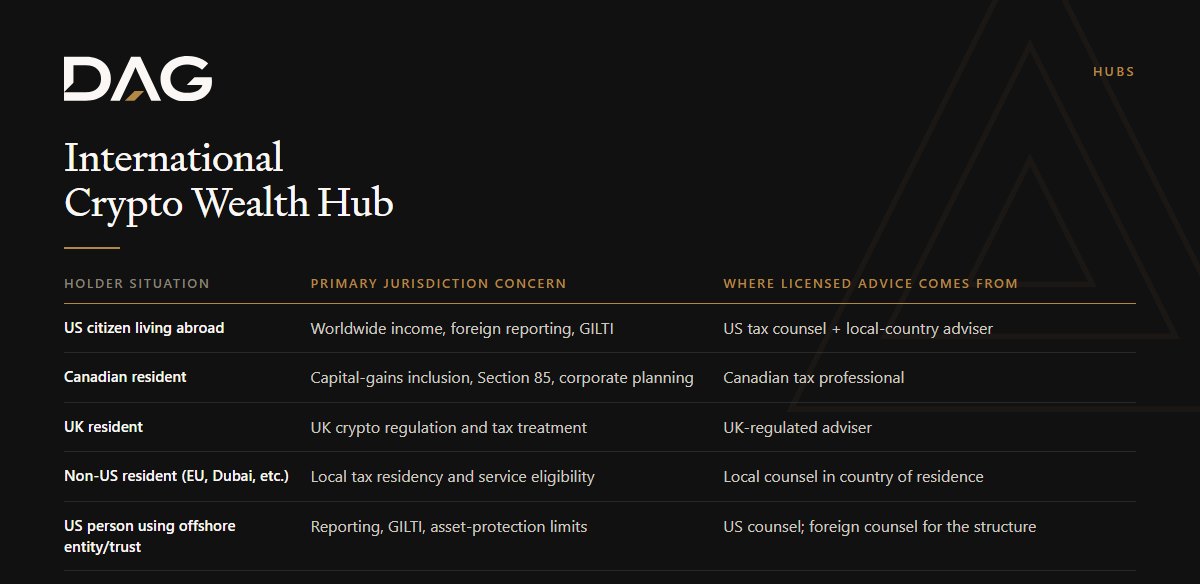
| Holder situation | Primary jurisdiction concern | Where licensed advice comes from |
|---|---|---|
| US citizen living abroad | Worldwide income, foreign reporting, GILTI | US tax counsel + local-country adviser |
| Canadian resident | Capital-gains inclusion, Section 85, corporate planning | Canadian tax professional |
| UK resident | UK crypto regulation and tax treatment | UK-regulated adviser |
| Non-US resident (EU, Dubai, etc.) | Local tax residency and service eligibility | Local counsel in country of residence |
| US person using offshore entity/trust | Reporting, GILTI, asset-protection limits | US counsel; foreign counsel for the structure |
Related Questions
Can I avoid US tax by moving my crypto offshore?
Generally, no. US citizens and residents are taxed on worldwide income and must report foreign accounts and assets; offshore structures do not change that and can add reporting obligations such as those tied to the GILTI rules. Confirm your situation with a qualified US tax professional.
Can a non-US resident work with a US-registered crypto firm?
It depends on the firm's registration and your home jurisdiction. A US-registered firm can generally provide education and coordination, but licensed investment, tax, or legal advice in your country must come from professionals licensed there. Ask about local-partner referrals and confirm with counsel where you reside.
Did Canada's capital-gains inclusion rate increase to two-thirds?
No. The inclusion rate remains 50%; a proposal to raise it to two-thirds for gains above a threshold was not enacted. Because tax rules change, confirm the current rate with a Canadian tax professional before acting.
Sources
- IRS: Frequently asked questions on virtual currency transactions
- IRS: Global Intangible Low-Taxed Income (GILTI)
- Canada Revenue Agency: Capital gains
- UK FCA: Cryptoassets consumer guidance
Compliance Note
This hub is educational and does not provide legal, tax, investment, or custody advice. Digital Ascension Group is US-registered and is not licensed to provide investment, tax, or legal advice in foreign jurisdictions. US persons are generally taxed on worldwide income and have foreign-asset reporting obligations; no structure removes those duties. Cross-border crypto planning should be reviewed with qualified professionals licensed in each relevant jurisdiction.