
Crypto life insurance covers the policy structures, most often private placement life insurance (PPLI), and sometimes indexed universal life, that high-net-worth digital asset holders use alongside trusts, LLCs, and estate plans. These are complex, suitability-driven contracts with strict eligibility rules, real costs, and meaningful risks, so any policy should be reviewed with licensed insurance, tax, and legal professionals before funding.
What Crypto Life Insurance Is
Crypto life insurance is not a separate product category; it is the use of permanent life insurance, typically PPLI, by investors whose wealth is concentrated in digital assets. The "crypto" part refers to how a policy is funded and how it interacts with appreciated tokens, not to insuring the coins themselves. Because PPLI is a securities product, it is generally available only to accredited investors and qualified purchasers and must satisfy IRC §817(h) diversification and the investor-control doctrine; failing those rules can forfeit the policy's tax treatment entirely. For how insurance fits the wider plan, see what is crypto wealth management and the Crypto Wealth Management Hub.
Core Questions
- What is private placement life insurance, and who qualifies?
- How does PPLI differ from indexed universal life (IUL)?
- Can I fund a policy without selling appreciated crypto first?
- What are the §817(h) diversification and investor-control rules?
- How does premium financing add leverage risk?
- How does life insurance coordinate with a crypto trust or LLC?
- At what portfolio level does PPLI start to make sense?
Understanding PPLI
PPLI is the structure most often discussed for digital asset holders, but it carries eligibility gates and ongoing compliance obligations that ordinary policies do not. Start with what is private placement life insurance for the minimums and funding mechanics, then review PPLI vs IUL to understand where each contract fits and where it does not. PPLI is not categorically better than other policies; it suits a narrow profile of eligible investors and involves trade-offs in cost, liquidity, and complexity. For US persons weighing where a policy is issued, offshore vs domestic PPLI explains why both face the same §7702 and §817(h) rules and why the offshore version adds a PFIC, FBAR, and FATCA reporting layer rather than removing US tax.
Integrating Insurance With a Digital Asset Strategy
A policy is one component, not the plan. Integrating life insurance with a digital asset strategy covers how a policy coordinates with custody, liquidity, and the rest of a portfolio, and portfolio levels for LLC, trust, and PPLI structures helps frame when insurance enters the conversation relative to simpler structures.
Funding and Premium Financing
Funding a policy without triggering a taxable sale is a common goal, but the mechanics matter. Infinite banking life insurance with crypto explains cash-flow and collateral approaches, which often rely on borrowing, and any leverage introduces margin-call, interest-rate, and policy-lapse risk that can compound a downturn in digital assets. Borrowing specifically to pay large PPLI premiums is covered in premium financing with crypto collateral, which treats the loan-to-value, liquidation, and rate exposure in depth. How fast you fund matters too: Section 7702 and MEC rules explain how much premium a policy can take before the 7-pay test turns it into a Modified Endowment Contract and the favorable treatment of policy loans and withdrawals is lost. Where borrowing against crypto is the alternative being weighed, compare bitcoin-backed loan vs selling bitcoin.
Life Events and Family Planning
Insurance decisions often surface around a liquidity event or a desire to provide for family. How can I use PPLI to support my parents after a liquidity event walks through one such scenario, and crypto liquidity planning after a token sale covers the broader sequencing. Because policies are frequently owned by or paired with trusts, also review how to fund a trust with crypto and the role of a trust-owned LLC for crypto assets. When the goal is to keep the death benefit out of the taxable estate, an irrevocable life insurance trust can own the policy itself, see ILIT for crypto for how Crummey premium gifts, an independent trustee, and the three-year lookback work, including with PPLI inside the trust. The reason families reach for these structures in the first place is liquidity: life insurance as estate liquidity for crypto covers how a death benefit can fund estate tax and settlement costs so heirs are not forced to fire-sell illiquid or volatile digital assets to pay the bill.
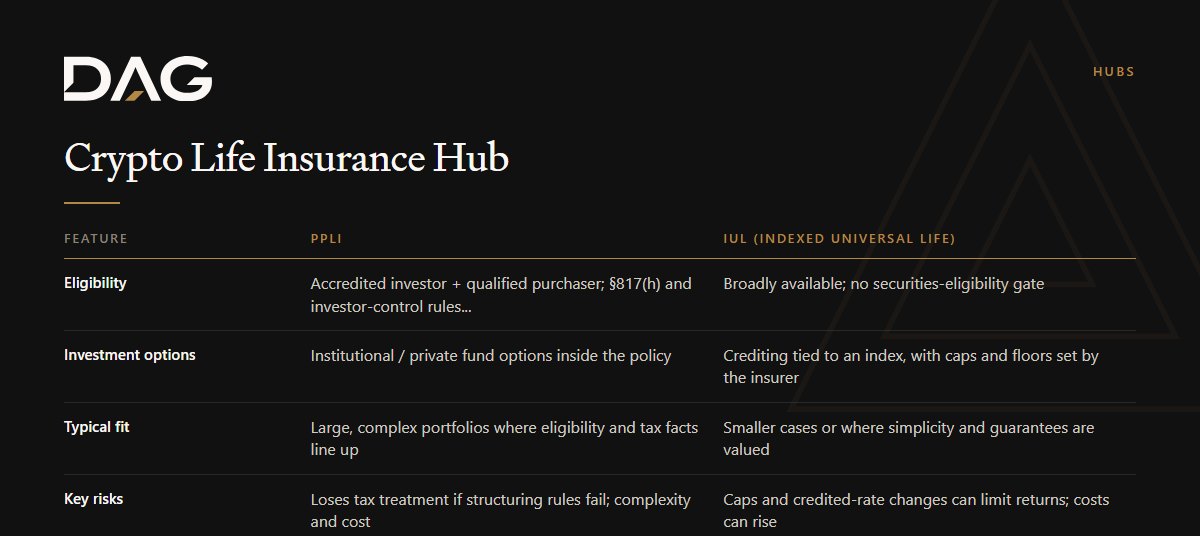
| Feature | PPLI | IUL (indexed universal life) |
|---|---|---|
| Eligibility | Accredited investor + qualified purchaser; §817(h) and investor-control rules apply | Broadly available; no securities-eligibility gate |
| Investment options | Institutional / private fund options inside the policy | Crediting tied to an index, with caps and floors set by the insurer |
| Typical fit | Large, complex portfolios where eligibility and tax facts line up | Smaller cases or where simplicity and guarantees are valued |
| Key risks | Loses tax treatment if structuring rules fail; complexity and cost | Caps and credited-rate changes can limit returns; costs can rise |
Adjacent Hubs
Insurance rarely stands alone. Coordinate it with estate documents via the Crypto Estate Planning Hub, with ownership vehicles via the Crypto Trust Structures Hub, and with the overall portfolio via the Crypto Wealth Management Hub.
Related Questions
Is the cash value or death benefit in a life insurance policy tax-free?
Permanent life insurance has tax features defined by the Internal Revenue Code, but those features depend on the policy qualifying and being maintained correctly. PPLI in particular can lose its intended tax treatment if §817(h) diversification or the investor-control doctrine is violated. No policy is guaranteed to be tax-free, and outcomes depend on your facts; confirm with a qualified tax professional.
Can I fund a policy with crypto without selling it?
Some structures aim to use borrowing or in-kind contributions so the holder does not realize a taxable sale, but these approaches add leverage and counterparty risk and are not available to everyone. Whether they fit depends on eligibility, the assets, and applicable law. Review the funding mechanics with licensed insurance and tax counsel.
Is PPLI better than other life insurance for crypto holders?
Not categorically. PPLI suits a narrow set of accredited, qualified-purchaser investors whose tax facts justify the cost and complexity; for many people a simpler policy or no policy is the better answer. It is an insurance contract, not a guaranteed investment, and suitability drives the decision.
Sources
- IRS: Life insurance & disability insurance proceeds
- Cornell LII: 26 U.S. Code §817. Treatment of variable contracts
- Investopedia: Private Placement Life Insurance (PPLI)
Compliance Note
This hub is educational and does not provide insurance, legal, tax, or investment advice, and is not an offer or solicitation to buy any insurance or securities product. Life insurance is not a guaranteed investment, and PPLI is restricted to accredited investors and qualified purchasers subject to IRC §817(h) and investor-control rules; failing those requirements can forfeit the intended tax treatment. Premium financing and other leverage add material risk. Any policy should be evaluated for suitability with licensed insurance, tax, and legal professionals. Advisory services are offered through DAG Wealth. Registration does not imply a certain level of skill or training.