
Premium financing with crypto collateral is borrowing against a digital asset position to pay the premiums on a large life insurance policy, often private placement life insurance (PPLI), instead of selling the crypto to raise cash. The borrowed funds pay the premium, the crypto stays invested as collateral, and the loan must be serviced and eventually repaid. It adds leverage, and leverage cuts both ways.
What Is Premium Financing With Crypto Collateral?
Premium financing is a lending arrangement: a lender advances the money to pay insurance premiums, and the borrower pledges collateral and repays the loan with interest. In a traditional case the collateral is the policy's cash value plus other assets. In a crypto case, the borrower pledges Bitcoin, Ether, or another holding, usually held with a qualified crypto custodian, and the lender advances premium dollars against a fraction of that collateral's value.
The appeal for a concentrated crypto holder is specific. Funding a large PPLI premium by selling appreciated tokens triggers a capital-gains event; borrowing against the tokens defers that sale. The holder keeps market exposure to the crypto and funds the policy at the same time. That is the pitch. The risk is that you now have two volatile things stacked on each other: a digital asset that can fall hard, and a loan secured by it.
This is distinct from putting crypto inside a policy. You cannot hold tokens in a life insurance contract; premium financing simply pays the cash premium of an otherwise conventional policy. For the foundational policy rules, see private placement life insurance.
How Does the Structure Work?
The order of operations matters because each step locks in a cost or a risk for the life of the arrangement.
- Confirm the policy and eligibility first. PPLI is restricted to accredited investors and, at many carriers, qualified purchasers, and must satisfy IRC §817(h) diversification and the investor-control doctrine. Premium financing does not change any of those gates.
- Size the loan against the collateral. Lenders advance only a portion of the crypto's value, the loan-to-value (LTV) ratio. Crypto-backed facilities commonly start well below 50% LTV because the collateral is volatile (LTV terms are illustrative and vary by lender; verify current terms). The lower the starting LTV, the more cushion before a margin call.
- Pledge collateral and draw premium funds. The crypto moves to the lender's required custody arrangement and the loan proceeds pay the carrier's premium.
- Service the loan. Interest accrues at a rate that may be fixed or floating. Floating-rate loans get more expensive when benchmark rates rise, independent of how the crypto or the policy performs.
- Plan the exit. The loan is eventually repaid from policy cash value, other liquidity, or a later sale of the collateral. A financing arrangement with no credible repayment plan is a deferred problem, not a solution.
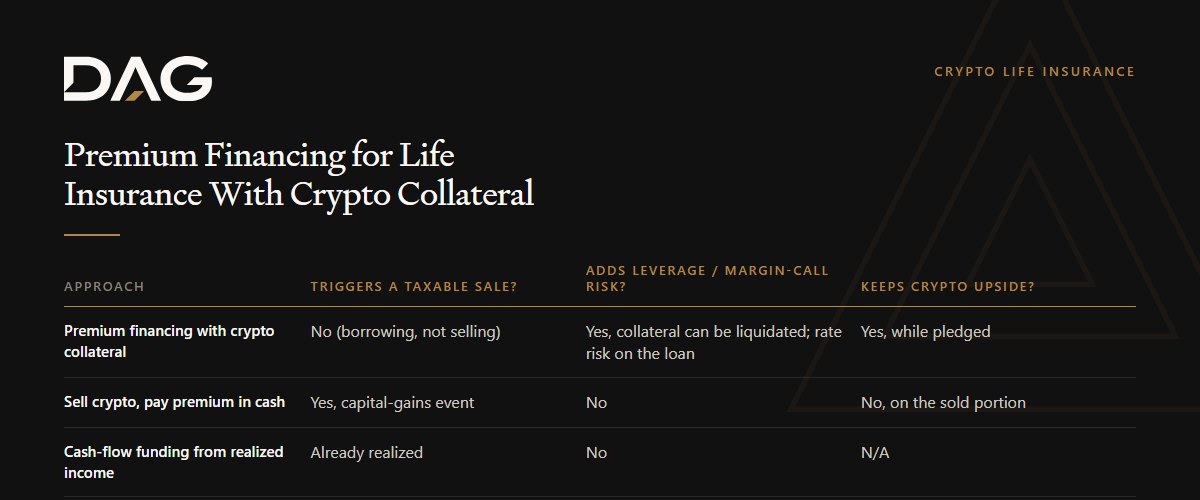
Premium Financing vs. Selling Crypto vs. Cash-Flow Funding
| Approach | Triggers a taxable sale? | Adds leverage / margin-call risk? | Keeps crypto upside? |
|---|---|---|---|
| Premium financing with crypto collateral | No (borrowing, not selling) | Yes, collateral can be liquidated; rate risk on the loan | Yes, while pledged |
| Sell crypto, pay premium in cash | Yes, capital-gains event | No | No, on the sold portion |
| Cash-flow funding from realized income | Already realized | No | N/A |
This compares mechanics, not merit. The right choice depends on your tax facts, time horizon, and tolerance for leverage. For the narrower borrow-vs-sell question on Bitcoin specifically, see bitcoin-backed loan vs selling bitcoin. For the broader lending and rate landscape, see crypto-backed loans for high-net-worth investors.
The Leverage Risks You Are Taking On
Premium financing is attractive precisely because it is leverage, and that is also where it can fail. The material risks compound:
- Margin call and forced liquidation. If the pledged crypto drops, the LTV rises past the lender's threshold and the lender can demand more collateral or sell the crypto, potentially at the worst possible price, locking in the loss and ending the upside thesis that justified borrowing.
- Interest-rate risk. A floating-rate loan grows more expensive as rates rise. The strategy that pencilled out at one rate can become a drain at a higher one. Rising borrowing cost can outrun the policy's projected growth.
- Policy lapse. If you cannot keep servicing the loan or funding premiums after a margin event, premiums can stop. If the policy's cash value is insufficient to carry it, the policy can lapse, and a lapse with an outstanding loan can itself create taxable income.
- Stacked volatility. You are financing a long-term obligation (a multi-year premium schedule) with collateral that can move 50% in a quarter. The mismatch between a volatile collateral asset and a fixed, recurring premium is the core hazard.
- Re-pledge and counterparty risk. Understand whether the lender can rehypothecate the pledged crypto and what happens to your collateral if the lender fails.
None of these is hypothetical. Borrowing against volatile collateral to fund a fixed obligation is the exact setup that unwinds badly in a downturn. There is no version of this that is guaranteed or tax-free.
Premium Financing Suitability Checklist (Discussion Points for Your Advisors)
- Confirm PPLI eligibility independently: accredited-investor / qualified-purchaser status, §817(h) diversification, investor-control compliance.
- Stress-test the collateral: model a 40–60% crypto drawdown and confirm you can meet a margin call without selling at the bottom.
- Identify the repayment source before borrowing, not after.
- Compare fixed vs. floating rate and price the strategy at a higher rate, not today's.
- Confirm custody and whether the lender can rehypothecate pledged assets.
- Coordinate insurance, tax, and legal counsel; if a trust will own the policy, see ILIT for crypto, and fit the decision into the broader Crypto Life Insurance Hub.
Related Questions
Is premium financing with crypto collateral tax-free?
Borrowing is generally not a taxable event, so funding premiums with a loan defers the capital-gains tax you would owe on a sale. That is deferral, not elimination. The gain is still embedded in the crypto, a policy lapse with an outstanding loan can create taxable income, and tax rules can change. No part of this structure is guaranteed to be tax-free; confirm treatment with a qualified tax professional.
What happens if my pledged crypto gets margin-called?
The lender can require additional collateral or sell the pledged crypto to bring the loan back within its loan-to-value limit. A forced sale in a falling market locks in the loss and removes the upside that justified borrowing in the first place. You remain responsible for the loan, and if you cannot continue funding premiums afterward, the policy can lapse. This is the central risk of the strategy and has to be planned for before you pledge anything.
How is this different from infinite banking with crypto?
Infinite banking is built on an overfunded whole-life policy where you borrow against the policy's own cash value; premium financing borrows from a third-party lender against your crypto to pay premiums on a policy that is often PPLI. Different collateral, different lender, different policy type. See infinite banking life insurance with crypto for that approach.
Do I need PPLI to use premium financing?
No, premium financing can fund other permanent policies, but it is most often discussed alongside large PPLI premiums because those premiums are sizable and the buyer typically holds appreciated assets they prefer not to sell. The financing arrangement and the policy are separate decisions; each has to stand on its own.
Sources
- Cornell LII: 26 U.S. Code §817. Treatment of variable contracts (§817(h) diversification)
- Cornell LII: 26 U.S. Code §7702. Life insurance contract defined
- IRS: Digital assets
- IRS: Topic No. 505, Interest expense
- IRS Notice 2014-21 (digital assets treated as property) on irs.gov.
Compliance Note
This page is educational only and does not provide legal, tax, insurance, or investment advice, and is not an offer or solicitation for any insurance, lending, or securities product. Premium financing is a leverage strategy: pledged crypto can be liquidated in a margin call, interest rates can rise, and a policy can lapse, outcomes are not guaranteed and there is no promise of tax-free treatment. Borrowing against volatile collateral to fund a fixed premium obligation carries margin-call, interest-rate, liquidation, counterparty, and policy-lapse risk. Loan-to-value figures, rates, and premium minimums cited here are illustrative and change; verify current terms. PPLI is restricted to accredited investors and qualified purchasers and must satisfy IRC §817(h) diversification and the investor-control doctrine; failing those rules can forfeit the policy's tax treatment. Suitability must be assessed with licensed insurance, tax, and legal professionals. DAG Insurance coordinates these services and does not provide legal or tax advice. Advisory services are offered through DAG Wealth, an SEC-registered investment adviser. Registration does not imply a certain level of skill or training.