
A qualified crypto custodian is a custody provider that may satisfy the "qualified custodian" requirements that apply to certain digital asset custody arrangements under investment adviser rules. Whether a provider actually qualifies depends on the entity holding the assets, its regulatory status, the asset type, and the account structure. The label is not automatic and not a marketing badge.
Short Answer
The term "qualified custodian" comes from the SEC custody rule under the Investment Advisers Act. It generally refers to entities such as banks, registered broker-dealers, or certain trust companies that hold client assets, provide account statements, and segregate those assets. A crypto provider may meet this standard for some advisers, assets, and account structures and not for others, so the status has to be verified rather than assumed.
Why This Matters
For high-net-worth families, family offices, and RIAs, custody is both a security question and a regulatory question. A custodian may offer strong technology while the legal status of the custody relationship remains a separate issue. Registered investment advisers in particular need to review whether client assets must be held with a qualified custodian, since the crypto custody rules that apply to advisers turn on who controls the assets and how. If you are weighing your options, the distinction between qualified custody and self-custody is usually the first one to settle.
How It Works
Qualified custodian analysis generally considers:
- the legal entity holding the assets and its regulatory status;
- account titling and whether the adviser has custody or authority;
- the asset type and how the custodian secures it (for example cold storage, multi-sig, or MPC);
- segregation of client assets from the custodian's own assets;
- the format and source of client account statements;
- transfer controls and authorization workflows;
- available audit and reporting, such as SOC 1 or SOC 2 reports.
A useful way to test a provider against these points is to walk through a structured custody due diligence checklist before assets move.
How a Qualified Custodian Differs From an Exchange
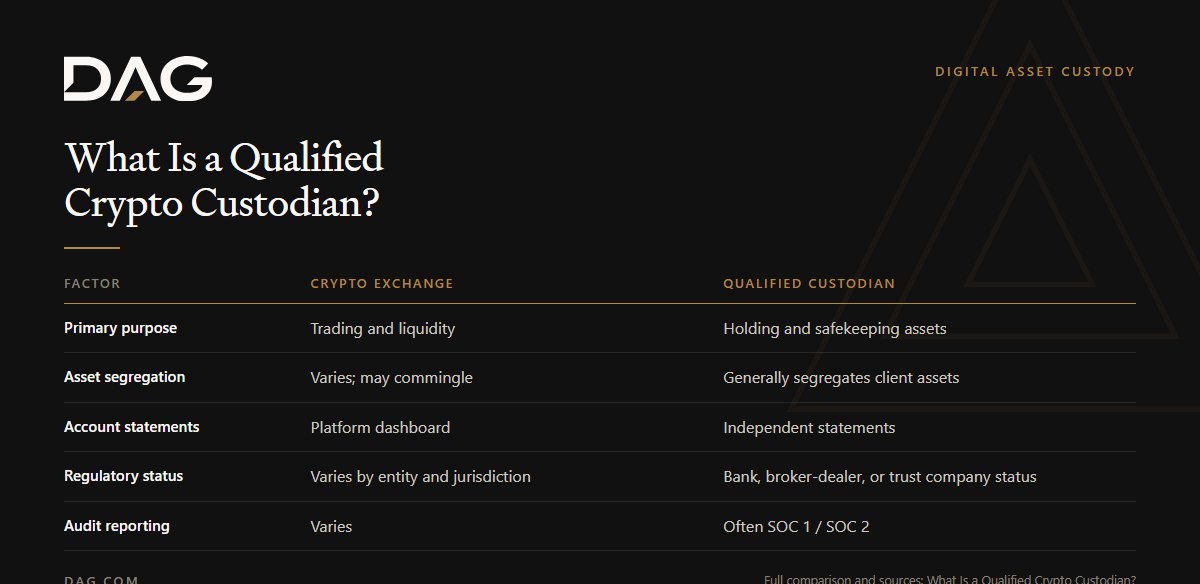
A trading venue and a qualified custodian serve different functions, and conflating them is a common error.
| Factor | Crypto Exchange | Qualified Custodian |
|---|---|---|
| Primary purpose | Trading and liquidity | Holding and safekeeping assets |
| Asset segregation | Varies; may commingle | Generally segregates client assets |
| Account statements | Platform dashboard | Independent statements |
| Regulatory status | Varies by entity and jurisdiction | Bank, broker-dealer, or trust company status |
| Audit reporting | Varies | Often SOC 1 / SOC 2 |
For a deeper treatment of that line, see qualified custodian vs crypto exchange.
Evidence Standard
This article relies on SEC custody materials and does not determine whether any specific custodian qualifies for a specific use case.
When It May Help
- An RIA wants to advise on digital assets and needs to satisfy custody-rule obligations.
- A family office needs institutional-level custody controls.
- A trust or LLC will hold crypto accounts.
- A client wants independent reporting and transfer controls.
- A firm is comparing self-custody, exchange custody, and institutional custody.
When It May Not Be Enough
The phrase "qualified custodian" is not a label to accept at face value. The specific facts, the applicable rules, and the actual custody agreement determine the answer. A provider that qualifies for one adviser, asset, or account may not qualify for another.
Related Questions
Is a crypto exchange a qualified custodian?
Not automatically. Some providers operate custody-related entities or trust-company structures, but the legal status of the entity actually holding the assets has to be verified rather than inferred from the brand.
Why does this matter for RIAs?
Advisers generally have custody-rule obligations when they have custody of client assets. Digital asset custody arrangements should be reviewed with qualified counsel before launch, because registration alone does not establish that a given arrangement complies.
Is qualified custody safer?
It may provide institutional controls and a clearer regulatory structure, but it does not eliminate market, custody, or operational risk, and it carries no FDIC or SIPC guarantee for crypto. Safety depends on the specific custodian and the facts.
Does using a qualified custodian remove the adviser's responsibility?
Generally no. The adviser typically retains diligence and oversight duties, which is why an annual custodian review is part of an ongoing custody program rather than a one-time check.
Bottom Line
A qualified crypto custodian can be a central part of digital asset wealth infrastructure. The analysis should be legal, operational, and compliance-based rather than brand-based, and it should be confirmed with a qualified professional for your specific facts.
Sources
- SEC: What is a qualified custodian?
- SEC custody rule compliance guide
- SEC statement on custody of crypto assets with state trust companies
Compliance Note
This article is for general educational purposes and is not legal, compliance, custody, or investment advice. Registration does not imply a certain level of skill or training.