
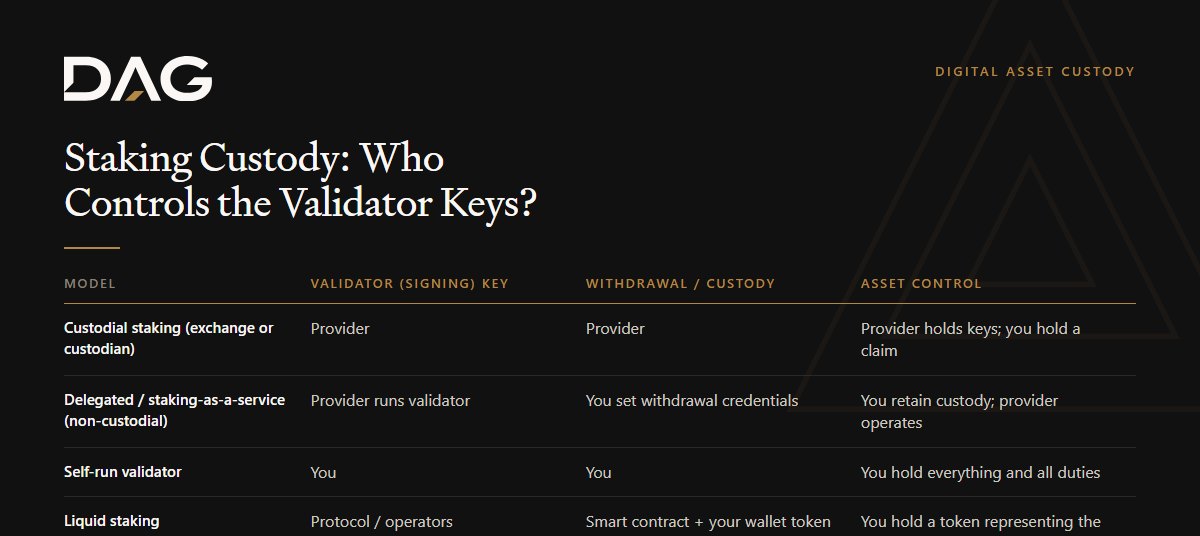
In staking custody, the central question is which keys you control and which you delegate. Proof-of-stake networks separate the validator (signing) key, which proposes and attests to blocks, from the withdrawal/custody key, which controls the underlying assets. You can let a provider run the validator while you keep custody, but the arrangement determines slashing exposure, who can move funds, and whether you ever cede control.
Two Keys, Two Different Powers
For networks like Ethereum, a staking setup generally involves two distinct credentials:
- Validator (signing) key. Authorizes the validator's duties, proposing and attesting to blocks. A party holding this key can perform (or fail to perform) validator actions, which exposes the stake to slashing penalties for misbehavior or downtime. It does not, by itself, let the holder withdraw the principal.
- Withdrawal / custody key (or withdrawal credentials). Controls where staked assets and rewards can ultimately be withdrawn. This is the custody-relevant key, whoever controls it controls the assets.
The core custody dimension is whether those two are held by the same party. A provider can run the validator (hold the signing key) while withdrawal credentials point to your custody, separating operational duties from asset control. Conversely, a fully custodial arrangement may hold both. This is the staking-specific version of the general MPC vs multi-sig custody question of where signing authority sits, a theme that runs through the crypto custody hub.
Who Controls the Keys in Each Model
| Model | Validator (signing) key | Withdrawal / custody | Asset control |
|---|---|---|---|
| Custodial staking (exchange or custodian) | Provider | Provider | Provider holds keys; you hold a claim |
| Delegated / staking-as-a-service (non-custodial) | Provider runs validator | You set withdrawal credentials | You retain custody; provider operates |
| Self-run validator | You | You | You hold everything and all duties |
| Liquid staking | Protocol / operators | Smart contract + your wallet token | You hold a token representing the position |
Each row trades operational burden against control. Custodial staking is simplest but cedes key control; self-running keeps full control but puts all slashing and uptime responsibility on you. Illustrative; exact mechanics vary by network and provider, verify the specific arrangement.
Why This Matters More for Large Stakers
For a large position, the staking-custody arrangement is a governance decision, not a convenience setting:
- Slashing concentration. A large stake run under one operator concentrates slashing risk in that operator's controls and uptime. Spreading across operators or clients can reduce correlated failure.
- Asset control vs. yield. Earning staking yield should not silently transfer custody of the principal. Confirm whether the provider can move or rehypothecate staked assets, the same trap covered in crypto prime broker vs custodian.
- Unbonding/exit timing. Withdrawing staked assets is not instant; exit queues and unbonding periods affect liquidity and any incident response. Build this into a crypto incident response plan.
- Entity and fiduciary fit. When a trust or LLC stakes, the operating documents should permit it and define who authorizes it. See can a Wyoming LLC stake crypto and can a trust receive staking rewards. Rewards also carry tax consequences, see crypto staking tax reporting.
Questions to Ask a Staking Provider
- Who holds the validator signing key, and who holds the withdrawal credentials?
- Can the provider move, lend, or rehypothecate the staked assets?
- How is slashing risk managed, and who bears a slashing loss?
- Across how many operators/validators is a large stake distributed?
- What are the unbonding/exit times and any withdrawal limits?
- Is the arrangement custodial or non-custodial, and is it documented as such?
- Does any insurance or SOC report cover the staking infrastructure?
Pair these with the crypto custody due diligence checklist and questions to ask a crypto custodian.
Related Questions
Does staking through a custodian mean I lose control of my crypto?
It depends on the model. In fully custodial staking, the provider holds both the signing and withdrawal keys, so you hold a claim rather than direct key control. In a non-custodial or delegated arrangement, the provider may run the validator while withdrawal credentials point to your custody, so you retain control of the principal. Confirm which keys the provider holds before staking a large position.
What is slashing, and who pays for it?
Slashing is a network penalty that reduces a validator's stake for misbehavior such as double-signing or, in some networks, extended downtime. Whoever runs the validator is operationally responsible, but the loss reduces the staked assets, so the asset owner can bear the economic hit. Clarify in writing who is liable for slashing losses and how the provider mitigates them before committing.
Can I keep custody and still earn staking rewards?
Often, yes, through non-custodial or delegated staking where a provider operates the validator while you control the withdrawal credentials. This separates operational duties from asset custody. The trade-off is that you may take on more configuration responsibility, and you should confirm the provider cannot move or pledge the staked assets. Verify the exact key arrangement rather than assuming.
Sources
- Ethereum.org, Staking withdrawals (validator vs. withdrawal credentials and exit mechanics). https://ethereum.org/en/staking/withdrawals/
- Ethereum.org, Proof-of-stake (PoS) and slashing overview. https://ethereum.org/en/developers/docs/consensus-mechanisms/pos/
- Internal Revenue Service, Rev. Rul. 2023-14 (treatment of staking rewards as income). https://www.irs.gov/pub/irs-drop/rr-23-14.pdf
Compliance Note
This page is for educational purposes only and does not constitute legal, tax, investment, or financial advice. Staking involves operational, slashing, liquidity, counterparty, and market risks, and key-control arrangements vary by network and provider; no yield or outcome is guaranteed. Network mechanics and tax treatment change over time, verify current details. Staking and custody decisions should be reviewed with qualified professionals. Advisory services are provided by DAG Wealth, an SEC-registered investment adviser. Registration does not imply a certain level of skill or training.