
The most common crypto custody mistakes for family offices are unclear ownership across personal, trust, and LLC accounts; weak transfer approvals; missing wallet inventories and tax records; and overreliance on a single custodian or signer. Each can turn a custody gap into an investment, legal, tax, or governance problem, so written controls matter.
A crypto custody mistake, in this context, is any gap in how a family office holds, moves, and documents digital assets that exposes the family to loss, disputed ownership, tax error, or operational failure. These gaps are usually procedural rather than technical, which is why a written policy and a qualified custodian tend to address most of them.
Mistakes to Avoid
- Mixing personal, trust, and LLC assets. Commingled holdings blur legal ownership and can undermine the charging-order protection an LLC or the asset separation a trust is meant to provide. Keep accounts and wallets segregated by legal entity.
- Allowing one person to control all transfers. A single signer is both a security risk and a key-person risk. Multi-sig or multi-party approval spreads authority across people.
- Failing to verify destination addresses. Crypto transfers are generally irreversible; an unverified address can mean a permanent loss. Use a documented address verification step before sending.
- Not reviewing custodian legal entity status. Whether a provider qualifies as a custodian under the SEC custody rule depends on its charter and structure, not its branding. Confirm the entity type.
- Ignoring qualified custody questions. Self-custody and exchange accounts are not the same as qualified custody. Ask whether assets sit with a qualified custodian and how they are titled.
- Not preserving statements and transaction records. Missing records complicate tax reporting (the IRS generally treats digital assets as property, and Form 1099-DA reporting is expanding) and weaken any later audit or dispute.
- Failing to plan for signer changes. Departures, incapacity, or death can lock funds when succession is not documented in advance.
- Treating proof of reserves as complete diligence. A proof-of-reserves attestation shows assets exist at a point in time; it is not a substitute for SOC 1 / SOC 2 reports, insurance review, and qualified custody.
Better Controls
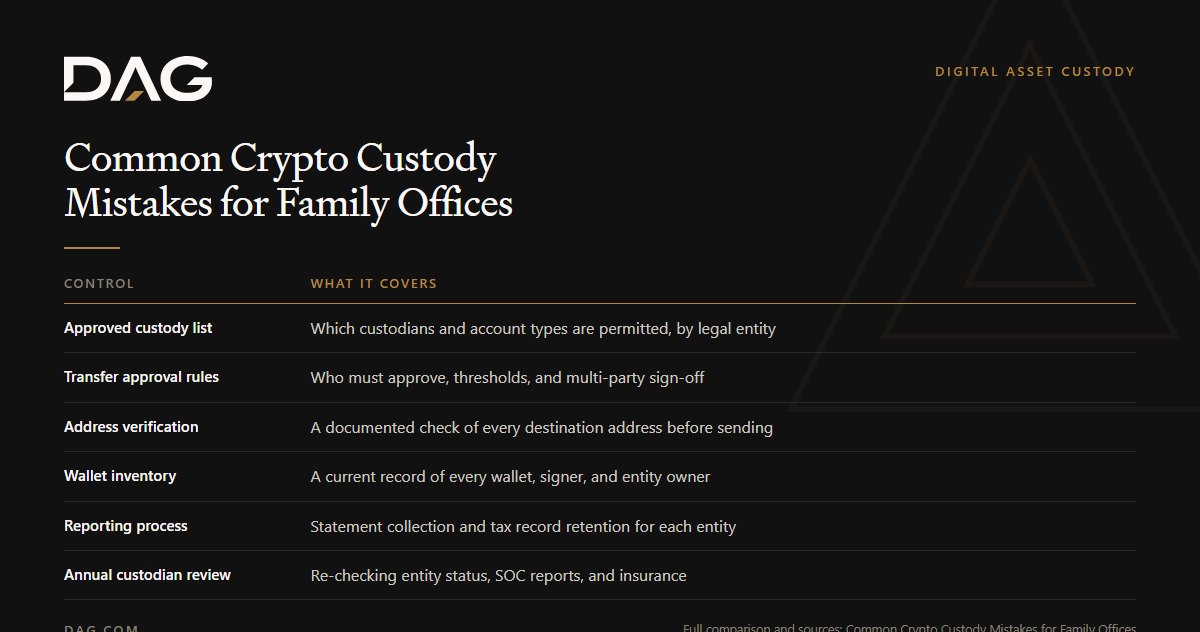
A family office should keep these controls in writing and review them at least annually:
| Control | What it covers |
|---|---|
| Approved custody list | Which custodians and account types are permitted, by legal entity |
| Transfer approval rules | Who must approve, thresholds, and multi-party sign-off |
| Address verification | A documented check of every destination address before sending |
| Wallet inventory | A current record of every wallet, signer, and entity owner |
| Reporting process | Statement collection and tax record retention for each entity |
| Annual custodian review | Re-checking entity status, SOC reports, and insurance |
Building these out is the core of a written policy; our walkthrough on how to build a crypto custody policy covers the structure, and the broader Digital Asset Custody Hub sets these controls in context. Families moving off exchange or self-custody arrangements may also want the steps in how do I move from self-custody to qualified custody.
No set of controls removes market, custody, or tax risk. The goal is to reduce avoidable operational and governance failures, not to promise a safe or guaranteed outcome.
Related Questions
What is the single most common crypto custody mistake for family offices?
There is no universal answer, but commingling assets across personal, trust, and LLC accounts is among the most frequent and consequential, because it can undermine the legal separation those structures are designed to provide. The right fix depends on your facts; consult a qualified professional.
Does using a qualified custodian eliminate custody risk?
No. A qualified custodian can address the SEC custody rule and add institutional safeguards, but custody, market, and tax risk remain. Registration or qualification alone does not guarantee skill, performance, or that assets are insured against every loss.
How often should a family office review its crypto custodians?
Generally at least annually, and after any major change such as a signer departure, a custodian merger, or a new account. A periodic review should re-check entity status, SOC reports, and insurance rather than assume nothing has changed.
Sources
Compliance Note
This article is educational and does not provide legal, tax, investment, fiduciary, compliance, or custody advice. Family office custody controls should be reviewed with qualified professionals.