
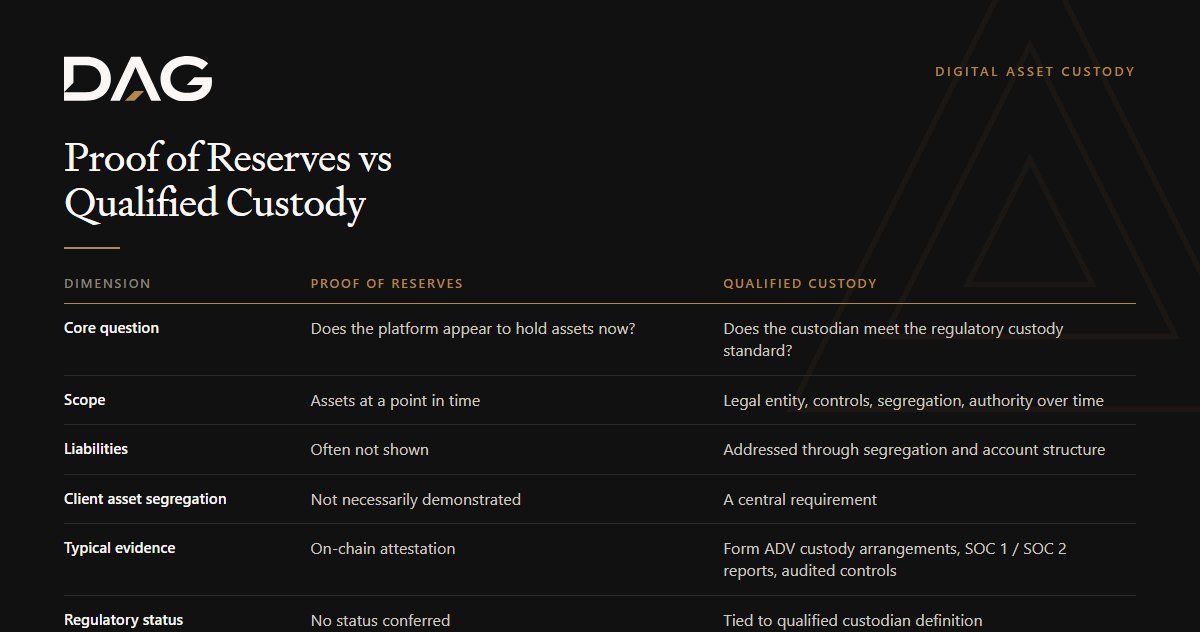
Proof of reserves vs qualified custody is a comparison of two different ideas: proof of reserves is generally an attempt to show that a platform controls certain assets at a point in time, while qualified custody describes whether a custodian meets the regulatory standards that apply to client assets in advisory contexts. They answer different questions, and one does not substitute for the other.
Investors should not treat a proof-of-reserves attestation as a substitute for custody due diligence. The two address separate risks, and understanding the distinction is part of broader digital asset custody planning.
What Each Term Means
Proof of reserves is generally a snapshot showing that a platform holds, or controls, certain assets at a specific moment. It is usually built from on-chain wallet attestations, sometimes paired with a third-party check.
Qualified custody is a regulatory concept tied to the SEC custody rule (Rule 206(4)-2) and how an investment adviser holds client assets. Whether a provider meets it depends on the law, the facts, and the legal entity involved. For a fuller treatment, see what is a qualified crypto custodian.
How They Compare
| Dimension | Proof of Reserves | Qualified Custody |
|---|---|---|
| Core question | Does the platform appear to hold assets now? | Does the custodian meet the regulatory custody standard? |
| Scope | Assets at a point in time | Legal entity, controls, segregation, authority over time |
| Liabilities | Often not shown | Addressed through segregation and account structure |
| Client asset segregation | Not necessarily demonstrated | A central requirement |
| Typical evidence | On-chain attestation | Form ADV custody arrangements, SOC 1 / SOC 2 reports, audited controls |
| Regulatory status | No status conferred | Tied to qualified custodian definition |
A proof-of-reserves report can be useful information, but on its own it may not address liabilities, legal entity structure, internal controls, insurance, client segregation, or who holds transfer authority. Qualified custody is built to speak to those questions. Proof of reserves and qualified custody are not interchangeable, which is also why teams weigh proof of reserves vs qualified custody alongside how keys are actually stored.
Due Diligence Questions
Use a specific checklist rather than relying on a single attestation:
- Who is the legal custodian, and what entity contracts with the client?
- Are client assets segregated from the provider's own assets?
- What controls govern the private keys (for example, cold storage, multi-sig, or MPC)?
- Are liabilities shown, not just assets?
- Are SOC 1 and SOC 2 reports available for review? See crypto custody SOC 1 and SOC 2 reports.
- Does the provider claim qualified custodian status, and on what basis?
- How would assets be treated if the provider failed? See what happens if a crypto custodian fails.
Note that being registered or audited does not, by itself, guarantee a provider's skill or that assets are safe; it indicates that certain standards are claimed and should be verified.
Related Questions
Is proof of reserves the same as an audit?
Generally no. Proof of reserves typically shows assets at a point in time and may not cover liabilities, internal controls, or client segregation the way a full financial-statement audit or a SOC examination would. Treat it as one data point, not a complete picture, and confirm scope with a qualified professional.
Does qualified custody eliminate risk?
No. Qualified custody addresses the regulatory standard for holding client assets, but no custody arrangement removes market, custody, operational, or tax risk. It is a structural safeguard, not a guarantee, and outcomes depend on the facts.
Can an exchange's proof of reserves replace a qualified custodian?
Generally not for advisory client assets. A proof-of-reserves page and qualified custodian status answer different questions; the distinction matters when comparing a qualified custodian versus a crypto exchange. Confirm the legal and custody arrangement before relying on either.
Sources
Compliance Note
This article is educational and does not provide legal, audit, compliance, investment, fiduciary, or custody advice. Custody diligence should be reviewed with qualified professionals.