
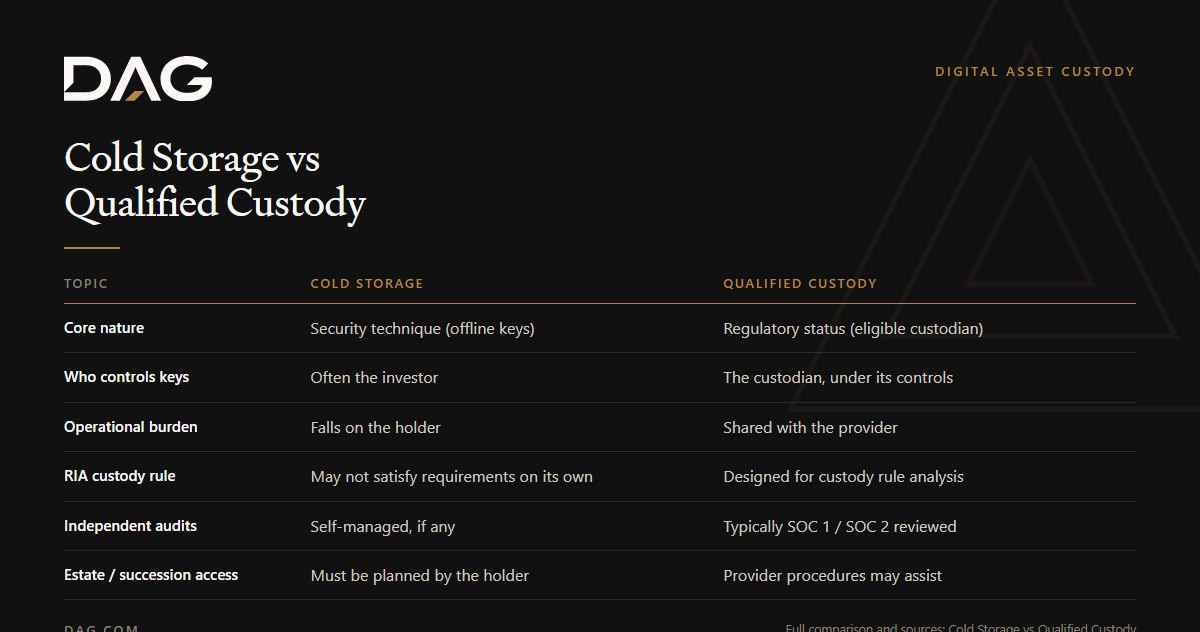
Cold storage vs qualified custody is a comparison between how keys are secured and who is legally responsible for them. Cold storage keeps private keys offline to reduce online attack surface; qualified custody means an asset is held by a custodian that meets regulatory requirements for certain advisory relationships. They are not mutually exclusive, and neither removes market, custody, or tax risk.
What These Terms Mean
Cold storage refers to holding private keys offline, away from internet-connected systems, for example on hardware devices or air-gapped signers. It describes a security technique, not a legal status.
Qualified custody refers to holding assets with a qualified custodian as contemplated by the SEC's custody rule (Rule 206(4)-2) for registered investment advisers. It describes a regulatory status, generally tied to the custodian being a bank, trust company, or another eligible entity subject to oversight, audits, and standards such as SOC 1 and SOC 2 reporting.
The distinction matters because the two answer different questions. An investor can use cold storage that is not qualified custody, and a qualified custodian may use cold storage as part of its own security architecture. For the threshold definition, see what is a qualified crypto custodian; for the self-custody side of the comparison, see qualified custody vs self-custody for crypto wealth.
Cold Storage
Cold storage may appeal to investors who want direct control or a reduced online attack surface. In exchange, it places the full operational burden on the holder: seed-phrase backups, signer access, inheritance planning, and transaction approval all become the investor's responsibility. Common failure points, lost keys, single-signer dependence, no documented succession, are catalogued in common crypto custody mistakes for family offices.
Qualified Custody
Qualified custody is most relevant for registered investment advisers subject to the custody rule, and for trusts and LLCs that need a verifiable chain of responsibility for their assets. A qualified custodian typically maintains audited controls, segregation of client assets, and documented procedures for access and recovery. Registration or qualified status alone does not guarantee a custodian's skill or performance, so independent diligence still applies, see the crypto custody due diligence checklist.
Key Comparison
| Topic | Cold Storage | Qualified Custody |
|---|---|---|
| Core nature | Security technique (offline keys) | Regulatory status (eligible custodian) |
| Who controls keys | Often the investor | The custodian, under its controls |
| Operational burden | Falls on the holder | Shared with the provider |
| RIA custody rule | May not satisfy requirements on its own | Designed for custody rule analysis |
| Independent audits | Self-managed, if any | Typically SOC 1 / SOC 2 reviewed |
| Estate / succession access | Must be planned by the holder | Provider procedures may assist |
Neither column is universally "safer." Cold storage concentrates control and responsibility with the holder; qualified custody distributes responsibility but depends on the custodian's controls. Neither eliminates market, custody, or tax exposure, and neither carries FDIC or SIPC protection for crypto assets.
Which Is Better?
There is no universal answer; the right model depends on the facts. The relevant factors generally include an investor's legal requirements, advisory relationship, security needs, trust or LLC structure, and tolerance for operational responsibility. Investors moving from self-managed keys toward a custodian can review how to move from self-custody to qualified custody. For the broader picture of how custody fits into a wealth plan, see the Digital Asset Custody Hub. Decisions in this area should be confirmed with a qualified professional.
Related Questions
Is cold storage the same as self-custody?
Often, but not always. Cold storage describes keeping keys offline, while self-custody describes who holds the keys. An investor usually self-custodies cold-stored assets, but a custodian can also hold assets in cold storage. The terms overlap without being identical.
Does a qualified custodian use cold storage?
Many do, generally as one layer within a broader security architecture that can include multi-signature approvals, access controls, and audited procedures. Qualified custody is a regulatory status; cold storage is a technique a custodian may employ to support it. Confirm specifics with the custodian directly.
Does qualified custody satisfy the SEC custody rule for an RIA?
It can, depending on the facts. The custody rule generally requires advisers with custody of client assets to use a qualified custodian and to meet related safekeeping and verification conditions. Whether a given arrangement satisfies the rule should be assessed with qualified legal and compliance counsel.
Sources
Compliance Note
This article is educational and does not provide legal, compliance, investment, fiduciary, or custody advice. Custody decisions should be reviewed with qualified professionals. Registration does not imply a certain level of skill or training.