
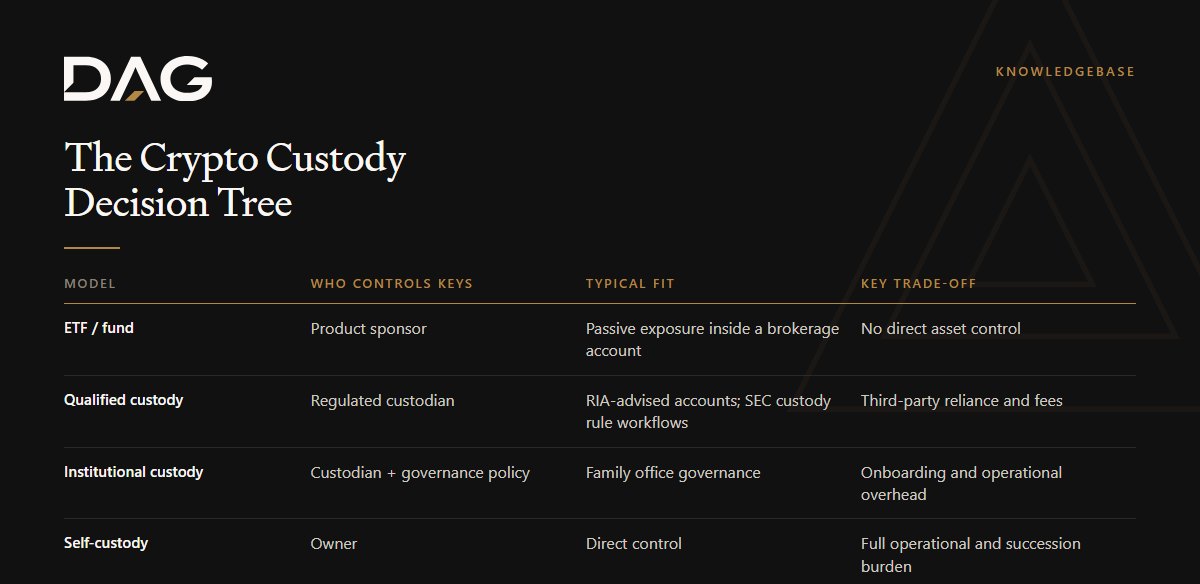
The crypto custody decision tree is a step-by-step framework for choosing a custody model by asking who legally owns the asset, who needs control, which regulations apply, and what tax reporting is required. It maps those answers to options such as self-custody, qualified custody, institutional custody, multi-signature, MPC, ETFs, or managed accounts. The right answer depends on your facts.
What the Crypto Custody Decision Tree Is
Custody means who holds the keys or account that can move an asset, and under what controls. A crypto custody decision tree turns that question into an ordered sequence: each answer narrows the field until one model fits the owner's legal structure, control needs, and reporting obligations. Custody should be chosen before assets are moved, because migrating keys or accounts later can trigger transfers, tax events, and operational risk. For broader context, see our crypto wealth management hub and the primer on what a qualified crypto custodian is.
A "qualified custodian" generally refers to a regulated entity, such as a bank, trust company, or registered broker-dealer, that holds client assets under the SEC custody rule (Rule 206(4)-2). Self-custody, by contrast, means the owner controls private keys directly, which removes a third-party intermediary but shifts the full operational and succession burden onto the owner.
How to Work Through the Decision Tree
Move through these questions in order. Each one should generally narrow your options before you reach the next.
- Is the asset direct crypto, an ETF, an SMA, or a fund? Wrapped exposure (an ETF or fund) is custodied by the product sponsor, not by you.
- Who is the legal owner, an individual, a trust, or an LLC? The owner determines whose keys and whose tax reporting govern.
- Is a registered investment adviser advising on the asset? Adviser involvement often brings the SEC custody rule into scope.
- Is qualified custody required or preferred? Where an RIA has custody of client crypto, a qualified custodian is generally expected; see qualified custody vs self-custody for crypto wealth.
- Does the owner need direct self-custody control, and can the owner support it operationally?
- Are trusts or LLCs involved, such as a Wyoming digital asset LLC or a directed trust?
- Who can approve transfers, one signer, multiple signers, or a policy engine?
- What tax records are required, including cost basis and Form 1099-DA reporting?
- What happens if a signer becomes unavailable, dies, or loses a key?
Custody Models Compared
The decision tree usually points toward one of the models below. None of them removes market, custody, operational, or tax risk; each shifts where that risk sits.
| Model | Who controls keys | Typical fit | Key trade-off |
|---|---|---|---|
| ETF / fund | Product sponsor | Passive exposure inside a brokerage account | No direct asset control |
| Qualified custody | Regulated custodian | RIA-advised accounts; SEC custody rule workflows | Third-party reliance and fees |
| Institutional custody | Custodian + governance policy | Family office governance | Onboarding and operational overhead |
| Self-custody | Owner | Direct control | Full operational and succession burden |
| Multi-sig / MPC | Shared among signers | Distributed approval | Coordination and recovery complexity |
Custody Selection Checklist
Before moving assets, confirm you can answer each item:
- Legal owner identified (individual, trust, or LLC) and documented.
- Custody model matched to whether an RIA is advising the account.
- Qualified-custodian status verified where the SEC custody rule applies (SOC 1 / SOC 2 reports, audited financials).
- Transfer-approval policy defined (single signer, multi-sig threshold, or MPC policy).
- Key succession and signer-unavailability plan in place; see private key succession planning.
- Tax records, cost basis, and Form 1099-DA handling addressed.
Verify any custodian's controls and registrations independently. Registration or a custody license alone does not guarantee competence, security, or good outcomes.
Related Questions
Is self-custody safer than using a qualified custodian?
Neither is categorically safer; they distribute risk differently. Self-custody removes counterparty exposure but places full responsibility for key security and succession on the owner. A qualified custodian adds regulatory oversight and operational support but introduces third-party reliance. The better fit generally depends on your governance, technical capacity, and whether an adviser is involved.
Do I need a qualified custodian if an RIA advises my crypto?
Generally, when a registered investment adviser is deemed to have custody of client crypto, the SEC custody rule points toward holding those assets with a qualified custodian. The specifics depend on the facts and the asset, so this should be confirmed with qualified legal and compliance professionals before you rely on any arrangement.
Where does multi-signature or MPC fit in the decision tree?
Multi-signature and MPC apply when control should be shared rather than held by one signer, common for trust structures and family office governance. They reduce single-point-of-failure risk but add coordination and recovery complexity, so the recovery plan matters as much as the setup.
Sources
- SEC: Custody rule compliance guide
- SEC: Custody rule FAQs
- MPC Alliance: Introduction to MPC for digital asset custody
Compliance Note
This article is educational and does not provide legal, tax, investment, fiduciary, compliance, or custody advice. Custody decisions should be reviewed with qualified professionals. Registration does not imply a certain level of skill or training.