
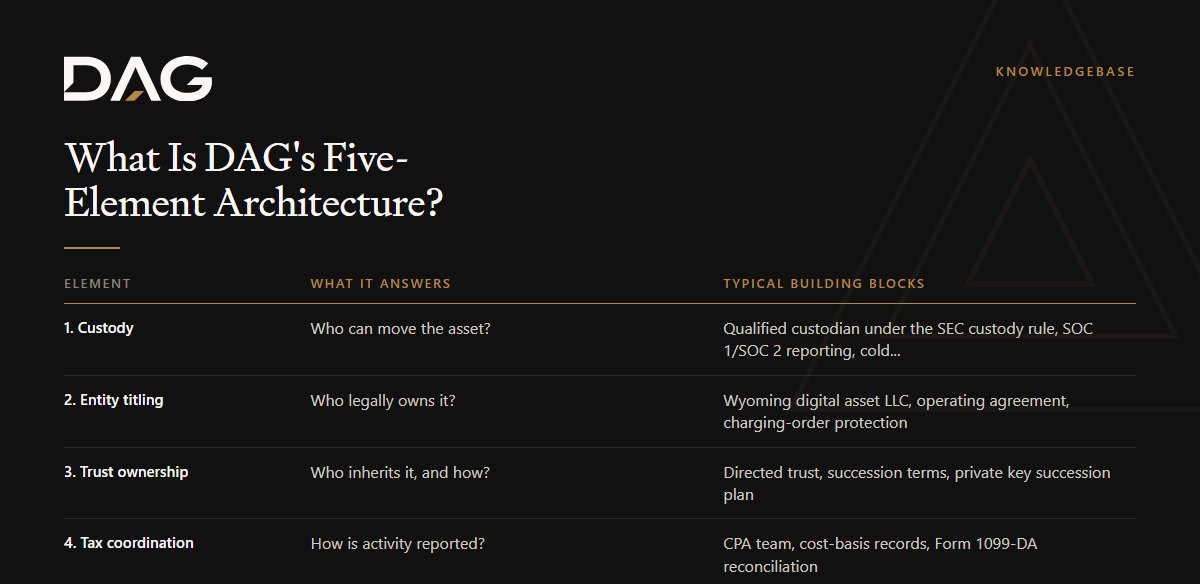
DAG's five-element architecture is a framework for coordinating the five major parts of crypto wealth so they work as one structure: custody, entity titling, trust ownership, tax coordination, and long-term wealth oversight. It does not prescribe a single setup for every family. It treats each layer as something serious digital asset wealth should consider together rather than in isolation.
Definition
The five-element architecture is a planning checklist, not a product. Each element names a layer that tends to break when crypto wealth becomes meaningful: who holds the keys (custody), who legally owns the assets (entity titling), who inherits them (trust ownership), how activity is reported (tax), and who keeps the structure current over time (wealth oversight). Coordinating these layers is the core idea behind crypto wealth management.
Why This Matters
Crypto wealth often sits outside the systems that protect the rest of a family's balance sheet. A person may have a financial advisor for traditional investments, a CPA for tax returns, an estate attorney for documents, and a wallet or exchange account for crypto. Each piece may work alone, but the family still lacks one coordinated structure.
The five-element framework gives families and advisors a way to check the parts that tend to fail when crypto wealth becomes meaningful, much like a crypto family office coordinates specialists around a single household.
The Five Elements
| Element | What it answers | Typical building blocks |
|---|---|---|
| 1. Custody | Who can move the asset? | Qualified custodian under the SEC custody rule, SOC 1/SOC 2 reporting, cold storage, multi-sig |
| 2. Entity titling | Who legally owns it? | Wyoming digital asset LLC, operating agreement, charging-order protection |
| 3. Trust ownership | Who inherits it, and how? | Directed trust, succession terms, private key succession plan |
| 4. Tax coordination | How is activity reported? | CPA team, cost-basis records, Form 1099-DA reconciliation |
| 5. Wealth oversight | Who keeps it current? | Adviser or RIA reviewing exposure, custody, and structure over time |
Custody generally determines operational access, so many families weigh qualified custody against self-custody before titling assets into an entity. The titling layer often uses a Wyoming digital asset LLC for operational control, while the trust layer addresses succession.
Evidence Standard
This is a DAG framework description, not a client story. Any examples added later should be labeled hypothetical unless based on an approved internal source or cited public source.
When It May Help
- A family has meaningful crypto wealth and no coordinated structure.
- Assets sit across wallets, exchanges, custodians, and traditional accounts.
- Existing estate documents do not address digital assets.
- The family needs tax, custody, trust, and investment decisions to fit together.
- A family office or RIA needs a model for reviewing client crypto exposure.
When It May Not Be Enough
A framework is not a substitute for documents, filings, legal advice, tax advice, or investment management. Each element has to be implemented and maintained. No structure removes market, custody, or tax risk; it organizes how those risks are managed. Engaging an adviser, attorney, or custodian who is registered or licensed does not by itself guarantee skill or results, the work still has to be done well, and you should confirm fit for your facts with a qualified professional.
Related Questions
Why include both an LLC and a trust?
Generally, the LLC handles operational control and account ownership while the trust handles succession and continuity. The two should be coordinated so titling and inheritance do not conflict. The right mix depends on the facts; confirm with a qualified attorney.
Why include custody?
Custody determines who can move the asset. Without a custody plan, legal ownership may not solve operational access, which is why custody is usually evaluated first when families choose a crypto custodian.
Why include tax coordination?
Digital asset activity can create complex reporting around sales, exchanges, staking, airdrops, and cost basis. The IRS generally treats digital assets as property, so each disposition can be a taxable event. A coordinated CPA team helps keep records consistent.
How is this different from just hiring an advisor?
An advisor typically manages one layer. The architecture is meant to make the custody, entity, trust, tax, and oversight layers fit together rather than operate in isolation.
Bottom Line
DAG's five-element architecture is a way to make crypto wealth legible to families, advisors, custodians, attorneys, and tax professionals. It turns a wallet-based net worth into a coordinated structure, with each layer assigned an owner and a maintenance plan.
Sources
- IRS digital assets guidance
- SEC: What is a qualified custodian?
- Wyoming digital asset statutes, Title 34 Chapter 29
Compliance Note
This article is for general educational purposes and is not legal, tax, or investment advice. The framework should be implemented only with qualified professionals.