
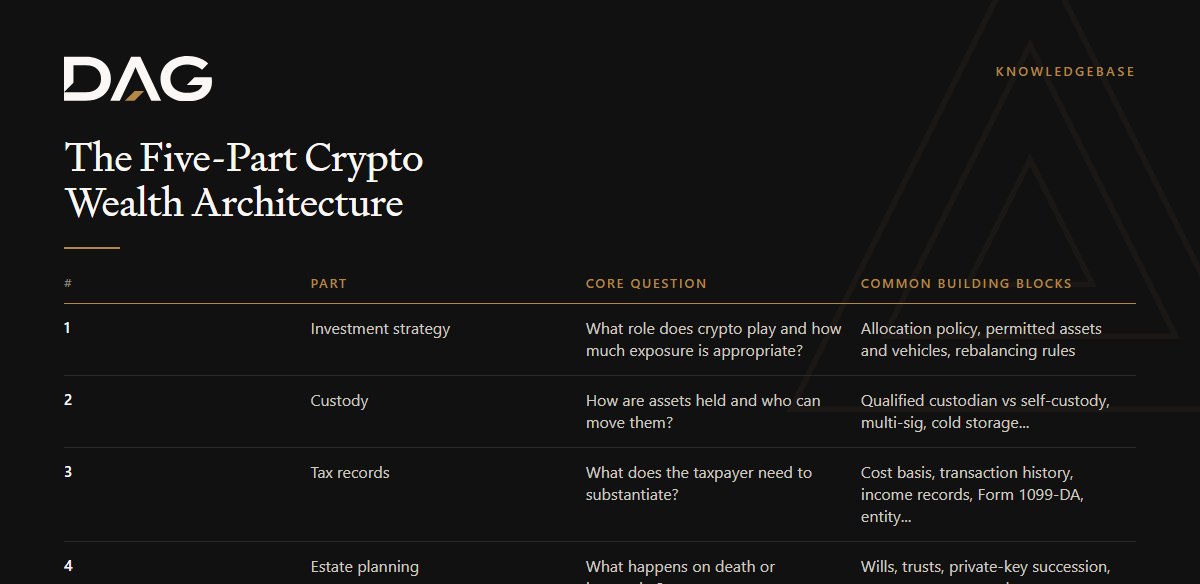
The five part crypto wealth architecture is a framework that organizes digital asset wealth into five connected parts: investment strategy, custody, tax records, estate planning, and governance. Designing each part on purpose, rather than letting it accrete by accident, generally makes a crypto portfolio easier to manage, harder to lose, and simpler to pass on.
What the Framework Covers
The architecture is a checklist for the questions a crypto-holding household or crypto family office has to answer eventually: what do we own and why, who can move it, what does the IRS see, what happens if a key-holder dies, and who decides. Each part below is a domain of decisions, not a product. The parts depend on one another, a custody choice shapes estate access, and a tax record depends on how assets are titled, so they are best reviewed together as part of broader crypto wealth management.
The Five Parts
| # | Part | Core question | Common building blocks |
|---|---|---|---|
| 1 | Investment strategy | What role does crypto play and how much exposure is appropriate? | Allocation policy, permitted assets and vehicles, rebalancing rules |
| 2 | Custody | How are assets held and who can move them? | Qualified custodian vs self-custody, multi-sig, cold storage, approved-custodian list |
| 3 | Tax records | What does the taxpayer need to substantiate? | Cost basis, transaction history, income records, Form 1099-DA, entity ownership records |
| 4 | Estate planning | What happens on death or incapacity? | Wills, trusts, private-key succession, secure access procedures |
| 5 | Governance | Who decides, and how is it documented? | Decision rights, reporting cadence, written policies, exception and review process |
1. Investment Strategy
Define what role crypto plays in the overall portfolio, how much exposure is appropriate given the household's risk tolerance, and which assets and vehicles are permitted. A written allocation policy is generally easier to follow under volatility than an ad hoc one. No allocation removes market risk; crypto prices can move sharply, and a strategy manages risk rather than eliminating it.
2. Custody
Decide how assets are held, who is authorized to move them, which custodians are approved, and how transfers are controlled. The main fork is qualified custody versus self-custody, each with different control and recovery tradeoffs, see qualified custody vs self-custody for crypto wealth. A qualified custodian is generally a regulated entity that may hold assets under the SEC custody rule and is often evaluated through a crypto custody due diligence checklist covering SOC 1/SOC 2 reporting, insurance, and key-management design. Custody arrangements carry their own risks, including counterparty failure and key loss; no setup is risk-free.
3. Tax Records
Maintain cost basis, transaction history, income records, entity ownership records, and a workflow with a tax professional. In the United States the IRS generally treats digital assets as property, so each disposal can be a taxable event that needs a basis figure. Brokers are phasing in Form 1099-DA reporting, but the taxpayer still bears the burden of accurate records. Treatment depends on the specific facts, so confirm positions with a qualified tax professional.
4. Estate Planning
Create legal authority and secure access procedures so heirs or a fiduciary can reach assets on death or incapacity. Crypto adds a wrinkle most estates do not face: legal title and the private key are separate problems, and an heir who inherits the coins but not the keys may be unable to recover them. Private key succession planning sits alongside the will or trust. Work the legal mechanics through with a qualified estate attorney.
5. Governance
Document decision rights, reporting cadence, policies, exceptions, and the review process. Governance is what keeps the other four parts current as assets, tax law, and family circumstances change. For multi-stakeholder households this often formalizes who can approve a transfer and how often the architecture is reviewed.
Related Questions
Do I need all five parts if my crypto holdings are small?
Not always to the same depth. The parts scale with complexity, a modest single-holder position may need light governance, while a multi-generation or founder-scale position generally benefits from all five. The framework is a checklist, not a mandate; adapt scope with a qualified professional.
Where does the framework start for most households?
It depends on the facts, but custody and tax records are frequently the most urgent, because lost keys and missing cost basis are hard to fix after the fact. Investment strategy and governance generally formalize decisions that are already being made informally.
How is this different from a traditional wealth plan?
The five domains mirror conventional planning, but crypto changes the mechanics: custody involves private keys rather than account numbers, tax records must track on-chain disposals, and estate planning must solve key access. The structure is familiar; the execution differs.
Sources
Compliance Note
This article is educational and does not provide legal, tax, investment, fiduciary, governance, or custody advice. Frameworks should be adapted with qualified professionals.