
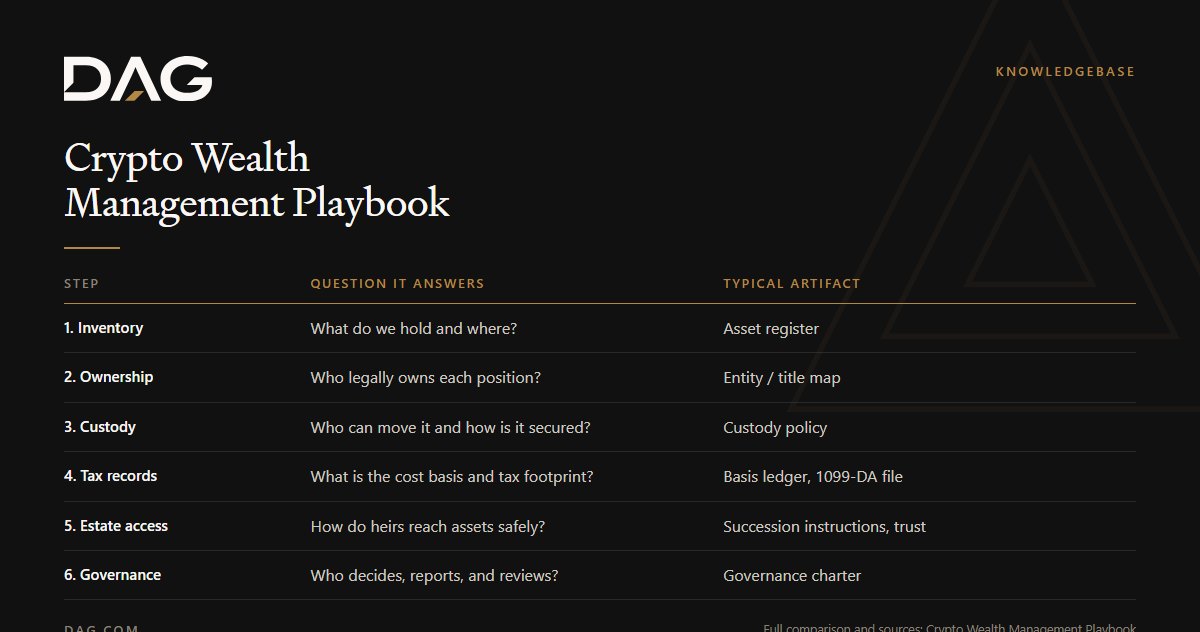
A crypto wealth management playbook is a repeatable process for organizing digital asset wealth across six areas: asset inventory, ownership, custody, tax records, estate access, and governance. It helps high-net-worth investors, family offices, and founders turn scattered crypto holdings into a coordinated wealth system. It does not remove market, custody, or tax risk, and it does not replace advice from qualified professionals.
What a Crypto Wealth Management Playbook Covers
The core idea is coordination. Crypto wealth tends to sprawl across exchanges, self-custody wallets, funds, trusts, and entities, each with its own access controls and tax footprint. A playbook documents what you hold, who controls it, how it is custodied, how it is taxed, and how it passes to heirs, then sets a governance cadence to keep those answers current. For a broader overview of the discipline, see what crypto wealth management is, and for how this fits a multi-generational structure, see what a crypto family office is. This playbook is one operating model under the Crypto Wealth Management Hub.
The Six-Step Playbook
Step 1: Inventory Assets
List every wallet, exchange account, custodian, fund, ETF, trust, LLC, and retirement account. Capture the asset, the platform, the approximate balance, and the access method (seed phrase, hardware device, multi-sig, exchange login). A complete inventory is the foundation; nothing downstream works without it.
Step 2: Confirm Ownership
Separate personal, trust, LLC, family office, and retirement holdings. Legal title matters for tax and creditor purposes, so confirm which entity actually owns each position. A Wyoming digital asset LLC or trust may hold assets that look personal on an exchange dashboard but are not.
Step 3: Review Custody
Document who can move each asset, what controls exist (multi-sig, withdrawal allowlists, cold storage), and whether a qualified custodian is appropriate. Under the SEC custody rule, an investment adviser with custody of client assets generally must hold them with a qualified custodian; institutional custodians are often evaluated on SOC 1 / SOC 2 reports and insurance. Compare the tradeoffs in qualified custody vs self-custody, and work through how to choose a crypto custodian before moving balances.
Step 4: Clean Tax Records
Preserve cost basis, transfers, sales, staking rewards, airdrops, and tax forms. The IRS generally treats digital assets as property, so each disposal can be a taxable event, and brokers are moving toward reporting on Form 1099-DA. Reconstruct any gaps in the record before filing season rather than during it. See how to reconstruct crypto cost basis for the mechanics.
Step 5: Plan for Estate Access
Create legal authority and secure access instructions so heirs can reach assets, without exposing private keys casually. The goal is access that survives you but cannot be exploited while you are alive, typically through a trust, documented succession steps, and split or sealed key material rather than a plaintext list. See how heirs access crypto after death and private key succession planning.
Step 6: Set Governance
Define decision rights, reporting, transfer approvals, and a review cadence. Decide who can authorize a transfer, who reviews holdings and how often, and what triggers a re-inventory (a new account, a fork, a large purchase). Governance is what keeps Steps 1–5 from going stale.
Playbook at a Glance
| Step | Question it answers | Typical artifact |
|---|---|---|
| 1. Inventory | What do we hold and where? | Asset register |
| 2. Ownership | Who legally owns each position? | Entity / title map |
| 3. Custody | Who can move it and how is it secured? | Custody policy |
| 4. Tax records | What is the cost basis and tax footprint? | Basis ledger, 1099-DA file |
| 5. Estate access | How do heirs reach assets safely? | Succession instructions, trust |
| 6. Governance | Who decides, reports, and reviews? | Governance charter |
Related Questions
Who needs a crypto wealth management playbook?
Investors whose digital assets span multiple wallets, exchanges, or entities generally benefit most, including high-net-worth individuals, family offices, and founders. The right structure depends on your facts, so review it with qualified legal and tax professionals.
Does a crypto wealth management playbook reduce investment risk?
No process removes market, custody, or tax risk. A playbook can reduce operational and access risk by documenting controls and ownership, but it makes no guarantee about returns, yield, or asset values, none of which are FDIC- or SIPC-insured for crypto holdings.
How is a playbook different from hiring a crypto wealth manager?
The playbook is the operating model; a crypto wealth manager is the person or firm that helps run it. Registration of an adviser alone does not guarantee skill or results, so evaluate experience and process when choosing one.
How often should the playbook be reviewed?
Many families review at least annually and after major events such as a new account, a large transaction, a fork, or an estate-plan change. The right cadence depends on the complexity of the holdings.
Sources
Compliance Note
This playbook is educational and does not provide legal, tax, investment, fiduciary, or custody advice. Crypto wealth planning should be reviewed with qualified professionals.