
The core questions to ask an estate attorney about crypto cover five areas: whether your will and trust explicitly name digital assets, who holds fiduciary authority to access them, how seed phrases and hardware wallets are secured, whether crypto should sit in a trust or LLC, and how heirs locate keys. Each answer generally depends on your facts and state law.
What This Conversation Covers
"Questions to ask an estate attorney about crypto" means the diligence checklist that turns a crypto holding into an inheritable, administrable estate. Crypto raises problems a traditional plan rarely addresses: a private key controls the asset directly, the IRS generally treats digital assets as property, and a fiduciary who lacks both legal authority and the technical means to reach a wallet cannot transfer it. A good attorney conversation closes both gaps at once. For the broader picture, see crypto estate planning for high-net-worth families within our Crypto Trust Structures Hub.
The Checklist
Use these questions, and listen for whether the answers are specific to your custody setup rather than generic boilerplate.
- Do my will and trust explicitly name digital assets? Documents drafted before crypto often omit it entirely. Ask whether language should reference digital assets as a defined property class and grant fiduciaries authority over them.
- Who has fiduciary authority to access my accounts? Most states have adopted a version of the Revised Uniform Fiduciary Access to Digital Assets Act (RUFADADA). Ask how your documents grant an executor or trustee lawful authority, and what a custodian will actually require to release assets.
- Should crypto be owned personally, by a trust, or by an LLC? A revocable living trust can help avoid probate; a Wyoming digital asset LLC can add charging-order protection and a management framework. Which fits depends on your goals, state, and asset mix.
- Should I use a digital asset letter of instruction? A non-public memorandum can tell fiduciaries what exists and where, without exposing keys in the will itself (wills generally become public on probate). Ask how it stays current and where it is stored.
- How should seed phrases and private keys be protected? A key written in a will is a public key once probate opens. Discuss whether multi-sig, cold storage, or a qualified custodian reduces single-point-of-failure risk while still allowing succession.
- Can my executor or trustee reach custodial accounts? For assets held with a qualified custodian, ask what authorization, death certificate, or court document the custodian requires, and whether your documents satisfy it.
- What happens if heirs find a hardware wallet but no instructions? Without the PIN or recovery phrase, a device is generally unusable. Ask how the plan documents recovery without creating a theft vector.
- Should a trust-owned LLC be considered? Combining a directed trust with an LLC can separate control, protection, and succession. Ask about added cost and administration against the benefit.
- How should fiduciaries coordinate with crypto advisors and custodians? Naming who holds keys, who has trading authority, and who the custodian is helps a fiduciary act without guessing.
- How often should the plan be updated? New wallets, custodians, or chains can orphan an old plan. Ask for a review cadence.
No structure removes market, custody, or tax risk, and none guarantees heirs will recover assets, the plan reduces the odds of loss, it does not eliminate them.
How the Ownership Options Compare
| Option | Probate exposure | Asset protection | Key handling | Notes |
|---|---|---|---|---|
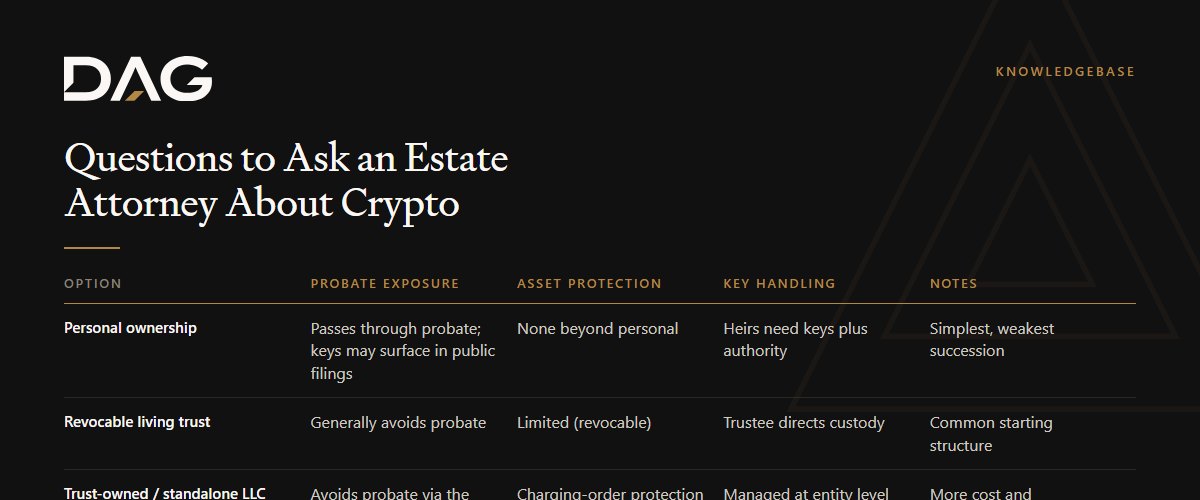
| Personal ownership | Passes through probate; keys may surface in public filings | None beyond personal | Heirs need keys plus authority | Simplest, weakest succession |
| Revocable living trust | Generally avoids probate | Limited (revocable) | Trustee directs custody | Common starting structure |
| Trust-owned / standalone LLC | Avoids probate via the trust | Charging-order protection in some states | Managed at entity level | More cost and administration |
The right choice generally depends on your facts and state law; confirm with qualified counsel.
Related Questions
Does my existing will already cover crypto?
Often it does not. Documents written before digital assets were common may not name them or grant fiduciaries authority to access them. An attorney can review whether updated language and a private key succession plan are needed.
Should I put my crypto private keys in my will?
Generally no. A will typically becomes a public record once probate opens, so a seed phrase placed in it could be exposed. Attorneys often use a separate, secured letter of instruction instead, and discuss how heirs access crypto after death.
Do I need a special attorney for crypto estate planning?
Not necessarily a separate one, but you want counsel comfortable with digital assets, fiduciary access law, and custody mechanics. Registration or membership alone does not guarantee skill; ask about relevant experience and how they coordinate with custodians and advisors.
Sources
Compliance Note
This article is educational and does not provide legal, tax, fiduciary, estate, investment, or custody advice. Estate planning should be reviewed with qualified counsel.