
The questions to ask a crypto family office cover how it coordinates custody, reporting, tax records, estate planning, governance, liquidity, and advisor oversight across your entities. Ask whether it holds keys or directs a qualified custodian, how it discloses fees and conflicts, and how it prepares heirs and trustees. The answers reveal fit, not guaranteed outcomes.
What a Crypto Family Office Does
A crypto family office is a coordinating function that organizes a wealthy family's digital assets alongside traditional holdings: custody arrangements, consolidated reporting, tax records, trust and entity structures, governance, and succession. It generally orchestrates specialists rather than replacing them. For the broader picture, see what a crypto family office is and how it fits within crypto wealth management. Asking these questions before signing helps you compare providers on substance rather than marketing.
Questions to Ask, and What a Good Answer Looks Like
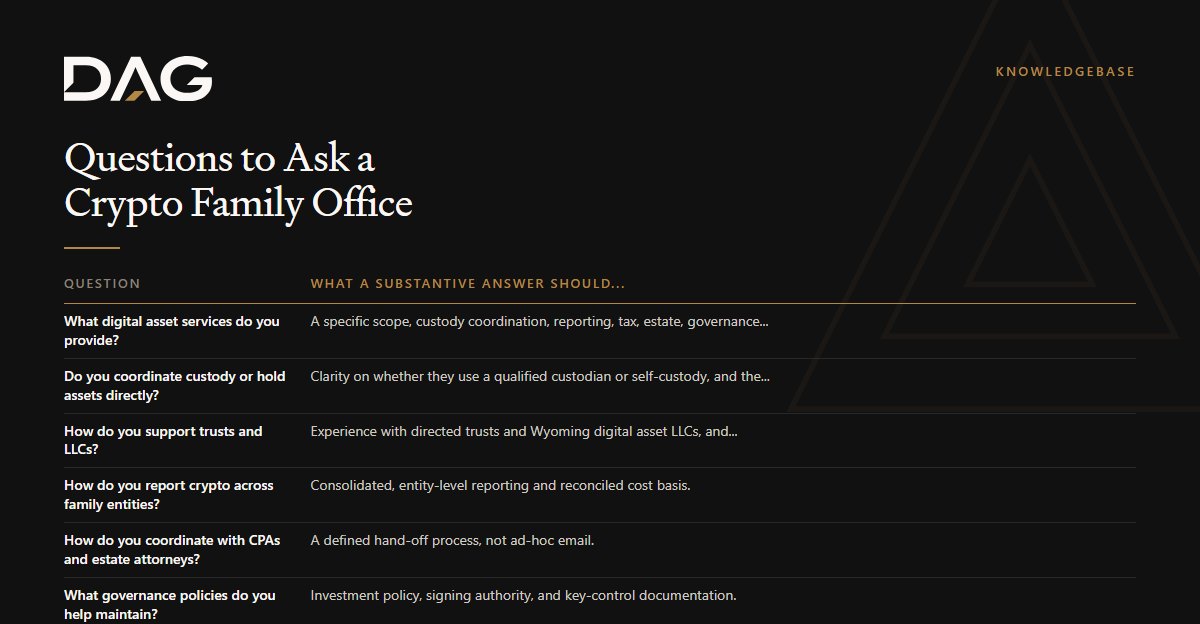
| Question | What a substantive answer should include |
|---|---|
| What digital asset services do you provide? | A specific scope, custody coordination, reporting, tax, estate, governance, not a vague "full service" claim. |
| Do you coordinate custody or hold assets directly? | Clarity on whether they use a qualified custodian or self-custody, and the SEC custody-rule implications. |
| How do you support trusts and LLCs? | Experience with directed trusts and Wyoming digital asset LLCs, and coordination with your attorney. |
| How do you report crypto across family entities? | Consolidated, entity-level reporting and reconciled cost basis. |
| How do you coordinate with CPAs and estate attorneys? | A defined hand-off process, not ad-hoc email. |
| What governance policies do you help maintain? | Investment policy, signing authority, and key-control documentation. |
| How do you handle token unlocks or liquidity events? | A planning process for concentrated or vesting positions. |
| How are fees and conflicts disclosed? | Written disclosure, ideally in a Form ADV Part 2 for a registered adviser. |
| What is your custodian due-diligence process? | SOC 1/SOC 2 review, insurance, multi-sig and cold-storage controls. |
| How do you prepare heirs or trustees? | Documented key succession and trustee onboarding. |
Use the table as a checklist: a provider that answers specifically, in writing, and with references is easier to evaluate than one that answers in superlatives. A registered adviser must file Form ADV, but registration alone does not guarantee skill or results.
Why These Questions Matter
Custody is the question that carries the most risk. Confirm whether the provider holds keys or directs a qualified custodian, since that shapes the SEC custody-rule and insurance picture, the qualified custody versus self-custody trade-off is central. Fee and conflict disclosure tells you how the firm is paid and where its incentives sit. Succession planning determines whether your family can recover assets if a key holder is unavailable; see how heirs access crypto after death. No provider, structure, or custody arrangement removes market, custody, or tax risk, and crypto carries no FDIC or SIPC coverage. Consult qualified legal, tax, and custody professionals before acting; the right answer often depends on your specific facts.
Related Questions
How is a crypto family office different from a crypto wealth manager?
A family office generally coordinates a broader scope, entities, governance, estate, and reporting, while a wealth manager typically focuses on portfolio and advisory work. The labels overlap, so compare the actual scope of services rather than the title.
Does a crypto family office take custody of my assets?
Often not directly. Many coordinate a qualified custodian and direct activity rather than holding private keys themselves. Ask each provider to state its custody model in writing, because the arrangement affects the applicable custody rules and insurance.
Should I ask about regulatory registration?
Yes. Ask whether the firm or its advisers are registered and request the relevant Form ADV. Registration supports transparency but does not by itself guarantee competence, performance, or safety, so weigh it alongside disclosures and references.
Sources
Compliance Note
This article is educational and does not provide legal, tax, investment, fiduciary, family office, or custody advice. Families should review provider qualifications and disclosures. References to third-party providers are for context only and are not endorsements or comparative claims of superiority.