
To choose a crypto family office, evaluate whether one firm can coordinate digital asset strategy, custody, governance, tax records, estate planning, reporting, and family decision-making as a single operating model. The right fit depends on your holdings and your facts; compare providers on capability and disclosures, and confirm details with a qualified professional before you commit.
A crypto family office is a coordinated service model that manages a wealthy family's digital assets alongside traditional wealth, covering custody, governance, reporting, tax records, and succession rather than only investment selection. The Crypto Family Office Hub maps how these functions fit together, and What Is a Crypto Family Office? defines the model in more depth.
The point of the evaluation is not to find the firm that talks most confidently about markets. No provider can remove market, custody, or tax risk, and past results do not predict future returns. The point is to find one that can build a durable operating model for digital asset wealth and document it.
Evaluation Areas
Weigh each provider across the functions a digital asset family actually has to run:
- Custody and wallet governance, qualified custodian relationships, cold storage, and multi-sig or signer policies. A crypto custody policy template for family offices should define who can move assets and how.
- Trust and LLC coordination, directed trusts, charging-order considerations, and entity titling for digital assets.
- Family office reporting, consolidated reporting across wallets, exchanges, and entities.
- Tax professional coordination, cost-basis tracking and readiness for IRS property treatment and Form 1099-DA reporting.
- Estate access planning, key recovery, succession, and emergency access without exposing seed material.
- Risk and concentration reporting, position, counterparty, and concentration views.
- Token liquidity planning, staged liquidity for founders with concentrated or locked positions.
- Stablecoin and treasury policy, written treasury rules; stablecoins are not FDIC- or SIPC-insured and pegs can break.
- Advisor and custodian oversight, ongoing due diligence on third parties, not a one-time check.
Questions to Ask Each Provider
Use these questions to compare candidates on substance, not sales language. A provider that answers specifically, in writing, and with references is easier to evaluate than one that relies on broad claims.
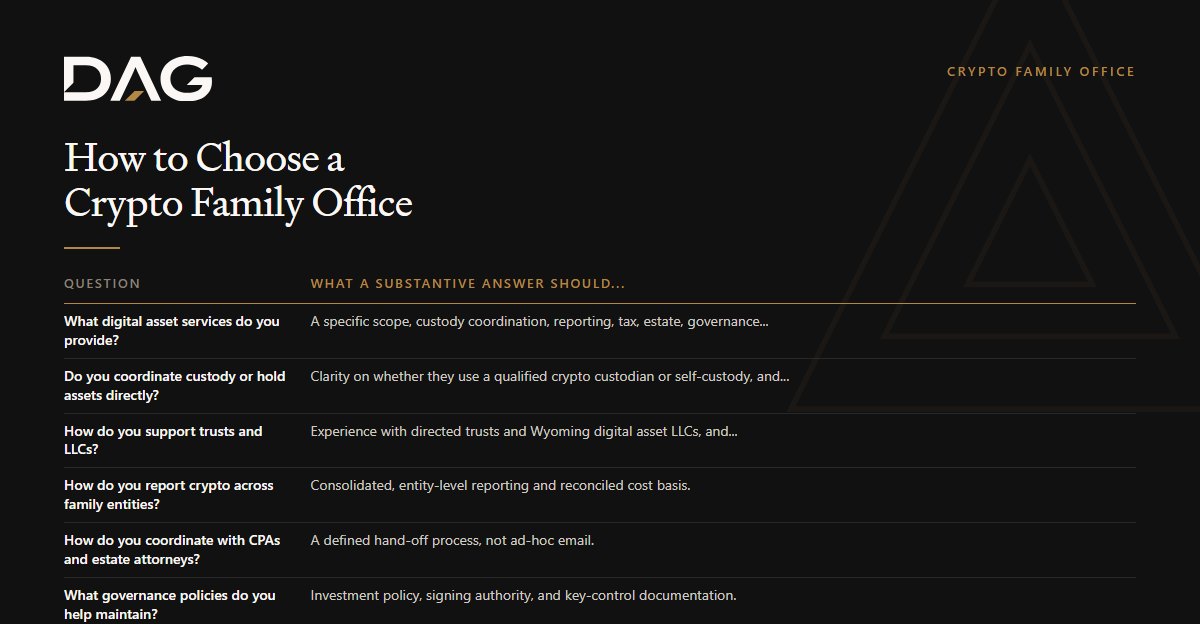
| Question | What a substantive answer should include |
|---|---|
| What digital asset services do you provide? | A specific scope, custody coordination, reporting, tax, estate, governance, not a vague "full service" claim. |
| Do you coordinate custody or hold assets directly? | Clarity on whether they use a qualified crypto custodian or self-custody, and the SEC custody-rule implications. |
| How do you support trusts and LLCs? | Experience with directed trusts and Wyoming digital asset LLCs, and coordination with your attorney. |
| How do you report crypto across family entities? | Consolidated, entity-level reporting and reconciled cost basis. |
| How do you coordinate with CPAs and estate attorneys? | A defined hand-off process, not ad-hoc email. |
| What governance policies do you help maintain? | Investment policy, signing authority, and key-control documentation. |
| How do you handle token unlocks or liquidity events? | A planning process for concentrated or vesting positions. |
| How are fees and conflicts disclosed? | Written disclosure, ideally in a Form ADV Part 2 for a registered adviser. |
| What is your custodian due-diligence process? | SOC 1/SOC 2 review, insurance, multi-sig and cold-storage controls. |
| How do you prepare heirs or trustees? | Documented key succession and trustee onboarding. |
A registered adviser must file Form ADV, but registration alone does not guarantee skill or results. Weigh it alongside disclosures and references.
Selection Checklist
Use this checklist to compare candidates on evidence rather than sales language:
- Can it support direct crypto, ETFs, SMAs, and multiple custody providers, or only its own products?
- Does it produce consolidated reporting across every family entity? See Crypto Tax Reporting for Family Offices.
- Will it work alongside your existing trustees and CPAs?
- Which governance documents does it help draft and maintain? Compare against a Crypto Family Office Checklist.
- How does it handle emergency access, signer changes, and key recovery?
- If the firm cites registration, ask what it covers, registration alone does not guarantee skill or results.
- Can it show its diligence process for third-party custodians and managers? See Crypto Due Diligence for Family Offices.
In-House vs Coordinated Family Office
Families generally choose between building digital asset operations internally or hiring a firm to coordinate them. Neither is automatically better; the fit depends on your size, complexity, and staffing.
| Consideration | In-house build | Coordinated crypto family office |
|---|---|---|
| Custody control | Direct, but you own all operational risk | Shared, with qualified-custodian relationships in place |
| Governance documents | You draft and maintain them | Provider helps draft and maintain |
| Reporting | You build consolidated reporting | Provider produces cross-entity reporting |
| Staffing | Requires in-house crypto and ops expertise | Draws on the provider's team |
| Best when | You have scale and dedicated staff | You want coordination without building a function |
Why Custody and Succession Questions Matter Most
Custody is the question that carries the most operational risk. Confirm whether the provider holds keys or directs a qualified crypto custodian, since that shapes the SEC custody-rule and insurance picture. Fee and conflict disclosure reveals how the firm is paid and where its incentives sit. Succession planning determines whether your family can recover assets if a key holder is unavailable, see how heirs access crypto after death. No provider, structure, or custody arrangement removes market, custody, or tax risk. Crypto carries no FDIC or SIPC coverage.
Related Questions
What does a crypto family office actually do?
Generally it coordinates custody, governance, reporting, tax records, estate access, and liquidity for a family's digital assets, working alongside trustees and tax professionals rather than replacing them. Specifics depend on the engagement and the family's facts.
How much crypto do you need before a family office makes sense?
There is no fixed threshold; it usually depends on holdings, complexity, and how many entities and family members are involved. How Much Crypto Is Enough to Need a Family Office? walks through the considerations.
Does using a family office remove crypto risk?
No. Market, custody, and tax risk remain regardless of structure. A family office can document policies, diligence providers, and improve controls, but no arrangement guarantees yield, safety, or a stable peg. Confirm any specific risk question with a qualified professional.
How is a crypto family office different from a crypto wealth manager?
A family office generally coordinates a broader scope, entities, governance, estate, and reporting, while a wealth manager typically focuses on portfolio and advisory work. The labels overlap, so compare the actual scope of services rather than the title. See Digital Asset Family Office for a service-scope breakdown.
Does a crypto family office take custody of my assets?
Often not directly. Many coordinate a qualified custodian and direct activity rather than holding private keys themselves. Ask each provider to state its custody model in writing, because the arrangement affects the applicable custody rules and insurance coverage.
Should I ask about regulatory registration?
Yes. Ask whether the firm or its advisers are registered and request the relevant Form ADV. Registration supports transparency but does not by itself guarantee competence, performance, or safety, so weigh it alongside disclosures and references.
Sources
Compliance Note
This article is educational and does not provide legal, tax, investment, fiduciary, family office, or custody advice. Families should review provider qualifications and disclosures before engaging any firm. References to third-party providers are for illustration only and are not endorsements or comparisons of relative quality; evaluate each provider against its own disclosures.