
A family office DAO is a forward-looking structure that uses a decentralized autonomous organization, smart contracts that encode rules for treasury control and decision-making, to govern a family's digital assets on-chain. The idea is to enforce governance in code: a multi-sig treasury where transfers require a defined set of approvals, executed automatically, rather than relying on a custodian or a person to enforce the policy. It is early and experimental, and the legal and tax treatment is unsettled.
What an On-Chain Governance Structure Is
Traditional family office governance is a written policy that humans follow: who can approve a transfer, add a signer, or change a custodian. On-chain governance encodes some of those rules in smart contracts so they execute automatically. In practice the most concrete, widely used version is a multi-sig treasury, assets held at an address that requires, say, 3 of 5 keyholders to approve any transaction before it executes. That is on-chain governance in its most defensible form, and it overlaps with custody mechanics the family office already considers; see MPC vs multi-sig custody and crypto custody for family offices.
A full DAO goes further, token-based or role-based voting, on-chain proposals, automated execution of approved actions, and is where the experimental, higher-risk territory begins.
Why a Family Office Might Explore This
The appeal is governance that is hard to bypass and easy to audit:
- Enforced controls. A multi-sig contract makes unilateral movement of funds impossible by design, protecting against both external theft and internal disputes.
- Transparent audit trail. Every action is recorded on-chain, giving the investment committee and auditors a verifiable history.
- Rule-based execution. Approved actions can execute without a custodian as intermediary, reducing one dependency.
- Continuity. Signing rules and roles can be designed to survive the loss of any single participant, relevant to private key succession planning.
These benefits are why the multi-sig version is already mainstream in institutional crypto custody, even where the broader DAO concept is not.
The Risks and Open Questions
This is forward-looking, and the downsides are real and current:
- Legal status is unsettled. How a DAO is treated as a legal entity (and who bears liability) varies by jurisdiction and is still developing. Some states have DAO-LLC statutes; treatment elsewhere is unclear.
- Tax treatment is unclear. On-chain governance actions, token-based voting rights, and DAO membership can raise tax questions without settled answers. Confirm any position with a tax professional.
- Smart-contract risk. Code can contain bugs or exploits; an immutable contract that enforces a flaw enforces it permanently.
- Key and access risk. On-chain governance does not remove the lost-key problem; it can concentrate it differently.
- Irreversibility. Automated execution means errors can be unrecoverable, unlike a reversible instruction to a custodian.
Because of this, families generally use on-chain governance for the control layer (multi-sig treasury) while keeping the legal structure in established entities and trusts, pairing it with a trust-owned LLC for crypto assets or the documented framework in crypto governance for family offices rather than replacing them.
On-Chain vs Documented Governance
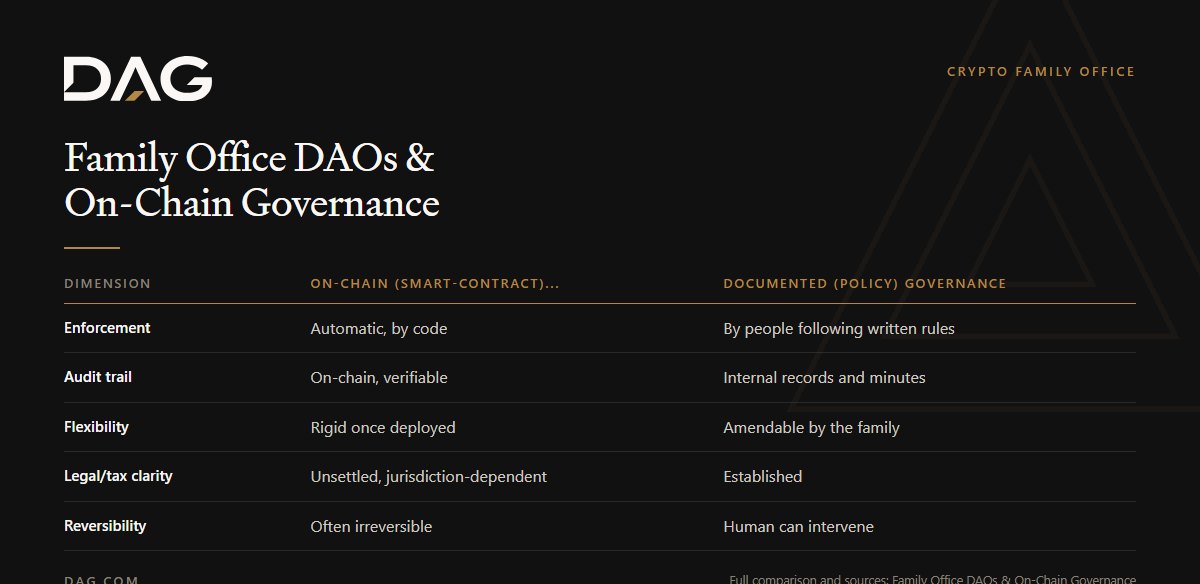
| Dimension | On-chain (smart-contract) governance | Documented (policy) governance |
|---|---|---|
| Enforcement | Automatic, by code | By people following written rules |
| Audit trail | On-chain, verifiable | Internal records and minutes |
| Flexibility | Rigid once deployed | Amendable by the family |
| Legal/tax clarity | Unsettled, jurisdiction-dependent | Established |
| Reversibility | Often irreversible | Human can intervene |
Most family offices today combine the two: code for the treasury control layer, documented policy and established entities for the legal and decision-making layer.
Related Questions
Can a family office use a DAO to manage its treasury?
A family office can use the multi-sig treasury mechanics that underlie DAOs, an on-chain address requiring multiple approvals to move funds, and that is already common in institutional custody. Using a full DAO as the legal and governance entity is experimental, with unsettled legal and tax treatment, so most families keep the legal structure in established entities and trusts and use on-chain rules only for treasury control. Review any approach with legal, tax, and custody professionals.
Is on-chain governance legal for a family office?
The multi-sig control layer is widely used and legally unremarkable. The broader question, a DAO as a recognized legal entity with defined liability, depends on jurisdiction and is still developing; some states have DAO-LLC statutes while others have no clear framework. Treat the legal status as unsettled and confirm it with qualified counsel before relying on a DAO as an entity.
Does on-chain governance replace a trust or LLC?
Generally no. On-chain governance can enforce treasury controls, but it does not by itself provide the established legal, tax, and estate framework that a trust or LLC does. Families typically pair the two, code for control, entities and trusts for legal structure, rather than substituting one for the other. The right combination depends on the facts and on professional advice.
Sources
- Wyoming Stat. § 17-31 (Decentralized Autonomous Organization Supplement), verify current at wyoleg.gov
- IRS: Digital assets (general property treatment; DAO-specific treatment unsettled), https://www.irs.gov/filing/digital-assets
Compliance Note
This article is educational and forward-looking only; it is not investment, legal, or tax advice. DAOs and on-chain governance are experimental, with unsettled legal, regulatory, and tax treatment that varies by jurisdiction and is subject to change. Smart-contract structures carry technical risk, including bugs and irreversible execution, and do not remove custody or market risk. Any structure should be reviewed with qualified legal, tax, and security professionals before use. Advisory services are provided by DAG Wealth, an SEC-registered investment adviser. Registration does not imply a certain level of skill or training. Entity and DAO formation are legal matters the firm coordinates rather than provides, and no outcome is guaranteed.