
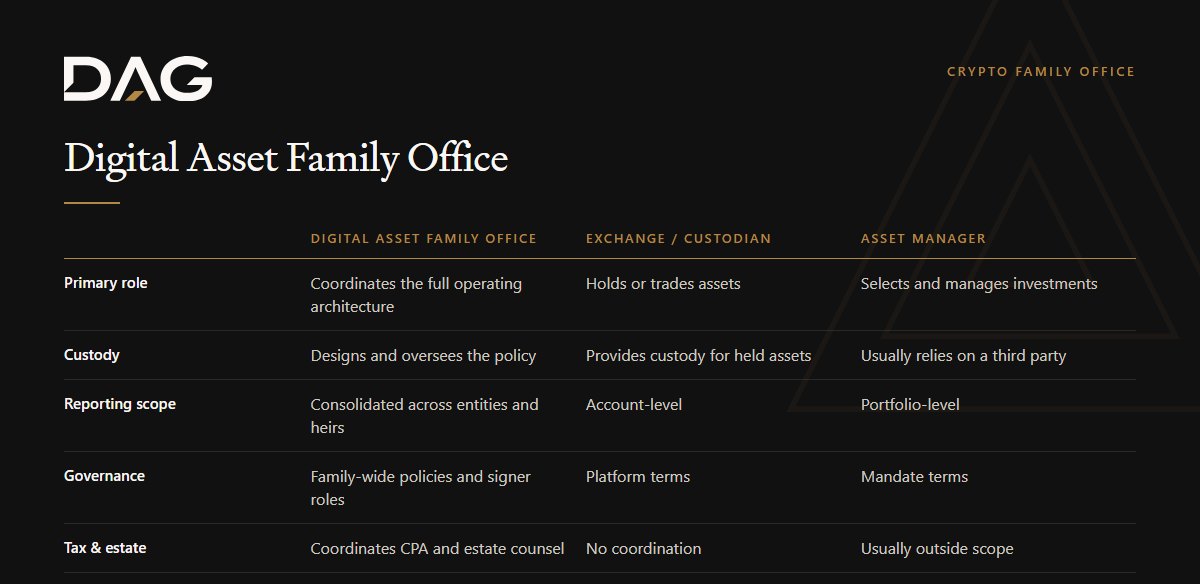
A digital asset family office coordinates a wealthy family's crypto holdings across investment policy, custody, governance, reporting, tax records, and estate planning, with advisor oversight connecting the pieces into one accountable structure. It is the operating architecture around crypto wealth, not a single product, and it does not remove market, custody, or tax risk.
What a Digital Asset Family Office Is
A digital asset family office is a coordinating function, in-house, outsourced, or hybrid, that manages the day-to-day operations of a family's crypto wealth. It differs from a crypto exchange, a custodian, or an asset manager: each of those handles one slice, while the family office connects legal ownership, actual control of keys, investment decisions, and reporting. For broader context, see the Crypto Family Office Hub and the related question of what a crypto family office is.
The core work spans two layers. The first is investment: deciding whether and how a family holds digital assets, through direct ownership, funds, ETFs, separately managed accounts, or staking. The second is supervision: the policies, custody arrangements, records, and governance that allow the family office to stand behind that exposure. A family that owns Bitcoin in a personal wallet has investment exposure; it does not yet have a service framework around it.
What a Digital Asset Family Office May Coordinate
- Digital asset allocation and investment policy, an investment policy statement that defines targets, ranges, approved assets, prohibited activities, and rebalancing rules.
- Custody selection and oversight, evaluating qualified custodians under the SEC custody framework, reviewing SOC 1/SOC 2 reports, and confirming cold-storage and multi-sig procedures.
- Direct asset management or adviser coordination, running holdings in-house or supervising an outside manager, with documented trading authority.
- Fund and manager due diligence, assessing structure, audit, and key-person risk before allocating; the crypto due diligence guide walks through each area.
- Wallet and account inventory, mapping each address, key holder, and signing threshold.
- Trust and LLC ownership structures, often paired with charging-order protection or a directed trust.
- Tax professional coordination, cost-basis tracking and Form 1099-DA reporting; the IRS generally treats digital assets as property.
- Consolidated reporting, rolling on-chain and off-chain positions into one view alongside the rest of the balance sheet, for family members, trustees, and advisors.
- Transfer approval policies and signer thresholds, set out in a custody policy template.
- Estate and incapacity planning, key-recovery instructions for heirs and integration into directed trusts or other structures.
- Family education and governance, committee charters, risk limits, and beneficiary education.
How a Digital Asset Family Office Compares to Other Services
| Digital Asset Family Office | Exchange / Custodian | Asset Manager | |
|---|---|---|---|
| Primary role | Coordinates the full operating architecture | Holds or trades assets | Selects and manages investments |
| Custody | Designs and oversees the policy | Provides custody for held assets | Usually relies on a third party |
| Reporting scope | Consolidated across entities and heirs | Account-level | Portfolio-level |
| Governance | Family-wide policies and signer roles | Platform terms | Mandate terms |
| Tax & estate | Coordinates CPA and estate counsel | No coordination | Usually outside scope |
When a Family May Need One
A family may want digital asset family office support when:
- Crypto is material to overall wealth and spread across multiple wallets or entities.
- Principals want exposure but the office lacks internal expertise.
- The family is evaluating direct holdings, funds, ETFs, SMAs, or staking.
- Trustees or investment committees need documentation for governance.
- A founder liquidity event is pending or complete.
- The family needs continuity planning if the crypto-native principal is unavailable.
- Holdings are expected to pass to heirs.
The threshold is judgment-based. The related question of how much crypto is enough to need a family office walks through the trade-offs.
Why Custody Is Central
Digital assets can be lost, moved, or misreported when custody is designed loosely. The family office connects legal ownership to actual control of the keys, who can sign, under what threshold, and with what recovery path. No custody arrangement is risk-free, and no provider offers FDIC or SIPC coverage for crypto held on-chain. The goal is documented, auditable control, not a guarantee.
Governance should come before purchase. A written crypto allocation policy typically precedes any position, because custody, reporting, tax, and succession planning determine whether the exposure can be managed responsibly.
What Limits Family Office Crypto Support
Family office crypto support does not remove regulatory, tax, custody, or investment risk, and does not mean every asset or strategy is appropriate. Digital assets can be volatile, and no service guarantees yield, safety, a stable peg, or FDIC or SIPC coverage. Working with an SEC-registered adviser does not by itself guarantee skill, performance, or suitability. Governance should include documented risk limits and qualified professional review.
Related Questions
Is a digital asset family office the same as a regular family office?
Not exactly. It performs the same coordinating role but adds crypto-specific work: key custody design, on-chain reporting, digital-asset tax records, and estate access procedures for private keys. Many families extend an existing family office rather than build a separate structure. The right choice depends on the facts; consult a qualified professional.
Should a family office hold crypto directly or through funds?
It depends on governance capability, custody infrastructure, liquidity needs, tax considerations, and the type of exposure the family wants. Direct ownership creates more operational responsibility, wallet management, signing policies, and on-chain tax records. Funds and ETFs can simplify access but may not resolve estate or custody-structure questions. A crypto investment memo helps the investment committee compare the options.
Does a family office need qualified custody?
It may, especially when working with regulated advisers or institutional governance processes. Custody obligations depend on the facts and on regulatory status; confirm requirements with counsel rather than assuming a default arrangement.
What should a family office crypto policy cover?
A policy generally addresses allocation limits, approved assets, custody provider standards, trading authority, staking, tax records, reporting cadence, prohibited activities, and succession procedures. Treat it as a living document and review it as facts and regulations change.
Does using a qualified custodian eliminate the risk of losing crypto?
No. A qualified custodian and SOC 1/SOC 2 controls reduce certain operational risks, but market, smart-contract, and key-management risks remain. Custody design lowers exposure; it does not guarantee against loss.
Does SEC registration mean a crypto family office adviser is skilled?
Registration indicates an adviser is subject to a regulatory framework and Form ADV disclosure. It does not by itself guarantee skill, performance, or suitability for your situation. Review the adviser's disclosures and consult a qualified professional before engaging.
Sources
Compliance Note
This article is for general educational purposes and does not provide legal, tax, investment, fiduciary, family office, or custody advice. Digital asset family office structures, custody arrangements, and investment policies should be reviewed with qualified legal, tax, and financial professionals before implementation. Registration does not imply a certain level of skill or training.