
Crypto due diligence for family offices is the structured review a family runs before it allocates to, custodies, trades, or inherits digital assets. It examines the investment thesis, custody and account titling, counterparty risk, tax reporting, wallet controls, manager quality, liquidity, regulatory standing, and estate-planning fit so the family understands what it is holding before approval.
Short Answer
Crypto due diligence for family offices is the process of evaluating digital asset exposure before the family allocates, custodies, trades, or inherits it. The review should cover investment thesis, custody, counterparty risk, tax reporting, wallet controls, manager diligence, liquidity, regulatory issues, and estate-planning fit. It reduces risk but does not remove market, custody, or tax risk.
What Crypto Due Diligence Means
Due diligence is the documented evidence-gathering a family office completes before a decision, then refreshes on a schedule. For digital assets it spans two questions at once: is the asset or strategy sound, and can the family actually hold, value, report, govern, and transfer it. The first is an investment review; the second is an operational one. A custody-focused review pairs naturally with the broader Digital Asset Custody Hub, and a full program borrows structure from a crypto family office checklist.
Why This Matters
Digital assets can enter a family office through direct purchases, founder wealth, early token allocations, funds, ETFs, SMAs, mining, staking, or inherited wallets. Each path creates different risks. Without diligence, the family may approve exposure without understanding how assets are held, valued, reported, or transferred, and unlike public securities, a lost key or an unqualified custodian can be unrecoverable.
How It Works: The Diligence Checklist
Work through each area and record the evidence reviewed, not just a yes/no:
- Asset and strategy, what the position is, the thesis, and the time horizon.
- Custody and account titling, whether a qualified custodian holds the assets, how accounts are titled, and whether key control is single-sig, multi-sig, or cold storage.
- Counterparty and platform review, financial standing, SOC 1 / SOC 2 reports, insurance, and segregation of client assets.
- Manager or fund diligence. Form ADV, audited financials, valuation policy, and fund documents.
- Liquidity and lockups, redemption terms, gates, and on-chain settlement constraints.
- Tax reporting, cost basis, income, staking rewards, airdrops, and readiness for Form 1099-DA; the IRS generally treats digital assets as property.
- Protocol and staking risk, slashing, smart-contract, and validator exposure.
- Valuation methodology, pricing source and how illiquid tokens are marked.
- Cybersecurity and access controls, key management, signer recovery, and who acts if a decision-maker is unavailable.
- Trust and estate fit, how the asset moves through a directed trust or charging-order-protected structure.
- Conflicts and fees, all-in costs and any related-party arrangements.
For governance documentation, a Digital Asset Investment Policy Statement and a defined crypto custody policy give the committee a standing baseline to diligence against.
Custody Review vs. Manager Review
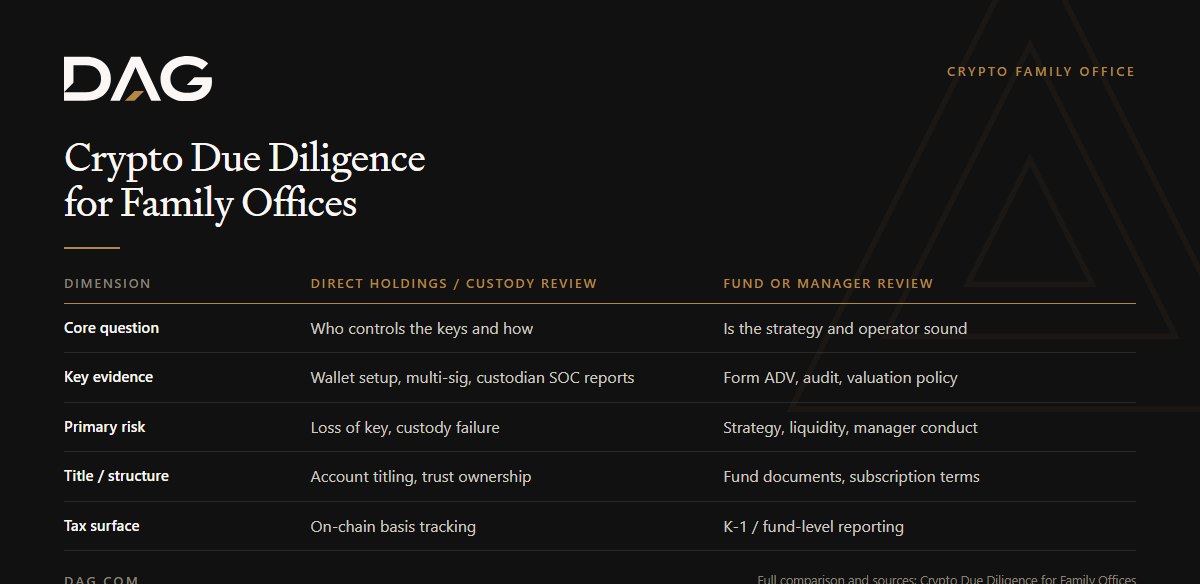
The two diligence tracks ask different questions and call for different evidence:
| Dimension | Direct holdings / custody review | Fund or manager review |
|---|---|---|
| Core question | Who controls the keys and how | Is the strategy and operator sound |
| Key evidence | Wallet setup, multi-sig, custodian SOC reports | Form ADV, audit, valuation policy |
| Primary risk | Loss of key, custody failure | Strategy, liquidity, manager conduct |
| Title / structure | Account titling, trust ownership | Fund documents, subscription terms |
| Tax surface | On-chain basis tracking | K-1 / fund-level reporting |
Evidence Standard
This article provides a general due diligence framework. It does not include any case study or claim about a specific family office. Where it names third parties, that is not an endorsement or a comparison of one provider against another.
When It May Help
- A principal already owns crypto outside the family office.
- The family is evaluating an ETF, fund, SMA, direct account, or staking strategy.
- A trustee or investment committee needs documentation, as set out in crypto governance for family offices.
- The office is reviewing a crypto custodian or manager.
- Beneficiaries may inherit digital assets.
When It May Not Be Enough
Due diligence is not a one-time event. Platforms, regulations, tax rules, protocols, and custody arrangements change. Reviews should be refreshed on a set cadence, and registration of any custodian or adviser alone does not guarantee skill, performance, or asset safety.
Related Questions
What is the first diligence question to ask?
Start with custody: where are the assets, who controls the keys, and what happens if the current decision-maker is unavailable. Custody generally determines whether everything else can even be verified.
Should a family office diligence crypto funds differently from direct holdings?
Generally yes. Funds call for manager, strategy, liquidity, fee, custody, valuation, audit, and document review. Direct holdings center on custody, wallet controls, reporting, and governance. The right depth depends on the facts.
Should tax be part of crypto diligence?
Yes. Cost basis, income, staking rewards, airdrops, and transaction history can materially affect the family's after-tax outcome, and the IRS generally treats digital assets as property. Confirm specifics with a qualified tax professional.
How often should crypto due diligence be refreshed?
There is no fixed rule, but most family offices revisit on a regular cadence and after material changes, a new custodian, a protocol upgrade, or a regulatory shift. The appropriate interval depends on the size and complexity of the exposure.
Bottom Line
Crypto due diligence should connect investment review with operational review. For family offices, the question is not only whether the asset is attractive, but whether the family can hold, report, govern, and transfer it responsibly. No process removes market, custody, or tax risk.
Sources
Compliance Note
This article is for general educational purposes and is not legal, tax, investment, custody, or due-diligence advice. Family offices should consult qualified professionals.