
Crypto planning for family office CIOs is the work of deciding how digital assets fit a family's portfolio strategy, risk limits, custody, liquidity, reporting, and governance. The CIO does not personally run every wallet workflow but owns the investment and oversight framework that ties each entry point together and survives staff turnover and market stress.
What This Means
A CIO sets the policy layer above day-to-day execution. The role covers what crypto exposure is allowed, how much, through which vehicles, where assets are held, how risk is measured, and how all of it is reported to principals and committees. The framework matters because crypto carries market, custody, and tax risks that no allocation method removes; the CIO's job is to make those risks visible and bounded, not to eliminate them. For the broader context, see the Crypto Family Office Hub.
CIO-Level Questions
- What role should crypto play in the family balance sheet, and what allocation limits apply?
- Are direct holdings, spot ETFs, SMAs, funds, or venture tokens permitted?
- Who approves exceptions, and how are they documented?
- How is custody reviewed, qualified custodian status, SOC 1/SOC 2 reports, key-management model (multi-sig, cold storage)?
- What tax and liquidity planning is required, including Form 1099-DA reconciliation and the IRS treatment of digital assets as property?
- How are risks reported to principals or committees, and how often?
These questions map directly to the governance work a crypto family office builds out over time.
Governance Documents a CIO Typically Owns
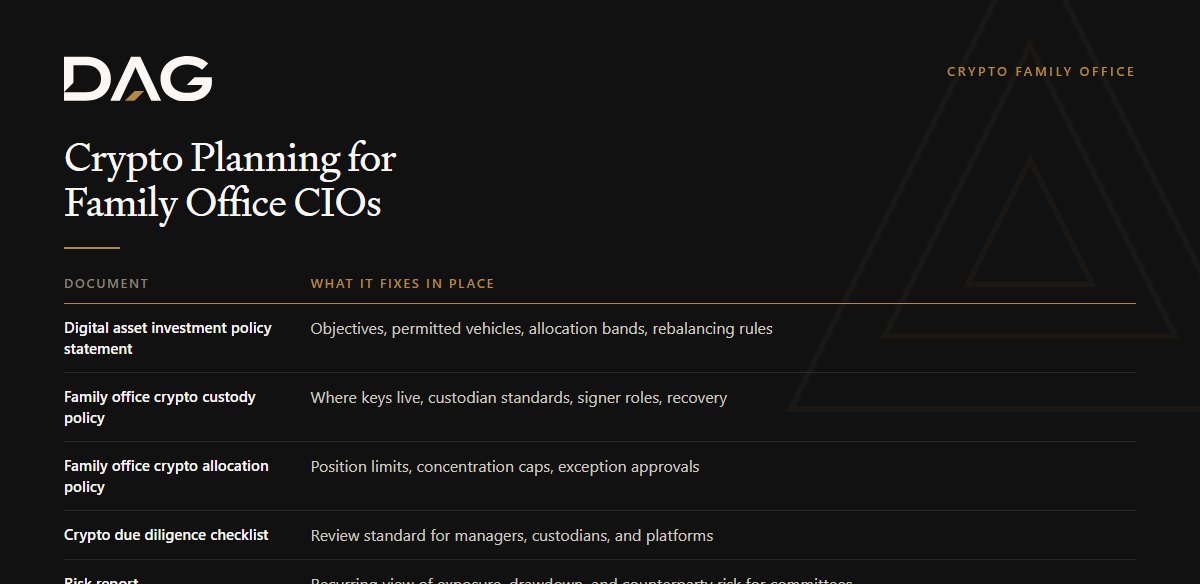
| Document | What it fixes in place |
|---|---|
| Digital asset investment policy statement | Objectives, permitted vehicles, allocation bands, rebalancing rules |
| Family office crypto custody policy | Where keys live, custodian standards, signer roles, recovery |
| Family office crypto allocation policy | Position limits, concentration caps, exception approvals |
| Crypto due diligence checklist | Review standard for managers, custodians, and platforms |
| Risk report | Recurring view of exposure, drawdown, and counterparty risk for committees |
Each document should name an owner, a review cadence, and the qualified professional who signed off. Registration of any manager or custodian is a baseline check, not a quality guarantee, registration alone does not certify skill or returns.
Why the CIO Role Matters
Crypto enters a family office through many doors: founder holdings, inherited wallets, ETFs, funds, SMAs, staking, or direct purchases. Without a consolidated framework, each door has its own custody, tax, and reporting gaps. The CIO's value is a single oversight view across all entry points, so the investment committee can review crypto on the same evidence standard it applies to any other asset class.
Related Questions
Does a family office CIO need to manage wallets directly?
Generally no. The CIO owns policy, manager selection, custody standards, and reporting. Day-to-day key handling usually sits with a qualified custodian or designated operations staff under documented procedures. The right split depends on the family's facts and should be set with qualified professionals.
How should crypto risk be reported to the investment committee?
A recurring report typically covers exposure by vehicle, concentration, drawdown, and counterparty and custody risk, on a fixed cadence. The goal is balanced disclosure, benefits alongside market, custody, and tax risks that no strategy removes. Consult qualified professionals when designing the format.
What allocation should a family office hold in crypto?
There is no universal figure; it depends on the family's objectives, liquidity needs, time horizon, and risk tolerance, and should be expressed as a band with concentration limits in the investment policy statement. No allocation guarantees yield or protects against loss. Decide allocation with qualified advisers.
Sources
- SEC Investor.gov: Crypto Assets
- IRS: Digital assets
- SEC: Investor Bulletin, Custody of Your Investment Assets
Compliance Note
This article is educational and does not provide legal, tax, investment, fiduciary, CIO, or custody advice. Family office investment frameworks should be reviewed with qualified professionals.