
A crypto family office risk report template is a reusable document a family office completes each reporting period to review digital asset exposure, custody controls, liquidity reserves, tax records, counterparties, and estate access in one structured view. Built for principals, trustees, and investment committees, it should be adapted to the family's governance process and reviewed with qualified professionals.
What a Crypto Risk Report Is, and Is Not
A risk report is a structured governance document, not a performance statement. Where a performance report answers "how did the portfolio do," a risk report answers "where does exposure sit, what control gaps exist, and which issues need the committee's attention this period."
The report rolls up holdings scattered across direct wallets, qualified custodians, ETFs, funds, trusts, and LLCs into one governance picture. It sits inside the broader discipline of crypto governance for family offices and should pair with a written digital asset investment policy statement and crypto custody policy template for family offices so that what the report measures maps to limits and policies the family has already agreed on.
No risk report removes market, custody, or tax risk. It makes those risks visible so principals can decide how much to carry and what to act on.
Section Skeleton (Fillable)
Copy these headings into your reporting document and complete each section for the period. Adapt the scope and detail to your governance process.
- Executive summary, top risks and open items this period, in plain language for principals.
- Total digital asset exposure, aggregate value and percentage of total net worth.
- Exposure by asset, concentration in any single token or sector, flagged against IPS limits.
- Exposure by custodian or wallet, how much sits with each qualified custodian, exchange, or self-custodied wallet; whether SOC 1 or SOC 2 reports are current for each.
- Exposure by legal owner, how much is held by each individual, trust, LLC, or foundation.
- Liquidity and tax reserve needs, cash available to meet estimated tax obligations and near-term spending, and whether reserves are adequate.
- Unrealized gain or loss status, summary of positions and their tax basis, to inform harvesting or rebalancing decisions.
- Custody and transfer control exceptions, multi-sig quorum gaps, single-signer wallets, missing withdrawal allowlists, and any transfers outside policy since the last report.
- Staking, lending, or protocol exposure, counterparty and smart-contract risk by venue; note that on-chain yield is not guaranteed and carries protocol and counterparty risk.
- Tax record completeness, cost basis coverage, 1099-DA readiness, and any missing data.
- Estate access readiness, whether keys, seed phrases, successor-signer designations, and access instructions are recoverable on death or incapacity; whether the current multi-sig quorum survives an incapacity scenario.
- Policy exceptions logged, any deviation from the IPS or custody policy since the last report, with owner and status.
- Open issues and action items, owner, due date, and risk rating for each.
For the documents that feed these sections, see the crypto custody policy template for family offices and the crypto family office checklist.
Example Risk-Rating Scale
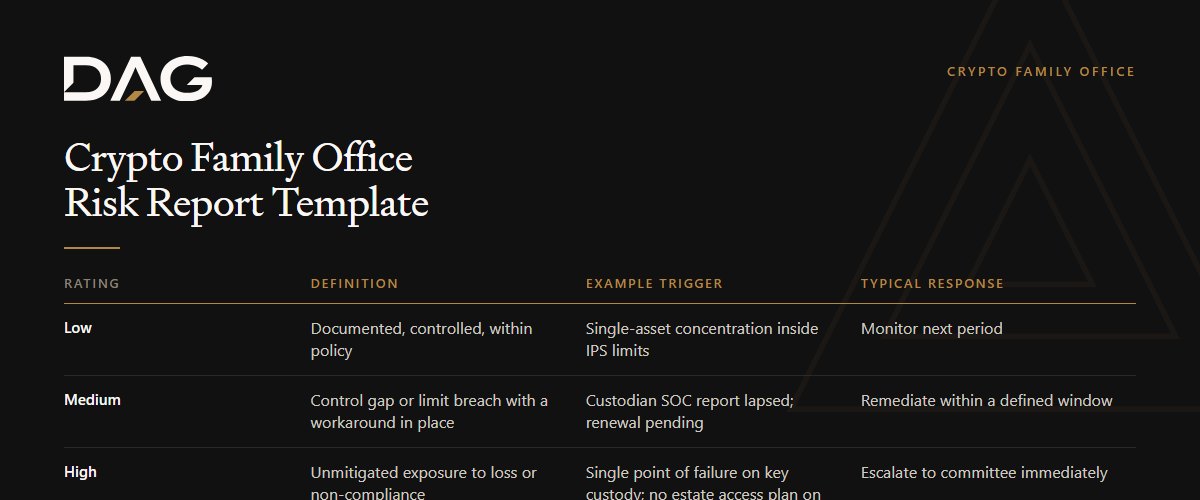
A consistent rating scale makes reports comparable across periods and helps two preparers rate the same issue the same way. The scale below is a hypothetical example to adapt; it is not a regulatory standard:
| Rating | Definition | Example trigger | Typical response |
|---|---|---|---|
| Low | Documented, controlled, within policy | Single-asset concentration inside IPS limits | Monitor next period |
| Medium | Control gap or limit breach with a workaround in place | Custodian SOC report lapsed; renewal pending | Remediate within a defined window |
| High | Unmitigated exposure to loss or non-compliance | Single point of failure on key custody; no estate access plan on file | Escalate to committee immediately |
Define triggers and responses in your governance policy before using the scale, so the rating is applied consistently across periods.
Why a Standalone Risk Report Helps
Crypto exposure fragments across investments, custody, taxes, operations, legal structures, and family governance at once. A custodian SOC 1 or SOC 2 report covers controls at one provider but says nothing about concentration, estate access, or tax reserves. A performance report shows returns but not gaps.
A single periodic risk report surfaces issues that no single vendor statement or performance report covers, and gives the committee a written record of what was known, when it was known, and what was done about it. That record matters if a question arises later about fiduciary process.
The report also supports the work of an investment committee reviewing crypto and feeds into the family's broader crypto family office hub reporting cadence. For the quarterly process that uses these outputs, see the family office digital asset quarterly review process.
Related Questions
How often should a family office produce a crypto risk report?
Cadence generally depends on the size and volatility of the holdings and the family's governance schedule. Many committees review quarterly, with ad hoc updates after a material custody change, a large transfer, a token unlock, or a sharp market move. Set the cadence in the governance policy and apply it consistently; a more concentrated or active book generally warrants tighter review.
Who should review the crypto risk report?
The report is generally prepared for principals, trustees, and the investment committee. Depending on the facts, qualified custody, tax, and legal professionals may need to review specific sections, particularly the custody control, tax record, and estate access sections. Roles and escalation paths are generally set in a written governance policy rather than left to case-by-case judgment.
How is a risk report different from a performance report?
A performance report measures returns; a risk report documents exposure, control gaps, and unresolved issues. The two are complementary. A risk report does not remove market, custody, or tax risk; it makes that risk visible so the committee can decide what to act on.
Does producing a risk report reduce investment risk?
No. The report documents and surfaces risk; it does not remove market, custody, liquidity, or tax risk, and it provides no yield, safety, or insurance guarantee. It supports more informed decisions, which remain the responsibility of the family and its qualified advisers.
What documents feed the risk report?
Typical inputs include custodian statements and SOC reports, the family's IPS and custody policy, wallet inventory records, tax basis documentation, and estate access instructions. For a companion checklist that confirms each section has a source document, see the crypto family office checklist and digital asset governance policy.
Sources
- SEC Investor.gov: Crypto Assets
- SEC: Investor Bulletin. Custody of Your Investment Assets
- IRS: Digital Assets
Compliance Note
This article is educational and does not constitute legal, tax, investment, fiduciary, risk management, or custody advice. Risk reports should be reviewed with qualified professionals. DAG Wealth services are provided by Digital Ascension Group; registered investment advisory services are provided by DAG Wealth, an SEC-registered investment adviser. Registration does not imply a certain level of skill or training.