
Multi-generational crypto wealth transfer is the process a family office uses to move digital asset wealth to children and later generations while keeping the assets accessible, tax-efficient, and governed by clear rules. Unlike a will alone, it pairs estate and trust structure with the crypto-specific problem of key continuity: heirs can inherit the legal right to assets and still lose them if no one can reach the private keys.
Why Crypto Wealth Transfer Is Different
Traditional wealth transfer moves titled assets, real estate, brokerage accounts, business interests, that a court or institution can re-title to an heir. Crypto adds two problems no traditional asset has: control of an asset equals control of its private keys, and a lost key is an unrecoverable loss with no central party to appeal to. A succession plan therefore has to transfer both the legal right (through wills, trusts, and entities) and the technical ability to access keys, in a way that survives the death or incapacity of the person who set it up. The general estate framing lives in the crypto estate planning hub; this playbook covers the family-office, multi-generation version.
The Wealth-Transfer Sequence
Each step constrains the next, so order matters.
Inventory and consolidate. Document every wallet, exchange account, and custodian, with where the keys live and who can access them. Scattered holdings cannot be governed or transferred reliably. This is the same discipline a family office uses for ongoing reporting.
Choose the holding structure. Decide whether assets sit personally, in an LLC, or in a trust, and how those interact. Long-horizon transfer usually points toward trusts; for transfer-tax-exposed families, a crypto dynasty trust and GST planning structure can shelter future appreciation across generations. Many families hold keys inside a trust-owned LLC for crypto assets so signers and liability sit in an entity the trust owns. The broad design is in trust structures for crypto wealthy individuals.
Solve key succession before funding. Define the custody model (qualified custodian, multi-sig, or institutional cold storage), who may sign, and how signing authority passes to successor trustees or heirs without a single point of failure. See private key succession planning. A perfectly drafted trust is worthless if the keys are unreachable after the grantor dies.
Coordinate the tax and gifting plan. Lifetime gifting, basis step-up considerations, and transfer-tax exposure should be planned with a tax professional before assets move, because moving crypto into an entity or trust can itself be a taxable event depending on structure. For the high-net-worth view, see crypto estate planning for high-net-worth families.
Document governance and prepare the next generation. Write down transaction-approval rules, successor-trustee procedures, and a plan to bring heirs up to speed on custody and security. Governance is what keeps the structure running after the founder is gone.
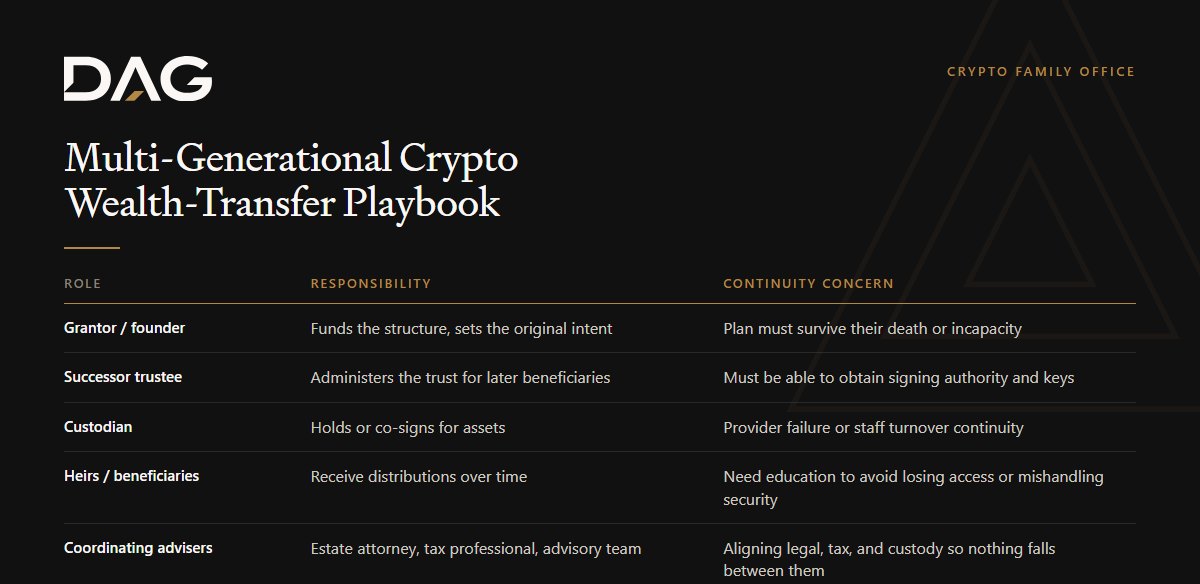
Roles in a Multi-Generation Transfer
| Role | Responsibility | Continuity concern |
|---|---|---|
| Grantor / founder | Funds the structure, sets the original intent | Plan must survive their death or incapacity |
| Successor trustee | Administers the trust for later beneficiaries | Must be able to obtain signing authority and keys |
| Custodian | Holds or co-signs for assets | Provider failure or staff turnover continuity |
| Heirs / beneficiaries | Receive distributions over time | Need education to avoid losing access or mishandling security |
| Coordinating advisers | Estate attorney, tax professional, advisory team | Aligning legal, tax, and custody so nothing falls between them |
Common Failure Points
- No key continuity. The estate documents are perfect, but no successor can reach the wallets.
- Single point of failure. One person holds the only seed phrase; their loss strands the assets.
- Unprepared heirs. Beneficiaries inherit assets they cannot securely custody and lose them to error or theft.
- Stale documents. Holdings or custodians change, but the plan and inventory are never updated.
- Tax surprises. Transfers into structures trigger unplanned taxable events because the plan skipped the tax step.
Related Questions
How is crypto passed to the next generation?
Through a combination of legal structure and technical access: a will, trust, or entity transfers the legal right to the assets, while a documented key-succession plan transfers the practical ability to reach the wallets. Both are required. For long-horizon, transfer-tax-exposed families, an irrevocable or dynasty trust is a common vehicle, but the right structure depends on the facts and should be set with counsel.
Can a trust solve the lost-key problem on its own?
No. A trust assigns legal ownership and administration, but it does not by itself keep private keys recoverable. The trust documents must be paired with a concrete custody and key-succession plan, defined signers, a multi-sig or institutional custody model, and secured procedures for passing access to successor trustees. See private key succession planning for the mechanics.
When should a family start planning crypto wealth transfer?
Generally once holdings are large enough that loss of access or transfer-tax exposure would materially affect the family, and well before any health or capacity issue forces a rushed transfer. Inventory and consolidation can start immediately; the structural and tax decisions are best made with an estate attorney and tax professional before assets are moved.
Sources
- IRS: Estate and Gift Taxes, verify current exemption figures at irs.gov
- IRS: Digital assets (property treatment), https://www.irs.gov/filing/digital-assets
- Uniform Fiduciary Access to Digital Assets Act (RUFADAA), model act adopted by most states; confirm your state's version
Compliance Note
This playbook is educational only and is not legal, tax, fiduciary, or estate advice. Trust drafting, GST allocation, gifting strategy, and choice of situs are professional services that the firm coordinates with qualified attorneys and tax professionals; it does not itself provide legal or tax advice. Any tax figures or thresholds referenced are illustrative, dated, and change with legislation, verify current amounts with a qualified tax professional. Advisory services are provided by DAG Wealth, an SEC-registered investment adviser. Registration does not imply a certain level of skill or training. No structure removes market, custody, or tax risk, and no outcome is guaranteed.