
A Bitcoin family office is a coordinated structure that manages a family's Bitcoin alongside custody, reporting, governance, tax records, estate planning, and long-term wealth strategy. It applies when a Bitcoin position grows material enough to affect a family's net worth, inheritance plan, or risk profile and needs oversight beyond a single exchange account. It does not remove market, custody, or tax risk.
What a Bitcoin Family Office Is
The term describes the people, policies, and service relationships a family uses to hold and pass on Bitcoin in an organized way, rather than a single product. A typical setup connects qualified custody arrangements, written transfer controls, entity and trust structures, and consolidated reporting so that ownership, access, and inheritance are documented. Because Bitcoin is generally treated as property by the IRS, gains and transfers carry tax consequences that usually call for a qualified professional. This sits within broader crypto wealth management and overlaps closely with what a crypto family office coordinates.
When Bitcoin May Need Family Office Support
Family office support may be appropriate when:
- Bitcoin is a large share of family wealth.
- Multiple family members or entities own Bitcoin.
- Assets are spread across wallets or custodians.
- The family needs succession planning.
- Reporting is needed for trustees, advisors, or beneficiaries.
- There is a need for written transfer controls.
Families weighing whether they have reached this point can review how much crypto is enough to need a family office.
What a Bitcoin Family Office Can Coordinate
A Bitcoin-focused family office process may include:
- Custody selection and oversight, reviewing whether a custodian is a qualified custodian, holds keys in cold storage, uses multi-sig, and produces SOC 1 or SOC 2 reports.
- Wallet inventory, a documented list of every wallet, custodian, and signer.
- Entity and trust coordination, aligning ownership with trusts or entities so transfers and inheritance follow a plan; see crypto trust structures.
- Risk and concentration review, sizing the position against the family's overall balance sheet.
- Tax professional coordination, record-keeping for property-treatment gains and reporting such as Form 1099-DA.
- Estate planning instructions, written guidance for how keys and assets pass to beneficiaries.
- Family governance and reporting, defined roles for who can authorize a transfer.
A written crypto custody policy often anchors these decisions.
Bitcoin Brokerage Account vs Bitcoin Family Office
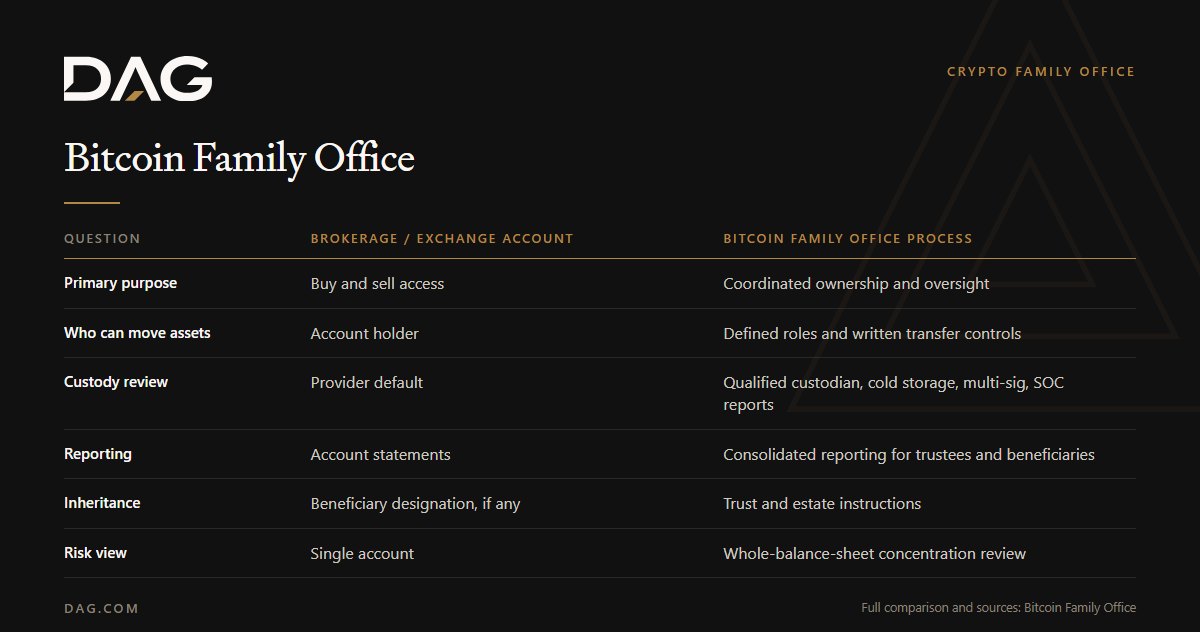
A brokerage or exchange account provides access to buy and sell. A family office process is broader: it asks who owns the asset, who can move it, how it is reported, how it will be inherited, and how it fits the family's overall financial life.
| Question | Brokerage / exchange account | Bitcoin family office process |
|---|---|---|
| Primary purpose | Buy and sell access | Coordinated ownership and oversight |
| Who can move assets | Account holder | Defined roles and written transfer controls |
| Custody review | Provider default | Qualified custodian, cold storage, multi-sig, SOC reports |
| Reporting | Account statements | Consolidated reporting for trustees and beneficiaries |
| Inheritance | Beneficiary designation, if any | Trust and estate instructions |
| Risk view | Single account | Whole-balance-sheet concentration review |
Related Questions
Is a Bitcoin family office only for billionaires?
No. The structure scales with need rather than a fixed threshold. What generally matters is whether Bitcoin has become material to net worth, inheritance, or risk, which depends on the family's facts and is worth reviewing with a qualified professional.
Does a family office custody Bitcoin itself?
Not necessarily. Many families use a qualified custodian and keep the family office in an oversight role, while others run self-custody with written multi-sig controls. The right approach depends on the family's risk tolerance, governance, and applicable rules.
How is Bitcoin taxed inside a family office?
Bitcoin is generally treated as property by the IRS, so sales and many transfers can trigger taxable gains regardless of the structure holding it. A family office helps organize records, but tax outcomes depend on the facts and should be confirmed with a qualified tax professional.
Sources
Compliance Note
This article is educational and does not provide legal, tax, investment, fiduciary, or custody advice. Bitcoin family office structures should be reviewed with qualified professionals.