
Stablecoin treasury management for family offices is the discipline of governing how stablecoins are selected, custodied, transferred, and reported. Before holding stablecoins, a family office should review issuer risk, custody, transfer controls, entity structure, and tax records, because a stablecoin is not cash, an insured deposit, or a cash equivalent, and its risks do not disappear by default.
What a Stablecoin Is
A stablecoin is a digital token designed to track the value of a reference asset, usually the U.S. dollar, by holding reserves (fiat-backed), over-collateralizing on-chain positions, or using algorithmic mechanisms. The peg is a design goal, not a guarantee: it depends on the issuer's reserves, redemption mechanics, and market conditions, and a stablecoin can deviate from or permanently lose its peg.
Key structural differences from cash:
| Consideration | Stablecoin | Bank Deposit |
|---|---|---|
| Backing | Issuer reserves; quality varies by disclosure | Bank balance sheet |
| Insurance | Generally none (no FDIC/SIPC) | FDIC up to applicable limits |
| Peg | Design goal; can deviate | Par value |
| Custody | Self-custody or qualified custodian | Bank |
| Tax | Property treatment; dispositions generally taxable | Interest income |
| Settlement | Often near-instant, on-chain, irreversible | Bank rails; reversible in some cases |
This comparison is structural, not a recommendation. No stablecoin removes market, depeg, custody, or tax risk.
These decisions sit within the broader Crypto Family Office Hub and the wider digital asset family office operating model.
Planning Questions
A family office should resolve these questions before holding stablecoins:
- Which stablecoins are approved, and on which blockchains? Is each one fiat-backed, over-collateralized, or algorithmic?
- Who is the issuer, and what is its regulatory and legal standing? Does it publish reserve attestations or independent audits?
- Where are stablecoins custodied, self-custody, exchange, or qualified custodian with SOC 1/SOC 2 reporting?
- Who can approve transfers? Does approval require more than one signer or a multi-party threshold?
- How are wallet addresses verified and allow-listed before funds move?
- Are stablecoins held personally, in a trust, in an LLC, or by another entity, and how does that affect liability, charging-order protection, and tax reporting?
- Are stablecoin transactions tracked for cost basis and Form 1099-DA reporting?
- Are there concentration limits by issuer, custodian, wallet, or counterparty?
Formal answers belong in a digital asset investment policy statement. The supporting due-diligence process is covered in crypto due diligence for family offices.
Why Stablecoins Need Governance
Stablecoins move quickly across exchanges, wallets, custodians, and on-chain applications, and on-chain transfers are generally irreversible. Without written controls, a family office can face operational errors, recordkeeping gaps, or unclear authority over who may move funds. Governance closes those gaps by naming approvers, custody locations, and reporting duties. These controls pair with a crypto custody policy template for family offices and the crypto governance for family offices framework, so stablecoin decisions follow the same review cadence as the rest of the digital asset book.
Suggested Policy Areas
The right structure depends on each family's facts; any policy should be reviewed with qualified legal, tax, and custody professionals before adoption.
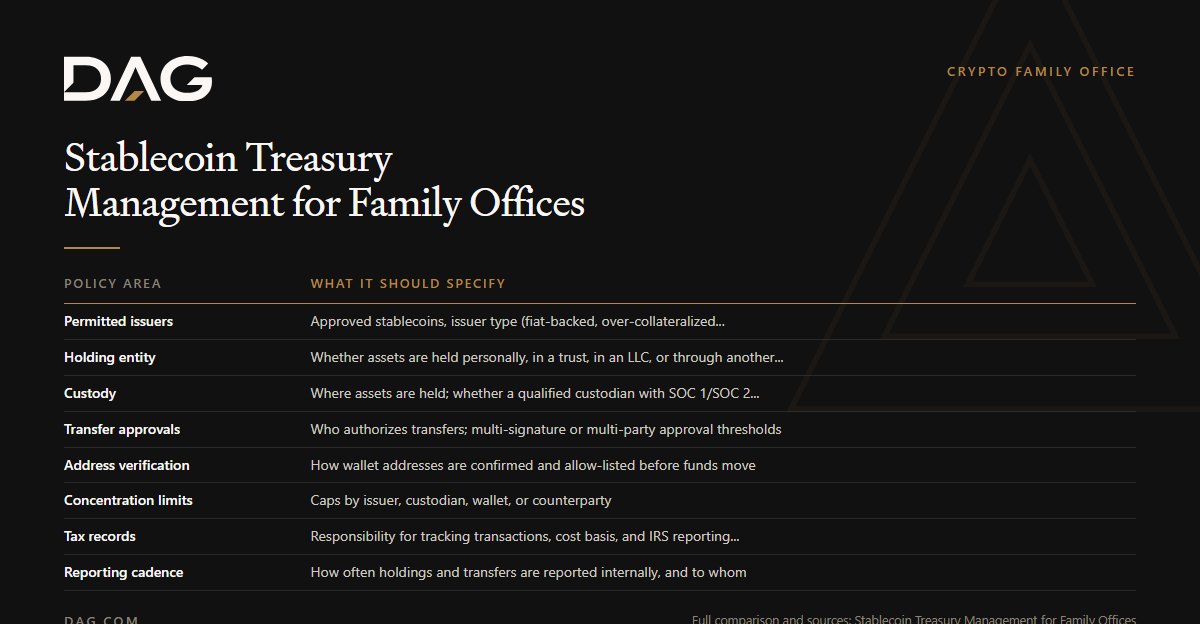
| Policy area | What it should specify |
|---|---|
| Permitted issuers | Approved stablecoins, issuer type (fiat-backed, over-collateralized, algorithmic), reserve and attestation standards |
| Holding entity | Whether assets are held personally, in a trust, in an LLC, or through another structure; legal and tax implications of each |
| Custody | Where assets are held; whether a qualified custodian with SOC 1/SOC 2 reporting is required |
| Transfer approvals | Who authorizes transfers; multi-signature or multi-party approval thresholds |
| Address verification | How wallet addresses are confirmed and allow-listed before funds move |
| Concentration limits | Caps by issuer, custodian, wallet, or counterparty |
| Tax records | Responsibility for tracking transactions, cost basis, and IRS reporting (including Form 1099-DA) |
| Reporting cadence | How often holdings and transfers are reported internally, and to whom |
Related Questions
Can a family office hold stablecoins?
Yes, but the question is really a governance question. There is no structural prohibition on a family office holding stablecoins, but the decision requires reviewing issuer risk, custody, entity structure, transfer controls, and tax records before holding begins. A stablecoin is not cash and does not carry FDIC or SIPC protection.
Are stablecoins insured like cash?
Generally no. Stablecoins are typically not covered by FDIC deposit insurance or SIPC protection. Their value depends on the issuer's reserves and redemption mechanics, which vary by issuer and are not standardized. Confirm coverage and reserve disclosures with a qualified professional before treating any stablecoin as a cash equivalent.
Should a family office hold stablecoins in a trust or an LLC?
It depends on the facts. The holding entity affects liability exposure, asset protection (e.g., charging-order features in certain LLC jurisdictions), and tax reporting obligations. Families often weigh personal holding against a trust or LLC structure. Decide with qualified legal and tax counsel rather than by default.
Where should a family office custody stablecoins?
Options range from self-custody (where the family office controls private keys) to an exchange account to a qualified custodian that publishes SOC 1 or SOC 2 reports. The choice affects who controls keys, how transfers are approved, and what recordkeeping support is available. Review custody arrangements with qualified professionals.
How are stablecoin transactions taxed?
The IRS generally treats digital assets, including stablecoins, as property. Transfers, conversions, and dispositions can generate taxable events and reporting obligations even when the stablecoin's price holds near its peg. Keep complete cost-basis records, prepare for Form 1099-DA reporting requirements, and confirm treatment with a qualified tax professional.
Sources
Compliance Note
This article is educational and does not provide legal, tax, investment, fiduciary, treasury, or custody advice. Stablecoin governance policies should be reviewed with qualified legal, tax, and custody professionals before adoption.