
A crypto family office cost is the total annual spend a family pays to coordinate its digital asset wealth, legal and entity setup, custody, advisory, tax, and operations, billed through a fee model rather than a single price tag. There is no published "rate" for a family office; cost depends on assets, complexity, and which functions are in-house versus outsourced. The fee structures used are the same ones in traditional wealth management, adapted for crypto.
What Drives the Cost of a Crypto Family Office
Cost is a function of scope, not a sticker price. A family that needs only investment oversight pays far less than one running custody, governance, tax coordination, and multi-generational estate work in-house. The main cost drivers are generally:
- Asset size and number of accounts, more wallets, custodians, and exchanges mean more reconciliation and reporting work.
- Custody model, institutional qualified custody, self-custody multi-sig, or a mix; each carries different setup and ongoing fees.
- Entity complexity, a single LLC costs less to maintain than a layered LLC-and-trust structure with multiple signers.
- In-house versus outsourced functions, staffing a dedicated team is a fixed overhead; outsourcing converts it to variable fees.
- Tax and reporting burden, cost-basis reconstruction across years and venues is labor-intensive and often the largest recurring line.
For the step-by-step setup sequence and component-level setup costs, see building a crypto family office. This page focuses on the fee models you choose between, not the build process.
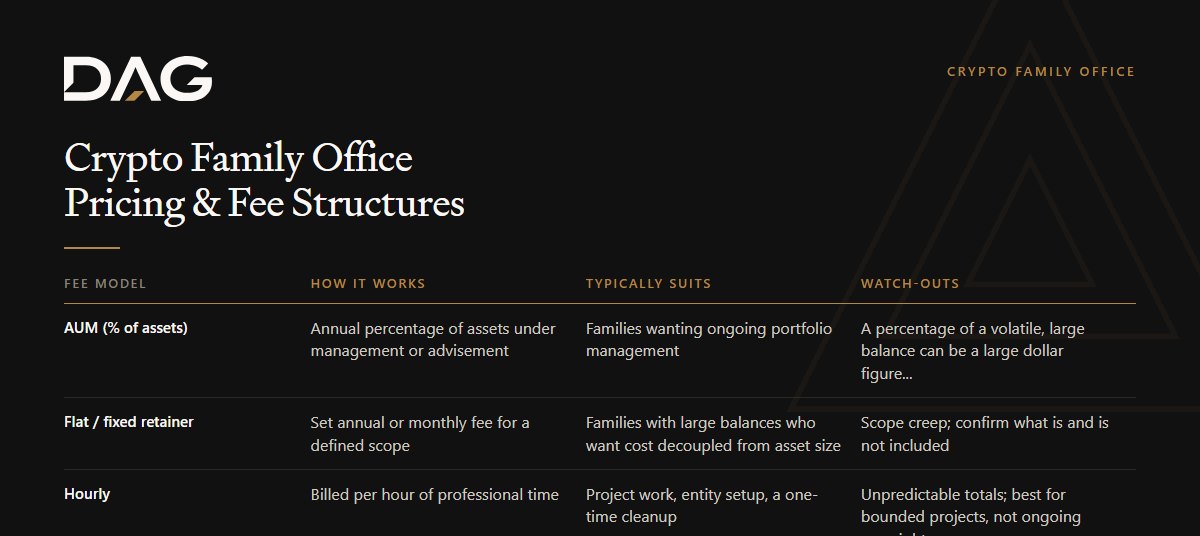
The Four Fee Models
Most crypto family office and advisory arrangements price under one of four models, or a blend.
| Fee model | How it works | Typically suits | Watch-outs |
|---|---|---|---|
| AUM (% of assets) | Annual percentage of assets under management or advisement | Families wanting ongoing portfolio management | A percentage of a volatile, large balance can be a large dollar figure; clarify what "assets" the percentage applies to |
| Flat / fixed retainer | Set annual or monthly fee for a defined scope | Families with large balances who want cost decoupled from asset size | Scope creep; confirm what is and is not included |
| Hourly | Billed per hour of professional time | Project work, entity setup, a one-time cleanup | Unpredictable totals; best for bounded projects, not ongoing oversight |
| Hybrid | Combination, e.g., flat retainer plus a smaller AUM or project fees | Families with both ongoing and project needs | Two billing lines to track; ask for an all-in estimate |
There is no single "best" model. A large balance can make a flat retainer cheaper than an AUM percentage, while a smaller or project-based engagement may be cheaper hourly. The fee-only versus fee-based distinction also matters: a fee-only crypto financial advisor is compensated only by client fees, not commissions or product sales, which removes one source of conflict.
Illustrative Cost Ranges (Dated. Verify Current)
The figures below are illustrative orientation points based on publicly observable professional service rate ranges as of 2026. They are not a quote, not a DAG Wealth price, and not a guarantee of any provider's pricing. Verify current figures with each provider before budgeting.
| Cost area | Illustrative annual range | Notes |
|---|---|---|
| Investment advisory (AUM) | ~0.50%–1.50% of assets | Lower percentages common at higher asset levels; confirm the fee schedule |
| Flat advisory retainer | $25,000–$150,000+ | Scales with scope and number of family members served |
| Tax preparation and coordination | $10,000–$75,000+ | Driven heavily by transaction volume and cost-basis cleanup |
| Custody (institutional) | Varies by custodian | Often a basis-point fee on assets plus transaction/withdrawal fees |
| Ongoing legal and governance | $5,000–$50,000+ | Entity maintenance, signer changes, document updates |
For how advisory fees specifically are structured on a crypto portfolio, see advisory fees for managing crypto portfolios. These ranges overlap and double-count nothing, total cost is the sum of the functions a given family actually uses, which is why two families with similar assets can pay very different amounts.
When Cost Justifies the Structure
A full family office structure carries fixed overhead, so below a certain asset level the cost can outweigh the benefit. Families generally work through how much crypto is enough to need a family office before committing. A common pattern is to start with a single entity and outsourced advisory, then add functions as assets and complexity grow, rather than building the full apparatus on day one. Choosing the provider and model is covered in how to choose a crypto family office.
Related Questions
How much does a crypto family office cost per year?
There is no fixed annual price. Total cost is the sum of advisory, custody, tax, legal, and operational fees a family actually uses, billed under an AUM, flat-retainer, hourly, or hybrid model. Smaller engagements may run in the low tens of thousands; full in-house structures for very large holdings run substantially higher. All figures should be confirmed with each provider, as ranges are illustrative and dated.
Is an AUM fee or a flat fee cheaper for a crypto family office?
It depends on asset size. Because an AUM fee is a percentage of the balance, it grows as assets grow, so at higher asset levels a flat retainer can cost less than the same percentage applied to a large, volatile balance. At smaller balances the percentage may be the lower number. Compare the actual dollar figures, not just the model, and ask each provider for an all-in annual estimate.
Do crypto family office fees include custody and tax?
Not always. Advisory fees, custody fees, and tax preparation are frequently billed separately by different providers. A fully coordinated or outsourced arrangement may bundle them, but in fragmented setups they are distinct lines. Ask precisely what a stated fee includes before comparing two providers, because an apples-to-apples comparison requires matching scope.
Sources
- SEC: Investment Adviser Regulation and Form ADV Part 2 (fee disclosure), verify current at sec.gov
- IRS: Digital assets (property treatment affecting tax-prep scope), https://www.irs.gov/filing/digital-assets
Compliance Note
This page is educational only and is not legal, tax, investment, or fee advice. All cost figures, percentages, and ranges are illustrative, dated to 2026, and provided for orientation only, they are not a quote, not DAG Wealth's pricing, and not a representation of any provider's fees. Verify current figures directly with each provider before relying on them. Advisory services are provided by DAG Wealth, an SEC-registered investment adviser. Registration does not imply a certain level of skill or training. Fees reduce returns, and no fee model guarantees any outcome. Legal, tax, and custody services referenced are coordinated with qualified professionals and providers; the firm does not itself provide legal or tax advice.