
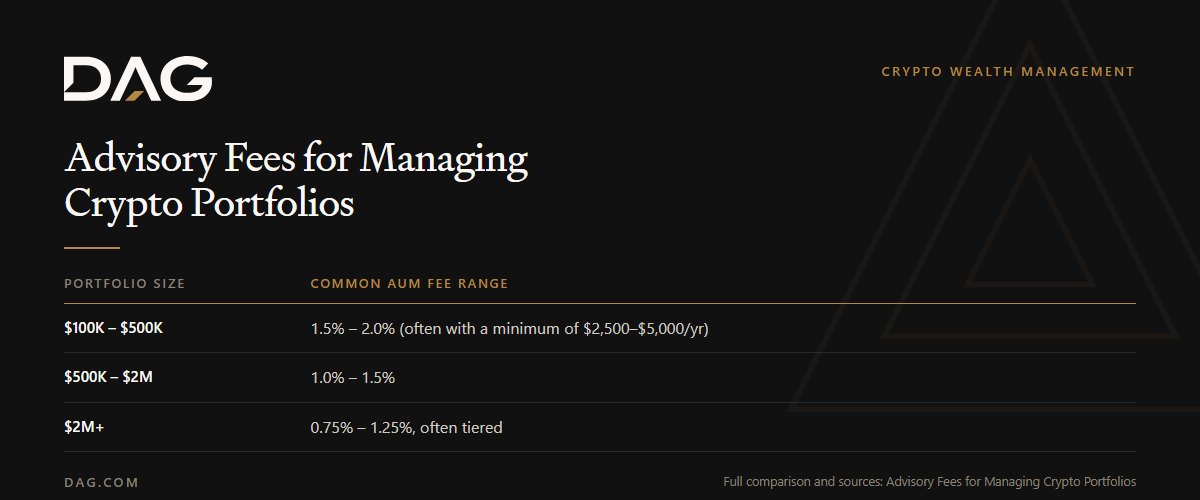
Advisory fees for managing crypto portfolios typically run 1% to 2% of assets under management (AUM) annually, though fee structures vary by firm. Some charge flat retainers, others blend a base AUM rate with performance components. Not all fees cover custody, tax coordination, or transactions. Knowing the full cost, and what it buys, is the starting point for evaluating any advisory relationship.
What Is an Advisory Fee for Crypto?
An advisory fee is the recurring cost an investment adviser charges to manage, monitor, and advise on a client's portfolio. For crypto, this generally covers portfolio strategy, rebalancing guidance, risk monitoring, and client communication. It does not automatically include custody, tax preparation, legal structuring, or transaction costs, those are typically separate line items.
How Do Crypto Advisors Structure Their Fees?
AUM-Based Fees
The most common model. The adviser charges a percentage of total portfolio value each year.
Typical ranges by portfolio size:
| Portfolio Size | Common AUM Fee Range |
|---|---|
| $100K - $500K | 1.5% - 2.0% (often with a minimum of $2,500-$5,000/yr) |
| $500K - $2M | 1.0% - 1.5% |
| $2M+ | 0.75% - 1.25%, often tiered |
These ranges assume comprehensive advisory: strategy, custody coordination, risk oversight, and ongoing management. Limited-scope engagements should cost less.
AUM fees broadly align adviser and client interests, the adviser earns more as the portfolio grows, but the adviser is compensated regardless of performance, which is worth understanding going in.
Performance Fees
Some advisers charge a percentage of gains above a defined hurdle rate. A common structure is 20% of returns above an agreed benchmark.
Key terms to verify before agreeing:
- High-water mark: The adviser should not charge performance fees on a recovery after a drawdown. Confirm this is in the agreement.
- Benchmark definition: What does "outperformance" mean? Holding Bitcoin? A blended index? Get it in writing.
- Incentive alignment: Performance fees can encourage excessive risk-taking. Understand how the adviser manages downside scenarios.
Pure performance-only models are rare in registered advisory. Most advisers use AUM fees or a lower AUM rate combined with a performance component.
Flat Retainers
A fixed monthly or annual fee regardless of portfolio size. This structure suits portfolios where AUM percentages would be too small to sustain serious advisory work.
Flat fees typically run $3,000–$10,000+ annually depending on service scope. They offer predictable costs, though if the portfolio grows substantially, the fee may no longer reflect market rates.
Onboarding Fees
Some advisers charge a one-time fee to cover initial portfolio review, custody setup, security assessment, and investment policy documentation. Range varies: $2,000–$10,000+ depending on complexity.
These are reasonable when the adviser is doing substantive upfront work. A fee for merely opening an account is not.
What's Usually Not Included in Advisory Fees?
- Custody fees: Institutional custody is typically priced separately, commonly 0.5%–1.0% of assets annually. For more on the distinction, see qualified custody for RIAs managing digital assets.
- Transaction costs: Exchange execution fees are separate from advisory fees.
- Tax preparation: Advisers may coordinate with tax counsel, but they do not file returns. Budget for tax work independently.
- Legal and structuring fees: Entity formation, trust drafting, and estate documents require separate legal counsel.
Ask every adviser to enumerate what is and isn't bundled before comparing headline fees.
About DAG Wealth Advisory Fees
DAG Wealth provides investment advisory services through its affiliated SEC-registered investment adviser, DAG Wealth. Advisory fees are disclosed in the Form ADV and presented in writing before any engagement.
DAG Wealth's standard model is AUM-based. Fees depend on portfolio size, complexity, and service scope. DAG Wealth handles portfolio strategy, risk management, rebalancing, and custody coordination. DAG handles entity and infrastructure coordination, not investment advice.
Specific fee quotes require a direct conversation. Portfolio size, complexity, and the services required all affect pricing.
How to Evaluate Whether Fees Deliver Value
Security Coordination
Proper multi-sig custody setup, institutional storage, and access-control frameworks can prevent losses that far exceed advisory fees. Security guidance has concrete, measurable value. For context on custody structures, see crypto custody options compared.
Tax Coordination
Coordinated tax-loss harvesting, gain timing, and compliance with IRS reporting requirements can save more than the annual advisory cost. Savings are case-specific and not guaranteed, but the opportunity is real for complex holdings. See crypto tax planning for HNW investors.
Time Allocation
Managing a large crypto portfolio actively, monitoring positions, tracking cost basis, staying current on regulation, takes significant time. If that time has value to you in other areas, a managed engagement may be a practical trade-off.
Net Outcome vs. Alternative
The real comparison is not fee vs. zero fee. It is fee-adjusted outcomes vs. self-managed outcomes. A higher-fee adviser who adds material value to risk management and rebalancing can outperform a lower-fee engagement that adds none. Evaluate outcomes relative to a realistic self-managed baseline.
Red Flags in Crypto Advisory Fee Structures
- Fees not disclosed in writing before engagement. Transparent advisers disclose all fees, including custody, minimums, and performance components, in their Form ADV and engagement agreements before you commit.
- Unverified performance claims. Ask for audited track records or third-party verification. Self-reported performance without documentation is not a reliable basis for comparison.
- Product-driven compensation. If an adviser directs you toward funds, structured products, or platforms where they earn referral fees, the incentive structure is misaligned. Ask directly whether the firm receives compensation from third parties.
- Guaranteed return language. Crypto markets are volatile. Any representation of guaranteed outcomes or risk-free strategies is a compliance red flag and factually unsupported.
- Vague service descriptions. "Portfolio management" means different things. Get a written service schedule that specifies what is and is not included.
When Advisory Fees May Not Be Warranted
Advisory services may not be cost-effective for investors who:
- Hold less than $100K, where AUM percentages rarely justify full advisory scope
- Are technically proficient and comfortable managing security and custody independently
- Follow a passive buy-and-hold strategy requiring minimal ongoing management
- Have time and expertise to handle tax coordination and regulatory compliance themselves
Crypto investors at this stage often manage effectively without a formal adviser. Whether advisory adds value depends on individual circumstances, not a universal portfolio threshold.
Related Questions
What is a reasonable AUM fee for a crypto adviser?
For comprehensive advisory, strategy, custody coordination, risk oversight, 1% to 1.5% AUM is common for portfolios above $500K. Fees above 2% for standard advisory should come with a clear explanation of scope. Fees below 0.5% for "full service" warrant scrutiny of what is actually delivered.
Do crypto advisers charge performance fees?
Some do. A common structure is 20% of gains above a stated hurdle rate. If a performance fee is part of the agreement, confirm the high-water mark provision, benchmark definition, and whether the structure incentivizes excessive risk-taking.
Are advisory fees for crypto tax-deductible?
As of 2026, investment advisory fees are generally not deductible for most individual taxpayers following the Tax Cuts and Jobs Act of 2017, which suspended miscellaneous itemized deductions through 2025 and beyond absent legislative change. Consult a qualified tax professional for your situation.
How do crypto advisory fees compare to traditional wealth management fees?
Traditional wealth management fees typically run 0.5%–1.0% AUM. Crypto advisory fees tend to be higher, reflecting the additional complexity of custody coordination, multi-jurisdiction tax reporting, and digital asset security. As the market matures, fee compression is likely, but it has not yet occurred at scale.
What is a fee-only crypto financial adviser?
A fee-only adviser is compensated solely by client fees, no commissions, referral fees, or third-party compensation. This structure eliminates a major category of incentive misalignment. For more on this structure, see fee-only crypto financial advisor.
Sources
- U.S. Securities and Exchange Commission, Investment Advisers Act of 1940, Rule 206(4)-1 (Marketing Rule): https://www.sec.gov/rules/final/2020/ia-5653.pdf
- SEC Form ADV disclosure requirements: https://www.sec.gov/info/edgar/edgarfm-vol2-v55.pdf
- IRS Publication 529, Miscellaneous Deductions (TCJA 2017 changes): https://www.irs.gov/publications/p529
- CFA Institute, "Fee Structures in Investment Management" (general reference): https://www.cfainstitute.org
Compliance Note
This page is educational and does not constitute investment, tax, or legal advice. Advisory fee ranges cited are general market observations and do not represent guarantees, benchmarks, or representations about any specific firm's pricing. Actual fees vary by portfolio size, complexity, and service scope. Past investment outcomes, if referenced, are not indicative of future results. Consult a qualified investment adviser, tax professional, and legal counsel for guidance specific to your situation. Investment advisory services referenced herein are provided by DAG Wealth, an SEC-registered investment adviser. Registration does not imply a certain level of skill or training.