
Choosing between onshore and offshore crypto structures is a tradeoff between asset-protection strength on one side and cost, complexity, and reporting burden on the other. For a U.S. person, offshore changes neither the tax owed nor the obligation to report. The U.S. taxes citizens and residents on worldwide income regardless of where assets sit, so the decision is about protection and administration, not tax savings or secrecy. This is educational only.
What "Onshore" and "Offshore" Mean Here
Onshore structures are formed under U.S. law: a Wyoming or Delaware LLC, a domestic trust (including strong domestic asset-protection trust states), or holding assets through a U.S. entity or custodian.
Offshore structures are formed under the law of a foreign jurisdiction: an offshore trust, a foreign LLC or corporation, or custody with a non-U.S. provider.
This page is the decision overview, the framing you use before going deep on any one route. It does not replace the jurisdiction-specific deep-dives. For the detailed mechanics of foreign trusts and foreign custody (including required filings and individual jurisdictions), see offshore trusts for crypto and offshore crypto custody for US investors.
The Core Tradeoff
Neither option is "better" in the abstract. The honest comparison:
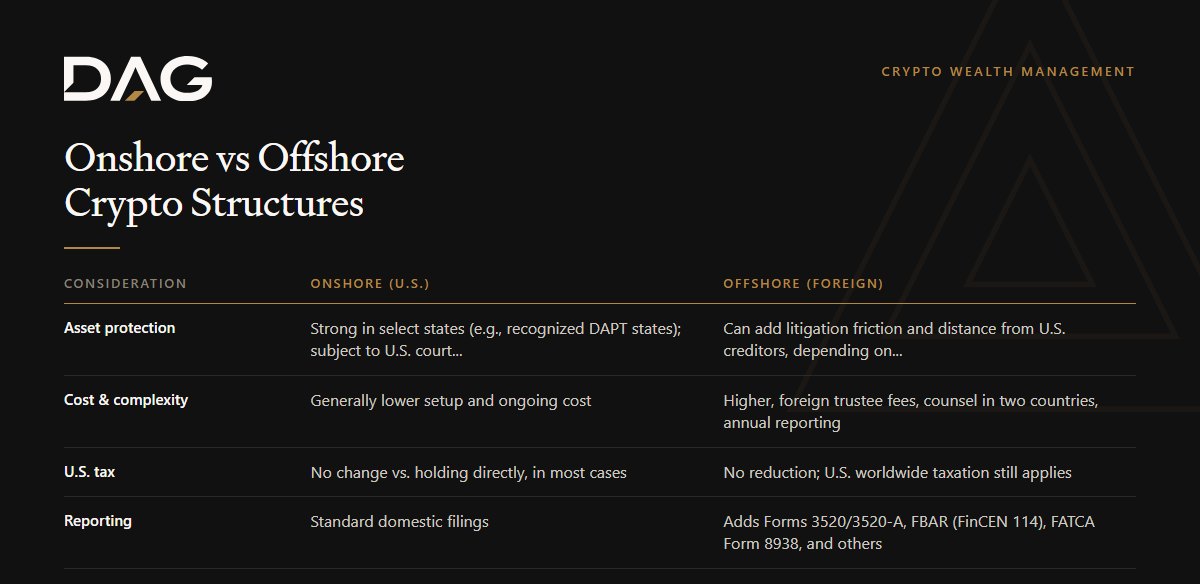
| Consideration | Onshore (U.S.) | Offshore (foreign) |
|---|---|---|
| Asset protection | Strong in select states (e.g., recognized DAPT states); subject to U.S. court jurisdiction | Can add litigation friction and distance from U.S. creditors, depending on jurisdiction and timing |
| Cost & complexity | Generally lower setup and ongoing cost | Higher, foreign trustee fees, counsel in two countries, annual reporting |
| U.S. tax | No change vs. holding directly, in most cases | No reduction; U.S. worldwide taxation still applies |
| Reporting | Standard domestic filings | Adds Forms 3520/3520-A, FBAR (FinCEN 114), FATCA Form 8938, and others |
| Familiarity | U.S. courts, custodians, and advisers understand it | Fewer U.S. professionals; coordination is harder |
The pattern that matters: offshore buys protection and distance, and pays for it with cost, complexity, and reporting. It does not buy tax savings or privacy from U.S. authorities.
Questions That Drive the Decision
Working through these usually narrows the choice before any structure is formed:
- What problem are you actually solving? Creditor protection, estate planning, jurisdictional diversification, and operational custody are different goals that point to different tools.
- Does a strong onshore option already solve it? A domestic asset-protection trust or a well-drafted LLC often achieves the protection goal at lower cost and complexity than going offshore.
- Can you carry the reporting? Offshore structures add mandatory U.S. filings with steep penalties for getting them wrong. Missing a Form 3520 or FBAR is costly.
- Is the timing clean? Transfers made after a claim arises can be challenged as fraudulent conveyance, onshore or offshore. Protection structures generally work only when set up well before trouble.
- What is the custody reality? Whoever controls the private keys controls the asset, regardless of what the structure says on paper. Custody and legal title must be reconciled.
What Offshore Does Not Do
Three myths worth retiring up front:
- It does not reduce U.S. income tax. U.S. persons owe tax on worldwide income. Offshore changes where assets are held, not what is owed.
- It does not make assets invisible. Foreign accounts and trusts are reportable, and the U.S. has information-sharing arrangements with many jurisdictions.
- It does not work as last-minute creditor defense. Moving assets ahead of a known claim can be unwound by a court.
For U.S. founders and residents abroad, GILTI rules and other anti-deferral regimes can also tax the earnings of foreign entities, another reason offshore is rarely a tax play. These are legal and tax questions for cross-border counsel.
Related Questions
Do offshore crypto structures lower my US taxes?
No. The United States taxes citizens and residents on worldwide income regardless of where assets are held. Offshore structures are used for asset protection and jurisdictional diversification, not tax reduction, and they add mandatory reporting (Forms 3520, FBAR, FATCA Form 8938). Confirm your obligations with a cross-border tax professional.
Is an onshore structure enough, or do I need offshore?
For many U.S. holders, a domestic structure such as a recognized asset-protection trust or a well-drafted LLC achieves the protection goal at lower cost and complexity. Offshore is generally considered only when a specific protection or diversification need is not met onshore, and the holder can carry the added reporting. This is a legal decision for qualified counsel.
Are offshore crypto structures legal?
Yes, offshore trusts, entities, and custody are legal for U.S. persons when used transparently and reported correctly. What is illegal is using them to hide assets or evade tax. The compliance burden, accurate filing of all required disclosures, is the price of using them properly.
Does the structure control the crypto, or does whoever holds the keys?
In practice, key control governs. A trust or LLC can hold legal title, but whoever can move the coins has effective control. Sound structures align legal title with a documented, controlled custody arrangement, which is why custody design is part of any onshore-vs-offshore decision.
If protection is the driver, compare the onshore options first: whether crypto should be held personally, in an LLC, or in a trust and trust structures for crypto wealthy individuals. For the cross-border picture and country-specific issues, see the international crypto wealth hub. And for where this sits overall, return to the crypto wealth management hub.
Sources
- IRS: Digital assets (irs.gov/filing/digital-assets)
- IRS: Foreign trust reporting, Forms 3520 and 3520-A, and their instructions
- FinCEN: Report of Foreign Bank and Financial Accounts (FBAR / FinCEN Form 114)
- IRS Form 8938, Statement of Specified Foreign Financial Assets, and its instructions
Compliance Note
This page is educational and is not legal, tax, or investment advice. Onshore and offshore structures carry significant legal, tax, and reporting consequences that depend entirely on your facts and on current law; penalties for misreporting foreign assets are severe. No structure removes U.S. tax liability or guarantees asset protection. These decisions require qualified cross-border legal and tax counsel. DAG coordinates with the client's own attorneys and tax professionals and does not provide legal or tax advice. Registration does not imply a certain level of skill or training.