
Borrowing against ETH lets you access liquidity without selling your position. You deposit ETH as collateral, receive cash or stablecoins, and pay interest until repayment. Your ETH stays in place, so you keep exposure to future price moves. The main trade-off is liquidation risk, which requires active management. For a broader look at how crypto lending and yield strategies compare, the hub covers the full range of borrowing and yield options available to digital asset holders.
ETH-backed loan (also called a crypto-collateralized loan) is a secured credit arrangement in which Ethereum serves as collateral. The lender holds or locks the ETH; you receive borrowed funds. Repay the loan and reclaim your collateral. If your collateral value falls below a set threshold, the platform liquidates the ETH to recover the debt.
How Do Loan-to-Value Ratios Work for ETH Loans?
Every platform sets a Loan-to-Value (LTV) ratio that caps borrowing relative to collateral value. At a 50% LTV, $1M in ETH supports up to $500K in borrowing.
The starting LTV is not the number that matters most. The liquidation threshold is. That is the LTV at which the platform begins selling your ETH automatically to recover the loan, and it is typically set above the starting LTV.
Example: A platform offers a 70% starting LTV with an 80% liquidation threshold. ETH drops 15%. Your collateral value shrinks, pushing effective LTV toward 80%. If it crosses the threshold, liquidation executes, automatically, often with little warning.
Experienced borrowers cap their effective LTV at 30–40% to maintain a meaningful buffer against volatile moves. Crypto markets can move 20% in a single day.
What Interest Rate Structures Apply to ETH-Backed Loans?
Crypto lending rates shift with supply and demand across the broader lending market. When borrowing demand spikes, rates rise; when liquidity is abundant, rates fall, especially on decentralized platforms.
| Rate Type | Trade-off |
|---|---|
| Fixed | Predictable payments for the loan's duration; typically higher starting rate than variable |
| Variable | Lower initial rate; total interest cost uncertain over long holds |
Fixed rates suit borrowers who plan to carry the loan for six or more months. Variable rates can work for short-duration liquidity needs where total interest exposure is limited.
Read fee structures carefully. Some platforms advertise a headline rate and embed origination fees, spread charges, or early repayment penalties elsewhere. The all-in cost, not the stated APR, is what you actually pay.
DeFi vs. CeFi: Which ETH Lending Platform Is Right for You?
These models are different enough to treat as separate products.
DeFi platforms (e.g., leading DeFi lending protocols) run on transparent, on-chain smart contracts. No intermediary makes judgment calls. In many structures, you retain key control throughout. Liquidations execute automatically according to protocol parameters, there is no customer service call to buy time if ETH drops sharply overnight. Users must be comfortable with wallet management, smart contract mechanics, and the risk of contract exploits.
CeFi platforms (e.g., centralized crypto lenders) operate closer to traditional secured lending. Onboarding is simpler, customer support exists, and repayment terms may be negotiable. The key trade-off is custodial risk: your ETH sits with the platform, not in your wallet. Counterparty exposure is real, and the failures of centralized crypto lenders in prior market cycles demonstrated that plainly.
Neither model is inherently superior. The right choice depends on how you weigh custody control, technical complexity, and rate efficiency against your own risk tolerance and operational capacity.
How Do You Manage Liquidation Risk on an ETH-Backed Loan?
Liquidation is the primary operational risk in ETH-backed borrowing. The mechanics: ETH price falls, collateral value drops, effective LTV rises, and if it hits the liquidation threshold, collateral is sold, often at a discount, to repay the loan. You may end the cycle with neither the loan proceeds nor your ETH position intact.
Liquidation risk management checklist:
- Borrow conservatively. Target 30–40% effective LTV, well below the starting LTV the platform offers. The further from the liquidation line, the more price movement you can absorb.
- Maintain a collateral buffer. Keep additional ETH accessible to top up if prices fall. Confirm whether the platform allows top-ups before liquidation triggers.
- Monitor positions actively. Set price alerts at your liquidation price. Crypto markets move outside business hours.
- Define an exit plan in advance. Decide the conditions under which you will repay, add collateral, or accept a loss, before a market event forces the decision.
What Should You Look for When Comparing ETH Lending Platforms?
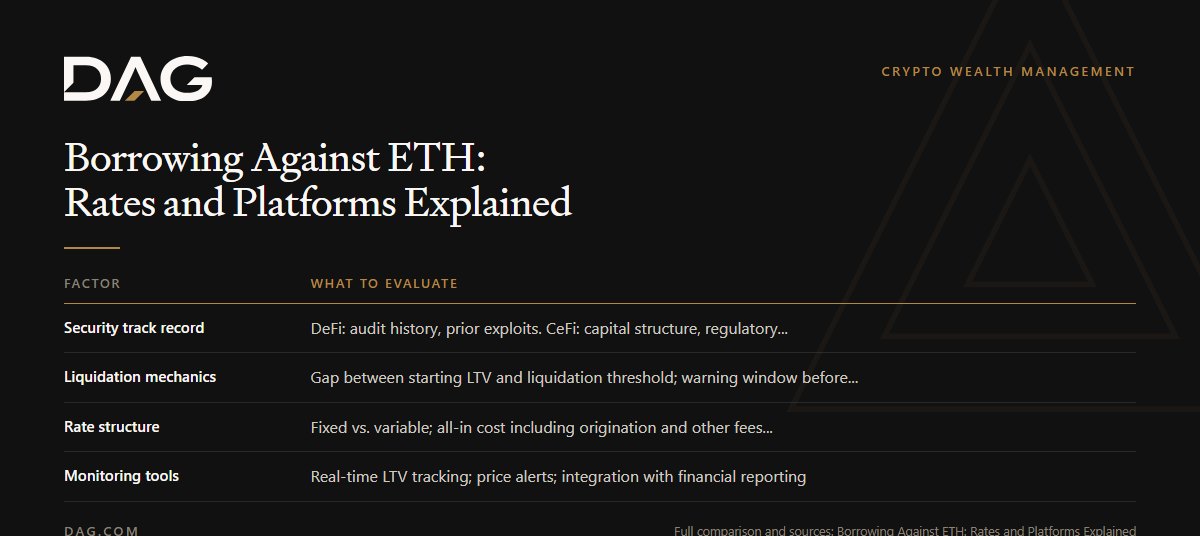
| Factor | What to Evaluate |
|---|---|
| Security track record | DeFi: audit history, prior exploits. CeFi: capital structure, regulatory standing, asset segregation |
| Liquidation mechanics | Gap between starting LTV and liquidation threshold; warning window before liquidation; execution speed |
| Rate structure | Fixed vs. variable; all-in cost including origination and other fees; historical rate behavior during volatile periods |
| Monitoring tools | Real-time LTV tracking; price alerts; integration with financial reporting |
How Does Borrowing Against ETH Affect Taxes?
The tax treatment of crypto-backed loans varies by jurisdiction and has not been resolved uniformly. In the United States, the IRS has not issued a definitive ruling specifically on whether taking a crypto-collateralized loan is itself a taxable event. The general position, not guaranteed, is that borrowing is not a realization event because you have not disposed of the asset. However, if the lender liquidates your collateral, that liquidation is generally treated as a taxable sale, potentially triggering capital gains.
Interest paid on a crypto-backed loan may or may not be deductible depending on how the loan proceeds are used and applicable limitations under the tax code. The treatment is fact-specific, so coordinate with a qualified tax professional familiar with digital asset reporting before borrowing.
See also: Crypto Tax Planning for HNW Investors and I Have Crypto Gains but No Cash for Taxes. What Now?
Where Does DAG Wealth Fit in an ETH Lending Strategy?
DAG Wealth evaluates whether borrowing against ETH fits within your overall portfolio, liquidity needs, and tax position, and coordinates platform onboarding, custody integration, and live LTV monitoring across active positions. Loan activity connects to broader financial reporting so positions are not managed in isolation.
Tax coordination with qualified professionals is part of the engagement. The tax picture around crypto-backed borrowing differs across jurisdictions, and working from assumptions rather than professional guidance carries real downside risk.
For the strategic evaluation, including whether the loan structure makes sense, what rate environment would justify borrowing, and how a loan interacts with your existing allocation, our overview of crypto-backed loans for high-net-worth investors covers ETH-backed lending in the context of larger crypto portfolios.
Related Questions
Is borrowing against ETH a taxable event?
Under the general U.S. tax position, taking a crypto-collateralized loan is not itself a taxable realization event, because you have not disposed of the asset. However, if the lender liquidates your collateral, that liquidation is generally treated as a taxable sale. State and international treatment varies. Consult a qualified tax professional before proceeding.
What LTV should I target when borrowing against ETH?
Most experienced borrowers target an effective LTV of 30–40%, well below the starting LTV platforms offer. This provides enough buffer to absorb significant price drops, potentially 30–40%, before approaching the liquidation threshold. Borrowing at the maximum offered LTV is high-risk given crypto's typical volatility.
What happens if ETH price drops and my loan gets liquidated?
If your collateral value falls to the liquidation threshold, the platform sells your ETH automatically to recover the outstanding loan balance. Depending on the platform's liquidation discount and fees, you may receive less than the remaining collateral value after repayment. You lose both the loan proceeds (if already spent) and your ETH position. Having a repayment or collateral top-up plan in place before a market event is essential.
Can I borrow against ETH using a trust or LLC?
Entities including LLCs and trusts can in some cases open accounts on CeFi lending platforms, though account eligibility, KYC requirements, and loan terms vary by platform. DeFi protocols are generally accessible to any wallet, including entity-controlled wallets. Entity ownership introduces additional structuring, custody, and tax coordination considerations. See Should Crypto Be Held Personally, in an LLC, or in a Trust? for the broader holding-structure question.
How does an ETH-backed loan compare to selling ETH?
Selling ETH is a permanent decision: you lock in today's price, trigger a taxable event, and surrender future upside. An ETH-backed loan preserves your position and defers the taxable event, but introduces interest cost, liquidation risk, and platform counterparty exposure. See Bitcoin-Backed Loan vs Selling Bitcoin for a parallel comparison on the Bitcoin side.
Sources
- IRS Notice 2014-21, https://www.irs.gov/pub/irs-drop/n-14-21.pdf (foundational crypto tax guidance; no specific ruling on collateralized loans)
- IRS Rev. Rul. 2023-14, https://www.irs.gov/pub/irs-drop/rr-23-14.pdf (staking rewards; cited for analogy to related treatment questions)
Compliance Note
This page is educational and does not constitute legal, tax, investment, or financial advice. Crypto-collateralized lending involves significant risks including liquidation of collateral, platform counterparty risk (CeFi), smart contract risk (DeFi), and uncertain or evolving tax treatment. Loan suitability depends on individual circumstances including risk tolerance, liquidity needs, portfolio composition, and tax situation. Any third-party platforms referenced here (such as DeFi lending protocols or centralized crypto lenders) are described only as illustrative examples of lending models and are not recommendations, endorsements, or an indication of any affiliation. Consult a qualified investment advisor, tax professional, and legal counsel before entering into any crypto-backed lending arrangement. Digital Ascension Group and its affiliated entities do not guarantee any outcome, rate, or tax result.