
Using crypto collateral for business loans means pledging digital assets as security to borrow cash or stablecoins without selling them, part of the broader crypto lending and yield landscape. Borrowing itself is generally not a taxable sale, but forced liquidation of that collateral is a taxable disposal. Volatility, margin-call risk, and lender counterparty risk are material concerns this page covers.
What Is a Crypto-Collateralized Business Loan?
Selling appreciated crypto to fund operations is a permanent decision: you lock in the current price, trigger a taxable event, and give up future upside on those tokens. For business owners with significant holdings and short-term liquidity needs, that trade-off often doesn't make sense.
A crypto-collateralized loan addresses the problem directly. You deposit crypto with the lender or into a custody arrangement the lender controls. Based on a percentage of that value, the Loan-to-Value ratio, the lender extends credit. You pay interest. When the loan is repaid, the collateral is returned and you retain the position.
The complications are in execution. This page walks through mechanics, liquidation risk, rehypothecation, lender evaluation criteria, and the tax picture.
How Does Loan-to-Value (LTV) Work for Crypto Loans?
LTV governs two things: how much you can borrow and when liquidation occurs.
Borrowing capacity: If you pledge $500,000 in BTC at a 50% LTV, you can borrow up to $250,000. At 65% LTV, up to $325,000. The ratio a lender offers depends on the asset, their risk model, and current market conditions. These figures are illustrative only, actual LTV offerings vary and change with market conditions; verify current terms directly with any lender before committing.
Liquidation trigger: LTV isn't static. If the price of your collateral drops, your effective LTV rises. Once it crosses the lender's threshold, they have the right to sell your collateral to recover the loan. How quickly that happens, and whether they notify you first, varies significantly by lender. Some provide a window to post additional collateral (a margin call). Others liquidate automatically.
Crypto prices can swing sharply over short periods, and a double-digit move in a single week is not unusual. A borrower at a high LTV has very little cushion before the liquidation threshold becomes live. Conservative borrowers generally target 40–50% LTV or below to preserve meaningful buffer. This is not a guarantee against liquidation, it reduces, but does not eliminate, the risk.
How to Structure a Crypto-Collateralized Loan (Step-by-Step)
- Assess your holdings and liquidity need. Determine how much you need to borrow and what collateral you're willing to pledge. Do not pledge holdings you cannot afford to lose if liquidated.
- Calculate your target LTV. Divide intended loan amount by current collateral value. Build in enough buffer for a significant price drop without hitting the liquidation threshold.
- Vet lenders. Evaluate custody arrangement, rehypothecation policy, interest rate structure, liquidation policy, and counterparty stability (see below).
- Review and negotiate loan terms. Confirm: LTV at origination, liquidation threshold, margin call window (if any), price oracle used, and any origination or prepayment fees.
- Pledge collateral and receive funds. Confirm the custody arrangement in writing before transferring assets.
- Monitor collateral value actively. Set price alerts. Know your liquidation price before you borrow, not after.
- Repay the loan and recover collateral. Confirm your collateral was held in segregated custody and is returned intact.
What Is Rehypothecation and Why Does It Matter?
When you pledge crypto as collateral, the lender takes custody of those assets. Some lenders treat pledged collateral as theirs to deploy, lending it to other parties, using it for trading, or pledging it against their own borrowing. This is rehypothecation.
The risk surfaces when the lender encounters difficulty. If they've rehypothecated your collateral and cannot recover it because their counterparties failed, your assets may not be present when you repay the loan. This is not hypothetical: several centralized crypto lenders that failed during the 2022–2023 market stress had rehypothecated significant portions of client collateral, and recovery for affected clients was complicated and slow.
Before signing with any lender, get direct answers to three questions:
- Is my collateral held in a segregated account or pooled with other clients?
- Does the lending agreement permit rehypothecation?
- Who is the custodian, and who actually controls the keys?
If a lender is vague about any of those, that vagueness is the answer.
How to Evaluate a Crypto Lender
Not all crypto lenders carry the same risk profile, and the differences matter more than the headline interest rate. See also crypto custody due diligence checklist and questions to ask a crypto custodian for related frameworks.
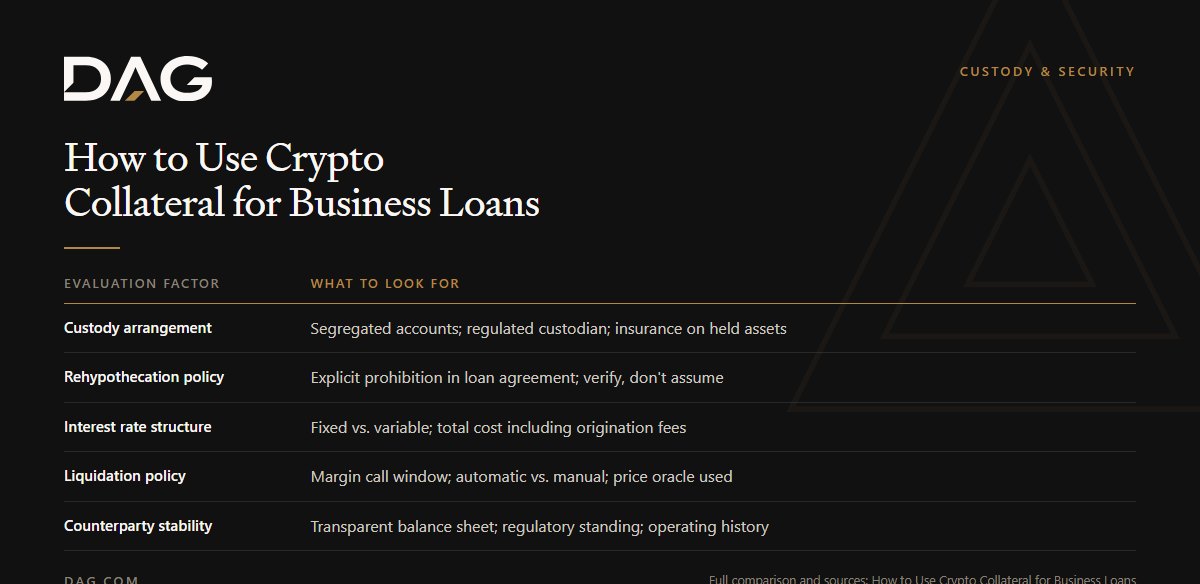
| Evaluation Factor | What to Look For |
|---|---|
| Custody arrangement | Segregated accounts; regulated custodian; insurance on held assets |
| Rehypothecation policy | Explicit prohibition in loan agreement; verify, don't assume |
| Interest rate structure | Fixed vs. variable; total cost including origination fees |
| Liquidation policy | Margin call window; automatic vs. manual; price oracle used |
| Counterparty stability | Transparent balance sheet; regulatory standing; operating history |
Established lenders with transparent balance sheets and regulatory standing generally carry lower counterparty risk than newer entrants with aggressive rate offers. No lender selection eliminates counterparty risk, it only changes the magnitude.
What Is the Tax Treatment of Crypto-Backed Loans?
Borrowing against crypto is generally not a taxable event. You are not selling. Loan proceeds are debt, not income or a capital gain. This is the primary reason the structure exists: it allows access to the economic value of appreciated holdings without crystallizing a gain.
The wrinkle: if your collateral is liquidated, that liquidation is a disposal and is taxable. The fact that you did not choose to sell is irrelevant to tax treatment. The liquidation triggers a capital gain or loss based on your original cost basis and the price at the time of liquidation.
Tax law in this area continues to evolve, and your specific situation, jurisdiction, entity structure, holding period, affects the outcome. See crypto tax planning for HNW investors and what should I do after a large crypto gain for related context. Consult a qualified tax professional before committing to a structure.
DAG coordinates with qualified tax professionals to help clients understand how crypto-collateralized borrowing interacts with their specific tax situation.
How DAG Wealth Fits In
Whether a crypto-collateralized loan makes sense for your business, how much to borrow relative to your overall holdings, and how this interacts with your investment strategy are questions that require a review of your full financial picture.
DAG Wealth handles the operational side: lender due diligence, custody arrangement review, rehypothecation policy assessment, and coordinating documentation and onboarding through DAG. Loan documentation and entity-level structuring are legal matters; DAG coordinates with qualified attorneys and does not provide legal advice.
Advisory services are provided by DAG Wealth, an SEC-registered investment adviser. Registration does not imply a certain level of skill or training.
For more on the custody framework underlying collateral arrangements, see crypto custody options compared and what is institutional crypto custody. For the broader borrowing decision, see crypto-backed loans for high-net-worth investors and bitcoin-backed loan vs selling bitcoin.
Related Questions
Can I use Ethereum or altcoins as collateral, or only Bitcoin?
Most institutional lenders accept BTC and ETH as collateral; some accept a broader set of large-cap assets. Acceptance and LTV ratios vary by lender and asset. Smaller or more volatile assets typically receive lower LTV offers or are not accepted. Verify directly with any lender you are evaluating.
What happens to my collateral if the lender goes bankrupt?
If the lender holds your collateral in a segregated, clearly titled account with a regulated custodian, your claim is generally cleaner than if assets were commingled. However, bankruptcy proceedings are complex, and recovery is not guaranteed. This is why the rehypothecation and custody questions matter before you sign, not after. No crypto lending arrangement carries FDIC or SIPC protection.
Does borrowing against crypto affect my credit score?
Crypto-collateralized loans are typically not reported to consumer credit bureaus because they are secured by digital assets rather than evaluated on creditworthiness. This means they generally do not affect or build credit history. Confirm with the specific lender whether they report to any bureau or make inquiries.
Can I pay business expenses directly from a crypto loan?
Most lenders disburse loan proceeds as fiat (USD) or stablecoins. Once received, proceeds can generally be used for business expenses like any other working capital. Consult your tax professional regarding how loan proceeds are classified if used within a specific entity structure (LLC, S-corp, etc.) and whether interest is deductible.
Sources
- IRS Notice 2014-21 (cryptocurrency as property): https://www.irs.gov/pub/irs-drop/n-14-21.pdf
- IRS Revenue Ruling 2023-14 (staking income): https://www.irs.gov/pub/irs-drop/rr-23-14.pdf
- IRS FAQ on Virtual Currency Transactions: https://www.irs.gov/individuals/international-taxpayers/frequently-asked-questions-on-virtual-currency-transactions
- SEC, "SEC Proposes Enhanced Safeguarding Rule for Registered Investment Advisers" (Feb. 15, 2023), addressing custody of client assets including crypto: https://www.sec.gov/newsroom/press-releases/2023-30
Compliance Note
This page is for educational purposes only and does not constitute legal, tax, investment, or financial advice. Crypto-collateralized loans carry material risks including but not limited to: forced liquidation from price volatility, variable or rising interest rates, counterparty failure, rehypothecation of pledged assets, and total loss of collateral. Borrowing proceeds are generally not taxable, but liquidation of collateral is a taxable disposal under current IRS guidance, consult a qualified tax professional regarding your specific situation. Crypto assets held with a lender are not protected by FDIC or SIPC insurance. LTV ratios, rates, and liquidation thresholds used in examples are illustrative and subject to change; verify current terms directly with any lender. Nothing here constitutes a guarantee of approval, rate, or outcome. Consult a qualified legal, tax, and financial professional before entering any borrowing arrangement.