
Crypto exit strategy planning means deciding in advance how to reduce a digital asset position, setting staged liquidity targets, coordinating pre-sale tax, and upgrading crypto custody, so choices are made calmly, not under pressure. Selling cryptocurrency is a taxable event in the U.S. This is educational content, not investment, tax, or legal advice.
What Is a Crypto Exit Strategy?
A crypto exit strategy is a written plan that specifies the conditions (price levels, calendar dates, or portfolio-weight thresholds) under which you will reduce or liquidate a digital asset position, along with the execution method, custody configuration, and tax coordination steps required to do so.
Having a plan in place before high-volatility periods is the operational foundation of crypto wealth planning for bitcoin millionaires. Without one, decision-making defaults to real-time emotion.
Why Emotional Decision-Making Destroys Gains
The common failure pattern: a position rises sharply, the holder waits for a higher price, the market reverses, panic sets in, and the position is eventually sold at breakeven or a loss. This is not a rare edge case, it is the default outcome for investors who have no pre-committed exit conditions.
The difference between investors who preserve gains and those who give them back is documented discipline, not superior timing.
How to Build a Crypto Exit Strategy
Step 1. Define your targets in writing
Set specific, measurable exit conditions before market conditions are favorable. Two common frameworks:
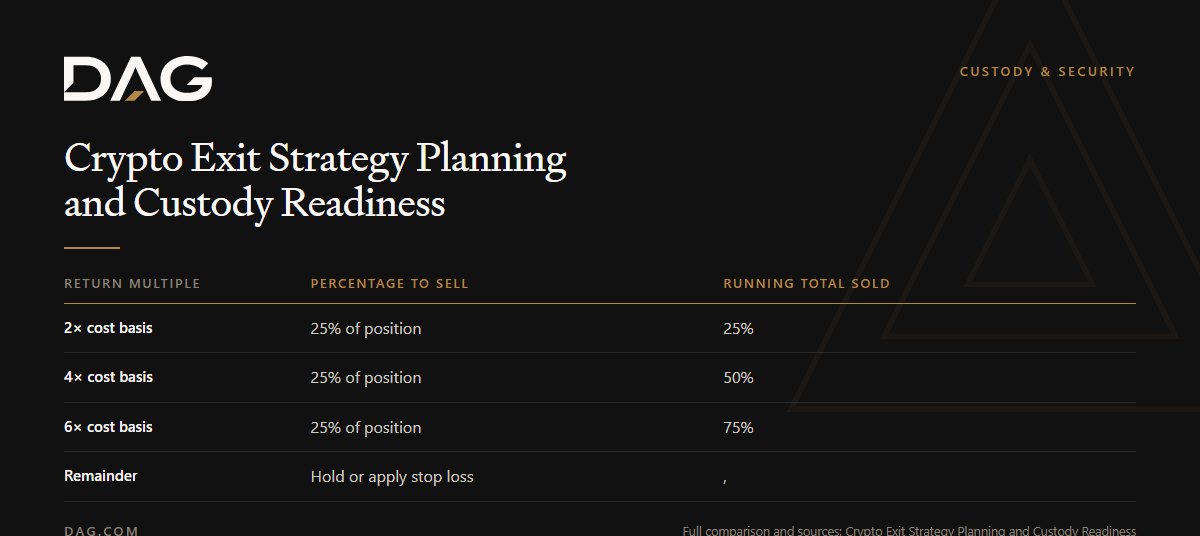
Price-based exits: Establish a tiered sell schedule tied to return multiples from your cost basis. For example:
| Return multiple | Percentage to sell | Running total sold |
|---|---|---|
| 2× cost basis | 25% of position | 25% |
| 4× cost basis | 25% of position | 50% |
| 6× cost basis | 25% of position | 75% |
| Remainder | Hold or apply stop loss | , |
This forces partial liquidation on the way up. If the market continues higher, you retain exposure. If it reverses, you have already realized a portion of gains.
Time-based exits: Sell a fixed percentage each calendar period regardless of price, for example, 10% per month over six months. This removes the requirement to forecast a peak. The two approaches can be combined: sell on a schedule, but accelerate if a price target is reached first.
Step 2. Coordinate tax planning before any sale
Selling cryptocurrency is a taxable event. Under current U.S. law, short-term capital gains (assets held one year or less) are generally taxed at ordinary income rates, while long-term gains (held more than one year) generally receive preferential rates. Rates are subject to change; verify current rates at IRS.gov. The distinction matters materially for large positions.
Pre-sale tax coordination should cover:
- Cost basis across all wallets and exchanges (see crypto cost basis cleanup for HNW investors)
- Short-term vs. long-term holding periods for each lot
- Which legal entity (personal, trust, or LLC) should realize the gain
- Estimated tax liability and whether quarterly estimated payments are required (see crypto estimated tax planning)
- Cash reserve sufficient to cover the tax bill, do not assume gains can be reinvested in full
DAG coordinates with qualified tax professionals. Do not execute large sales without completing this step first.
Step 3. Upgrade custody before balances spike
A custody configuration adequate at lower portfolio values may be inadequate at substantially higher values. Security incidents, exchange compromises, phishing attempts, SIM-swap attacks, and social-engineering schemes, increase in frequency during high-media-attention market conditions, precisely when holders are most likely to be moving funds quickly.
Assess whether your current setup is appropriate given a materially higher portfolio value. See the crypto custody decision tree for a structured evaluation framework.
Institutional custody options for holders with six- or seven-figure balances may include:
- Cold storage with institutional-grade key management protocols
- Multi-signature configurations requiring multiple approvals to authorize transfers
- Regulated custodians with insurance coverage (coverage scope varies; verify policy terms with the custodian)
- Compliance infrastructure: documentation, reporting, and audit trails
These services involve cost. The relevant comparison is cost vs. the risk of total or partial loss from a security failure.
For a practical comparison, see qualified custody vs. self-custody for crypto wealth and cold storage vs. qualified custody.
Two-tier custody split: One approach is to keep a smaller liquid allocation (illustratively 10–20% of holdings) in more accessible wallets or exchange accounts for active use, while securing the bulk of holdings in cold storage or institutional custody. This limits the attack surface for the portion most exposed to online threats.
Step 4. Choose execution methods for large positions
Retail exchange market orders are not designed for large positions. Two alternatives used by institutional-scale sellers:
OTC desks: Over-the-counter desks execute large trades privately and off the public order book, reducing price impact and slippage. Settlement terms are negotiable. Major exchanges and specialized firms operate OTC desks; they are generally designed for trades above a minimum threshold (thresholds vary by provider; verify current minimums directly).
Algorithmic execution: Time-weighted average price (TWAP) and similar tools execute a large order in smaller tranches over a defined period, smoothing execution price without requiring manual intervention at each step.
Step 5. Document everything
All transactions require accurate records for tax reporting. Maintain:
- Cost basis and acquisition date for each lot
- Complete transaction history across all exchanges and wallets
- Wallet addresses used
- Records of any entity-level transactions
See crypto tax records checklist for a full documentation framework.
Step 6. Review the plan on a defined schedule
Markets and personal circumstances change. Review exit conditions, tax situation, and custody configuration on a defined schedule (quarterly is common), but make changes methodically rather than reactively during high-volatility periods.
Common Mistakes in Exit Planning
Waiting for the peak. No one consistently identifies market tops. Staged exits on the way up remove the dependency on perfect timing.
Selling before calculating tax liability. A large realized gain generates a tax bill due in the same tax year. Failing to reserve cash for that liability is a predictable and expensive mistake.
Concentrating holdings in one place. An exchange account freeze, hack, or insolvency event can interrupt access to funds at exactly the moment you need to act. Diversifying custody locations reduces single-point-of-failure risk. See what should I do if my crypto exchange freezes my account.
No written plan. Verbal intentions do not survive periods of extreme market movement. The plan must be written and specific.
Ignoring security as values increase. Custody that was adequate at one portfolio value level may be inadequate at 5× or 10× that value.
How DAG Wealth and Digital Ascension Group Work Together
Investment strategy decisions, when to exit, how to allocate across asset classes, and portfolio positioning, are provided by DAG Wealth, an SEC-registered investment adviser.
DAG coordinates the operational side: custody configuration, platform access, tax professional coordination, and execution logistics. Entity formation and trust or estate structuring are legal services. DAG coordinates with qualified attorneys and does not provide legal advice.
Investment advice comes from DAG Wealth. Registration does not imply a certain level of skill or training. Operational coordination runs through DAG Wealth.
Related Questions
Does selling cryptocurrency trigger a tax event even if I reinvest the proceeds?
Yes. Under current IRS guidance, selling, exchanging, or otherwise disposing of cryptocurrency is a taxable event regardless of what is done with the proceeds. The gain or loss is calculated against your cost basis, and reinvesting does not defer the tax. Guidance can change; confirm current rules at IRS.gov or with a qualified CPA.
What is the difference between short-term and long-term crypto capital gains?
Assets held for one year or less before sale generate short-term capital gains, taxed at ordinary income rates. Assets held for more than one year generate long-term capital gains, generally taxed at lower preferential rates (commonly 0%, 15%, or 20% for most taxpayers under current law; rates are subject to change, verify current rates at IRS.gov). Holding period tracking matters significantly for tax planning on large positions.
When should I move from self-custody to institutional custody?
There is no universal threshold, but common triggers include: portfolio value reaching a level where a single security failure would be financially catastrophic, requiring multi-party authorization for asset movements, operating within a trust or LLC structure that requires audit documentation, or delegating custody decisions to a fiduciary. See how do I move from self-custody to qualified custody for a structured process.
What happens if I cannot identify my cost basis before selling?
Absent documented cost basis, the IRS may default to a $0 basis, resulting in the full sale proceeds being treated as gain. Cost basis reconstruction is possible in many cases but requires transaction records. See how to reconstruct crypto cost basis and what if I cannot prove my crypto cost basis.
Sources
- IRS, Virtual Currencies, https://www.irs.gov/businesses/small-businesses-self-employed/virtual-currencies (guidance on taxable events and cost basis; verify current guidance)
- IRS, Topic No. 409. Capital Gains and Losses, https://www.irs.gov/taxtopics/tc409 (short-term vs. long-term rates; verify current rates)
- SEC, Custody of Digital Asset Securities by Special Purpose Broker-Dealers, Release No. 34-90788 (custody standards framework)
Compliance Note
This page is educational only and does not constitute investment, tax, legal, or financial advice. Cryptocurrency markets are volatile and speculative; past performance does not predict future results. Selling digital assets is a taxable event under current U.S. tax law; consult a qualified tax professional before executing any sale. Custody insurance coverage varies by provider and may not cover all loss scenarios; verify policy terms directly with any custodian. Nothing on this page constitutes a prediction of future market conditions or a recommendation to buy, sell, or hold any digital asset. DAG coordinates operational services and does not provide legal advice; investment advisory services are provided by DAG Wealth, an SEC-registered investment adviser. Registration does not imply a certain level of skill or training. Consult qualified legal, tax, and investment professionals for guidance specific to your situation.