
To cash out large crypto without moving the market, route the trade through an OTC (over-the-counter) desk, stage the exit across venues over time, and plan before urgency forces a single lump-sum sale. Structure can reduce slippage, but each sale is a taxable event requiring separate planning with a qualified professional. Large exits are a core topic within crypto wealth management for high-net-worth holders.
What Is an OTC Desk and Why Do Large Sellers Use One?
An OTC desk executes trades directly between parties, off a public exchange's order book. When a large sell order hits a public exchange, every participant watching the order book sees the pressure coming and prices move against the seller before execution finishes. OTC desks route the transaction privately, typically to institutional buyers, hedge funds, or family offices willing to negotiate size, so the market does not react in real time.
OTC desks can generally handle nine-figure transactions. They locate counterparties, coordinate settlement, and manage custody transfers. Pricing is typically negotiated in advance based on an index price or volume-weighted average (VWAP), not a live order book, which means the seller is executing a structured transaction rather than chasing fills on a screen.
How Do You Execute a Large Crypto Sale Without Slippage?
Slippage is the difference between the price you expected and the price you received, caused by market movement during execution. Three techniques reduce it for large positions:
- Use OTC desks for block trades. A block trade happens off-exchange and does not print to the public order book. Settlement may take T+1 or longer; confirm settlement mechanics with the desk before executing.
- Stage the exit over time. Divide the total position into tranches executed over days or weeks. If the market drops after the first tranche, you can pause. If it rallies, the remaining position benefits. Spreading reduces concentration of timing risk in a single moment.
- Distribute across venues. Different OTC desks have different liquidity pools. For very large positions, splitting execution, for example, a portion through one OTC desk, a portion through another, and a portion through an institutional venue, diversifies execution risk and may produce better blended pricing. No specific allocation percentages are guaranteed to be optimal; the right split depends on the asset, market depth, and your timeline.
A related technique for algorithmic execution is TWAP (time-weighted average price): breaking the order into smaller pieces executed at regular intervals to approximate the average price over a period, rather than transacting all at once. TWAP is more commonly used on institutional trading platforms than through retail venues.
Execution Comparison
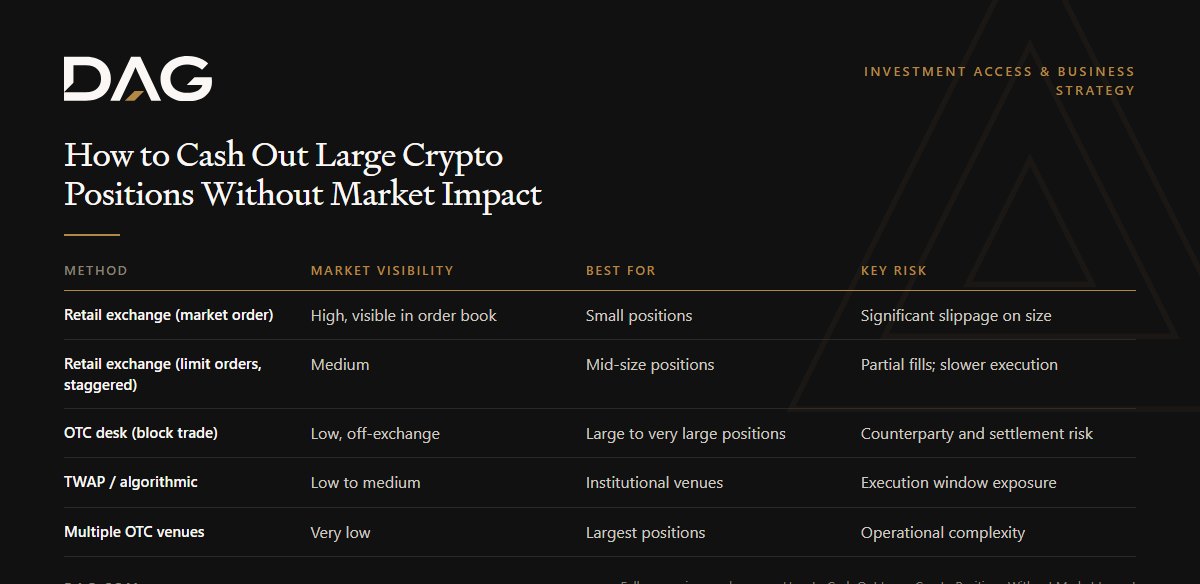
| Method | Market Visibility | Best For | Key Risk |
|---|---|---|---|
| Retail exchange (market order) | High, visible in order book | Small positions | Significant slippage on size |
| Retail exchange (limit orders, staggered) | Medium | Mid-size positions | Partial fills; slower execution |
| OTC desk (block trade) | Low, off-exchange | Large to very large positions | Counterparty and settlement risk |
| TWAP / algorithmic | Low to medium | Institutional venues | Execution window exposure |
| Multiple OTC venues | Very low | Largest positions | Operational complexity |
What Are the Tax Consequences of Selling Crypto?
Selling cryptocurrency is a taxable event under current IRS guidance. The gain or loss is the difference between your cost basis (what you paid, including fees) and your proceeds. Gains held longer than one year may qualify for long-term capital gains rates; gains on positions held one year or less are taxed as ordinary income. State taxes apply separately and vary by jurisdiction.
Staging a sale across multiple tranches or tax years does not eliminate the tax, it distributes when you recognize it. Specific identification of lots (HIFO, LIFO, FIFO, or specific lot ID) affects which gains you recognize. Working with a qualified tax professional before executing is essential; do not rely on this page for tax advice.
One alternative to selling is a crypto-backed loan for high-net-worth investors: borrowing against the position provides liquidity without triggering a taxable sale. The asset remains in your estate; if held until death, heirs may receive a stepped-up cost basis (verify current tax law with a qualified attorney, as rules can change). Collateralized loans carry their own risks, margin calls, liquidation triggers, and interest costs, which must be weighed against the tax deferral benefit.
For a broader view of what to do after a large gain, see what should I do after a large crypto gain? and crypto tax planning for HNW investors.
When Should You Start Planning a Large Crypto Exit?
Before you need the liquidity. Once urgency forces the sale, your structural options narrow, you take the price and execution quality the market provides rather than choosing among alternatives.
Planning in advance lets you:
- Establish OTC desk relationships before they are needed (most desks require KYC/AML onboarding, which takes time)
- Evaluate tax timing, which tax year to recognize gains, whether loss harvesting elsewhere offsets some liability
- Determine whether a collateralized loan addresses short-term cash needs without a full sale
- Coordinate the exit with estate and entity structure, particularly if the position is held in a trust, LLC, or other entity
For complex positions, crypto alongside traditional assets, multiple entities, or multi-generational planning, the liquidity decision affects far more than the sale itself. A crypto wealth management framework should account for how a large exit changes the overall portfolio, tax profile, and estate position.
DAG provides wealth management and investment advisory services under a fiduciary standard, including coordination of digital asset strategies with traditional portfolios. For business owners and families where crypto is one component of a larger financial picture, DAG offers digital asset family office services, multi-generational planning, plus coordination of estate and tax strategy with the qualified attorneys and tax professionals who provide those legal and tax services. DAG coordinates, but does not itself provide legal or tax advice, and oversees how liquidity decisions interact with the rest of the financial structure.
Related Questions
Can I sell large amounts of crypto without using an OTC desk?
Yes, but the alternatives carry higher execution risk at scale. Staggered limit orders on institutional-grade exchanges reduce single-moment slippage but leave the order visible in the book and may execute slowly. For positions above a few million dollars, OTC desks generally provide better execution quality. See can a family office use an institutional custody platform? for more on institutional venue options.
Does selling through an OTC desk affect my tax reporting?
No, the method of sale does not change the tax treatment. A sale is a sale regardless of venue. You still recognize a capital gain or loss based on cost basis and proceeds. Some OTC desks issue 1099s; others may not, depending on their structure and your jurisdiction. Keep complete records of all transactions regardless of whether a 1099 is issued. See how do I report crypto from multiple exchanges?
What is the minimum position size that warrants OTC execution?
There is no universal threshold. As a practical matter, OTC desks target clients with meaningful position size, often starting at $250,000 or more per transaction, with some desks focused on $1 million or above (verify minimums directly with any desk, as these vary and change). Below those levels, staged limit orders on institutional venues may be sufficient. The right answer depends on the asset's liquidity profile, not just the dollar amount.
How does crypto-backed borrowing compare to selling as a liquidity strategy?
A bitcoin-backed loan vs. selling bitcoin comparison covers this in detail. The short version: a loan avoids the taxable event and preserves upside, but introduces liquidation risk if the collateral drops in value. It is a deferral strategy, not a permanent tax solution, you still owe tax when you eventually sell.
Sources
- IRS Notice 2014-21 (virtual currency treated as property for federal tax purposes): https://www.irs.gov/pub/irs-drop/n-14-21.pdf
- IRS Revenue Ruling 2023-14 (staking rewards): https://www.irs.gov/pub/irs-drop/rr-23-14.pdf
- IRS Publication 544 (Sales and Other Dispositions of Assets): https://www.irs.gov/publications/p544
- SEC Division of Corporation Finance, statement on accounting for and custodying digital assets: https://www.sec.gov/corpfin/staff-statement-accounting-custodying-digital-assets
- CFTC Primer on Virtual Currencies (background on OTC crypto markets): https://www.cftc.gov/sites/default/files/idc/groups/public/@customerprotection/documents/file/labcftc_primercurrencies100417.pdf
Compliance Note
This page is for educational purposes only and does not constitute investment, tax, or legal advice. Large crypto exits involve material market, execution, tax, and counterparty risks. Past execution quality through any venue or strategy does not guarantee future results. Selling cryptocurrency is a taxable event under current IRS guidance; consult a qualified tax professional before executing. Nothing on this page constitutes a recommendation to buy, sell, or hold any specific asset. Figures, thresholds, and desk minimums mentioned are illustrative and should be verified directly with any service provider before transacting. There are no guarantees regarding execution price, slippage, or settlement outcomes through any OTC desk, venue, or strategy. DAG Wealth does not provide tax or legal advice; entity formation, trust and estate drafting, and similar work are legal services that DAG coordinates with qualified attorneys and tax professionals who provide them. Advisory services are provided by DAG Wealth, an SEC-registered investment adviser. Registration does not imply a certain level of skill or training.