
XRP and XLM AMM liquidity pools on a DEX let token holders deposit paired assets into a decentralized exchange protocol and earn a share of trading fees. They carry material risks, including impermanent loss and smart-contract exploits, and no return is guaranteed. For the broader planning context around holding and deploying digital assets, see the crypto wealth management hub. This is educational content, not investment, tax, or legal advice.
What Is an AMM Liquidity Pool on the XRPL or Stellar DEX?
An AMM pool holds two tokens in fixed proportion. Depositors contribute equal-value amounts of both tokens and receive a liquidity token as proof of their share. When traders swap through the pool, an automated pricing formula rebalances the reserves, no order book, no human market maker. Trading fees generated by each swap are distributed to liquidity providers proportionally.
On the XRP Ledger (XRPL) and Stellar network, transaction costs are low relative to Ethereum-based protocols, which reduces the drag on smaller deposits. The underlying mechanics are the same as other AMM implementations.
How Does Providing Liquidity Actually Work?
Step-by-step: entering a pool
- Choose a trading pair. Select two tokens you are willing to hold simultaneously (e.g., XRP/USDC or XLM/USDC).
- Acquire equal values of both tokens. The pool requires a balanced deposit at the current exchange rate.
- Connect a compatible, non-custodial wallet to the DEX interface. Use only bookmarked, official sites, phishing replicas are common.
- Deposit into the pool. The protocol issues liquidity tokens representing your proportional share.
- Monitor the position. Fee income accrues continuously; pool ratios shift as trading occurs.
- Withdraw when ready. Return the liquidity tokens to retrieve your share of the pool, plus fees earned, minus any impermanent loss realized at withdrawal time.
Withdrawing while price ratios are significantly displaced from your entry point converts paper impermanent loss into a permanent shortfall. Timing withdrawal matters.
What Is Impermanent Loss and Why Does It Matter?
Impermanent loss is the gap between the value of your deposited tokens if you had simply held them versus their value inside the pool when you withdraw.
When one token's price rises significantly against the other, the AMM formula continuously sells the appreciating token to maintain balance. You end up holding more of the lagging token and less of the winning one. Fee income can partially offset this, but in high-volatility pairs, impermanent loss can exceed all fees earned.
The loss is "impermanent" only if prices fully revert before you withdraw. In practice, prices rarely revert exactly, so the loss can become permanent.
Pairs most exposed: two volatile assets with uncorrelated price movements (e.g., XRP/altcoin). Pairs least exposed: stablecoin/stablecoin, or stablecoin paired with a large-cap token in a range-bound market.
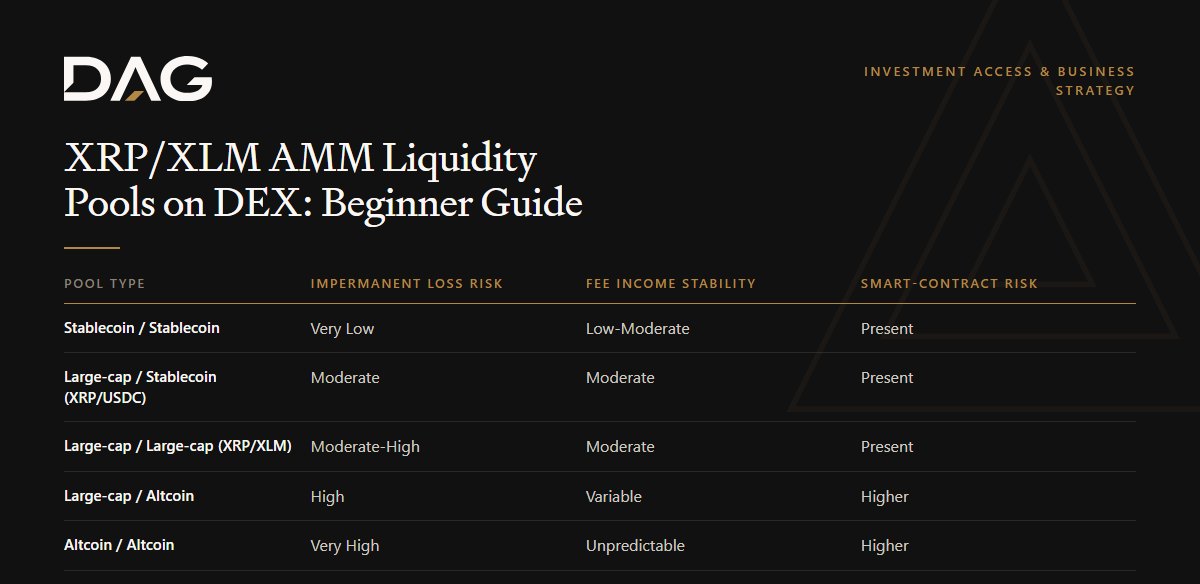
Risk Comparison: Pool Types
| Pool Type | Impermanent Loss Risk | Fee Income Stability | Smart-Contract Risk |
|---|---|---|---|
| Stablecoin / Stablecoin | Very Low | Low-Moderate | Present |
| Large-cap / Stablecoin (XRP/USDC) | Moderate | Moderate | Present |
| Large-cap / Large-cap (XRP/XLM) | Moderate-High | Moderate | Present |
| Large-cap / Altcoin | High | Variable | Higher |
| Altcoin / Altcoin | Very High | Unpredictable | Higher |
Smart-contract risk is present in every pool. Protocol bugs, front-end exploits, and fraudulent interfaces have drained liquidity pools across multiple chains. No pool is immune.
How Are Liquidity Pool Fees Taxed?
As of 2026, the IRS has not issued AMM-pool-specific guidance. The prevailing practitioner analysis, drawing on the agency's treatment of on-chain rewards in Revenue Ruling 2023-14, generally treats fee income as ordinary income in the year it is received, similar to other crypto yield. This is interpretive, not an explicit IRS ruling on liquidity-pool fees. Depositing and withdrawing tokens may each constitute taxable dispositions depending on how the transaction is structured. Tax treatment can vary based on entity type, holding periods, and how the protocol functions, and rules may change.
Fee income from AMM pools is generally not treated as capital gain. Consult a qualified crypto tax professional before participating, particularly for meaningful position sizes. See crypto staking tax reporting for parallel IRS treatment of on-chain yield, and crypto tax planning for HNW investors for broader planning context.
How Do You Evaluate a Pool Before Depositing?
Volume is the primary signal. Fee income scales directly with swap volume. A pool with minimal trading activity generates near-zero income while carrying full price and smart-contract risk.
Pool depth reduces slippage and exit risk. Shallow pools are more susceptible to large swings when a single participant exits. Check total value locked (TVL) before committing.
Ignore headline APY figures. Displayed APY numbers are calculated from recent fee rates extrapolated forward, they are not guaranteed and often reflect brief volume spikes. High APY without sustained volume is not a reliable income signal.
Verify the protocol's track record. Audited code, incident history, and team transparency matter. New or unaudited protocols carry higher smart-contract risk.
For broader evaluation frameworks, see crypto concentration risk management and crypto diversification strategy.
Wallet Security Checklist
- Use only official, bookmarked DEX interfaces, fake sites are visually identical.
- Never share private keys or seed phrases. Store seed phrases in physical, offline form only.
- Avoid connecting wallets to applications promoted through social media without independent verification.
- Revoke smart-contract approvals after use where the protocol allows it.
- Treat each new protocol connection as a new risk exposure.
See seed phrase storage for estate planning and hardware wallet estate planning for custody and continuity planning.
Related Questions
Can a trust or LLC participate in AMM liquidity pools?
Technically possible on permissionless protocols, but legal and fiduciary questions apply. A trustee participating in DeFi on behalf of a trust may face liability for speculative activity. See can a trust participate in DeFi and can a crypto LLC participate in DeFi for structure-specific analysis.
Does providing liquidity count as trading for tax purposes?
Depositing tokens into a pool and receiving liquidity tokens in exchange may constitute a taxable swap depending on protocol structure. Withdrawing and receiving a different ratio of tokens back may also trigger recognition. The IRS treats each disposition of crypto as potentially taxable. Track every entry and exit with cost basis documentation, see common crypto tax record mistakes.
What happens to my liquidity if the DEX is hacked or the protocol shuts down?
Smart-contract exploits have resulted in complete loss of pool assets on multiple protocols. There is no SIPC or FDIC equivalent for DEX liquidity. Protocol insurance products exist but are themselves subject to counterparty and coverage limitations. Position sizing relative to total crypto wealth is the primary risk control available to individual participants.
Sources
- Stellar Development Foundation. Liquidity pools on the Stellar DEX: https://developers.stellar.org/docs/learn/fundamentals/liquidity-on-stellar-sdex-liquidity-pools
- IRS Notice 2014-21. Virtual currency tax treatment: https://www.irs.gov/pub/irs-drop/n-14-21.pdf
- IRS Revenue Ruling 2023-14. Staking reward income recognition: https://www.irs.gov/pub/irs-drop/rr-23-14.pdf
Compliance Note
This page is educational only and does not constitute investment, tax, or legal advice. AMM liquidity pool participation involves material risks including but not limited to: impermanent loss, smart-contract exploits, total loss of deposited assets, ordinary income tax on fee receipts, and potential taxable events at deposit and withdrawal. Past fee income does not indicate future returns. No yield, return, or income level is guaranteed. Consult a qualified financial advisor, tax professional, and legal counsel before participating. DAG Wealth and Digital Ascension Group do not provide custody, execution, or direct management of client DeFi positions.