
The accredited investor verification process generally starts when you submit a government-issued ID plus a signed letter from a CPA, attorney, or registered investment adviser confirming you meet Reg D Rule 501 income or net-worth thresholds. Third-party accredited-investor verification services review the documentation and issue a credential that may be reusable across private placements. Accreditation is one component of a broader crypto wealth management strategy.
What Does "Accredited Investor" Mean Under Reg D?
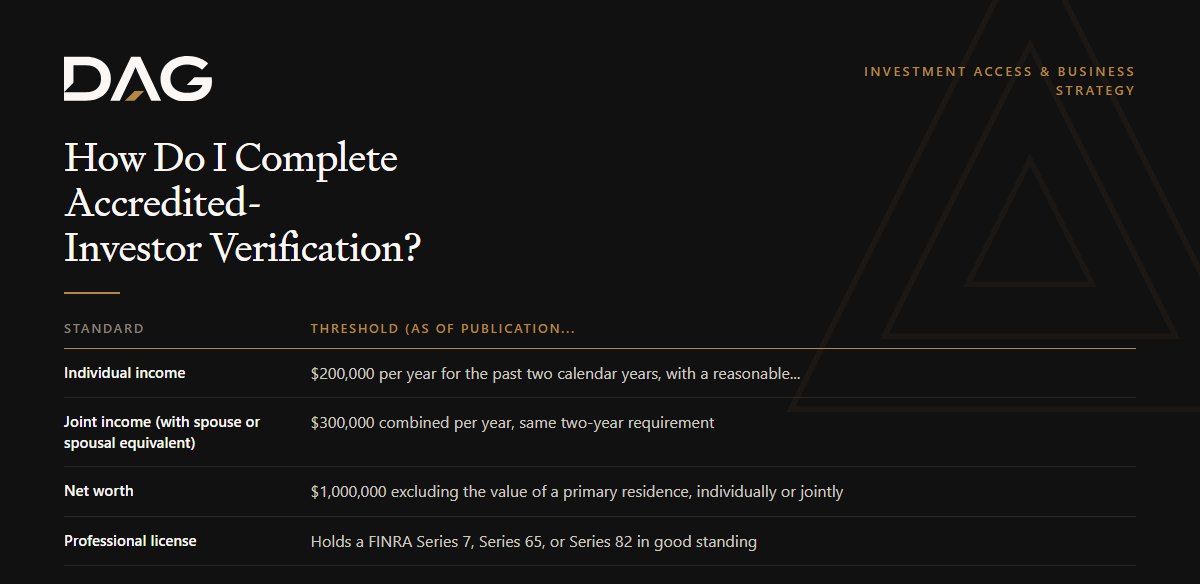
Under SEC Regulation D Rule 501, an accredited investor is an individual (or entity) that meets at least one of the following standards, verified as of the date of the letter:
| Standard | Threshold (as of publication, verify current SEC rules) |
|---|---|
| Individual income | $200,000 per year for the past two calendar years, with a reasonable expectation of the same in the current year |
| Joint income (with spouse or spousal equivalent) | $300,000 combined per year, same two-year requirement |
| Net worth | $1,000,000 excluding the value of a primary residence, individually or jointly |
| Professional license | Holds a FINRA Series 7, Series 65, or Series 82 in good standing |
| Knowledgeable employee (for funds) | Specific additional criteria apply; consult a qualified attorney |
These thresholds are set by the SEC and may be adjusted. Confirm current figures at sec.gov before submitting documentation.
How to Start the Accreditation Process Through an Accredited-Investor Verification Service
Contact your advisory firm. Reach out to DAG Wealth to request initiation of the verification process. Your adviser can direct you to the verification platform the relevant offering uses, an accredited-investor verification service is typically required, and provide a letter template tailored to the verification standard you intend to use. DAG Wealth does not endorse or guarantee any particular verification vendor.
Choose your verification path. Select the standard that fits your financial profile: income test, net-worth test, or professional license (Series 7/65/82). The appropriate professional must sign off on the path you choose.
Gather your identity document. The verification service requires a current government-issued photo ID (passport or driver's license).
Obtain the verification letter. A licensed CPA, attorney, or registered investment adviser (RIA) must issue a letter on their firm letterhead stating that, based on their knowledge of your finances or your license status, you meet the applicable standard. DAG Wealth can provide this letter if they serve as your RIA and have sufficient knowledge of your financial situation.
Submit through the verification portal. Upload your ID and the letter through the secure link provided. The service reviews and issues a verification credential, typically within a few business days.
Use your credential across deals. Once verified, your credential is portable. You do not need to reverify for each individual private placement, venture deal, or pre-IPO opportunity, provided the credential remains current and the deal sponsor accepts that verification service.
How Long Is an Accredited-Investor Verification Valid?
Verification letters in connection with Reg D offerings are commonly treated as valid for roughly 90 days from the date of the letter, though this period is not a fixed SEC requirement and varies by platform, offering, and deal sponsor. After the applicable window lapses, a new letter from a qualified professional is generally required. Confirm the current validity period with your issuing professional and the specific deal sponsor before relying on an existing credential.
What Documentation Do You Need?
- Government-issued photo ID (passport, driver's license, or equivalent)
- Verification letter from one of the following:
- A licensed CPA confirming income or net worth
- A licensed attorney confirming income or net worth
- A registered investment adviser confirming income, net worth, or professional knowledge/experience in financial matters
- Supporting financials (not submitted to the verification service, but the signing professional will need them): prior two years' tax returns (income test), or a current balance sheet showing assets and liabilities excluding primary residence (net worth test)
- Brokerage or custodial statements may be requested by the letter issuer to verify liquid asset values
You do not submit raw financial statements to the verification service, only the ID and the professional letter. The letter itself represents the professional's attestation.
Why an RIA Instead of a Broker-Dealer for This Process?
A broker-dealer's legal standard is suitability, they must reasonably believe a product is suitable for a client's situation. An RIA operates under fiduciary duty under the Investment Advisers Act of 1940, meaning the adviser is legally required to act in the client's best interest.
When you are becoming accredited to access higher-risk private investments, private credit, venture capital, pre-IPO equity, the adviser's legal standard matters. An RIA who can issue your accreditation letter is the same adviser legally required to evaluate whether each investment is genuinely appropriate for your situation, not just whether you qualify to participate.
For more on this distinction, see What Is a Crypto Fiduciary Advisor? and What Is a Digital Asset Fiduciary?.
Related Questions
Can a financial adviser issue the verification letter?
Yes. A registered investment adviser (RIA) who has sufficient knowledge of your financial circumstances can issue the letter. The RIA signs based on their professional knowledge of your income, net worth, or license status, not as an endorsement of any specific investment.
Do I need to reverify every time I look at a new private deal?
Not necessarily. Accredited-investor verification services store your verified credential and share it with deal sponsors who use the platform. You may need a fresh letter once the 90-day validity window lapses (verify current validity periods with your letter issuer and each deal sponsor).
What happens if my net worth is close to the threshold?
The net worth calculation excludes your primary residence (both its value and any mortgage secured against it, up to the property's fair market value). A qualified CPA or attorney should calculate the figure. If your net worth is near the $1,000,000 threshold, professional review of the calculation is especially important, an incorrect letter can expose both you and the letter-issuer to regulatory risk.
Does having a Series 7 or Series 65 automatically qualify me?
Yes, under Reg D Rule 501 as amended in 2020, holding a FINRA Series 7, Series 65, or Series 82 license in good standing qualifies an individual as an accredited investor based on professional sophistication, regardless of income or net worth. The letter issuer would confirm the license status rather than financial thresholds. Confirm the current list of qualifying licenses with your adviser or at sec.gov, as the SEC may expand the list over time.
Sources
- SEC, Regulation D, Rule 501. Definitions and Terms, 17 CFR § 230.501: https://www.law.cornell.edu/cfr/text/17/230.501
- SEC, Accredited Investor. Building Blocks of Capital Raising: https://www.sec.gov/education/capitalraising/building-blocks/accredited-investor
- SEC, Amending the "Accredited Investor" Definition (2020 final rule): https://www.sec.gov/news/press-release/2020-191
- Investment Advisers Act of 1940, § 206: https://www.law.cornell.edu/uscode/text/15/80b-6
Compliance Note
This page is for educational purposes only and does not constitute legal, tax, investment, or securities advice. Advisory services are provided by DAG Wealth, an SEC-registered investment adviser. Registration does not imply a certain level of skill or training. Accredited investor thresholds and qualification criteria are set by the SEC and are subject to change; verify current requirements before submitting documentation. Private investments carry material risks including illiquidity, loss of principal, limited regulatory oversight, and the absence of SEC registration. Qualification as an accredited investor does not mean a specific investment is appropriate for your situation. DAG Wealth does not endorse or guarantee any third-party verification platform. Consult a qualified attorney, CPA, and registered investment adviser before participating in any private offering.
Legal entity note: The SEC-registered investment adviser described in the source content is DAG Wealth. This legal-entity designation remains in effect until a Form ADV amendment is filed and approved reflecting any name change. Marketing references have been rebranded to "DAG Wealth" per instructions; all regulatory/legal-entity references to the RIA are preserved as DAG Wealth.
See also: What Is a Crypto Fiduciary Advisor? | What Is a Digital Asset Fiduciary? | Fee-Only Crypto Financial Advisor | When Do You Need a Crypto Wealth Manager? | Best Crypto Wealth Management Firm for High-Net-Worth Investors | What Is Crypto Wealth Management?