
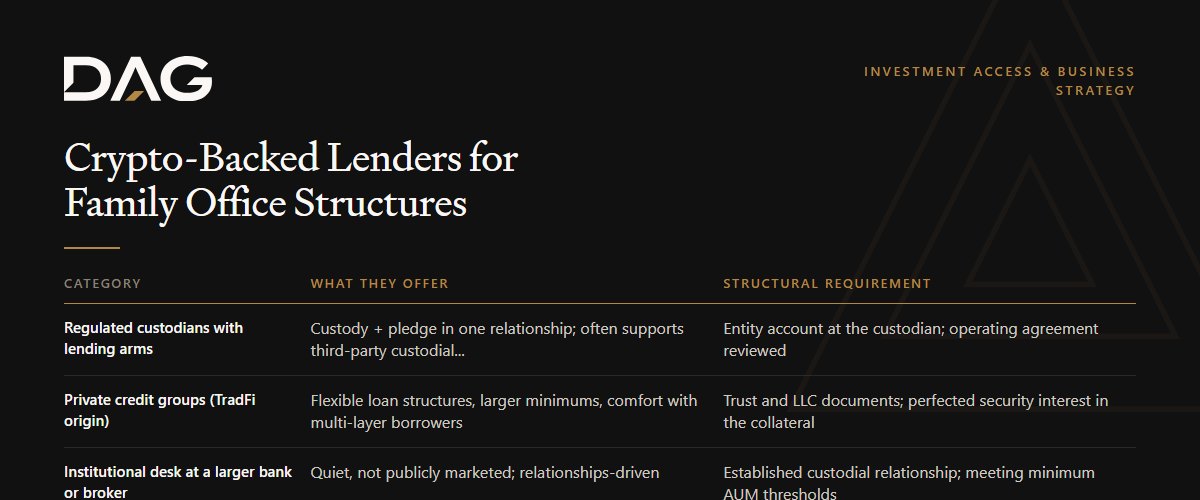
Lenders for crypto-backed loans to family office structures fall into three categories: regulated custodians with lending arms, private credit groups that expanded from traditional finance into digital assets, and specialized institutional desks. The right match depends on having a completed multi-entity structure first, because structure determines which lenders can even process the loan.
Why No One Should Publish a Static Lender List
Lender appetite moves. A firm aggressive on Bitcoin collateral one quarter may tighten to a lower LTV the next because its risk committee hit exposure limits or responded to regulatory pressure. Publishing a fixed list creates two problems: it goes stale immediately, and it encourages families to shop lenders before their structure is ready. That is backward. The structure determines which lenders can even process the loan, not the other way around.
Retail crypto lending platforms are built for individuals pledging personal assets in personally held accounts. When a borrower arrives as an LLC owned by a trust, with collateral at a third-party qualified custodian, retail platforms typically lack the legal infrastructure and loan documentation to handle it. Their agreements assume the borrower and the beneficial owner are the same person.
What Categories of Lenders Work for Family Office Structures
Three categories tend to have the infrastructure required:
| Category | What They Offer | Structural Requirement |
|---|---|---|
| Regulated custodians with lending arms | Custody + pledge in one relationship; often supports third-party custodial pledges | Entity account at the custodian; operating agreement reviewed |
| Private credit groups (TradFi origin) | Flexible loan structures, larger minimums, comfort with multi-layer borrowers | Trust and LLC documents; perfected security interest in the collateral |
| Institutional desk at a larger bank or broker | Quiet, not publicly marketed; relationships-driven | Established custodial relationship; meeting minimum AUM thresholds |
None of these lenders market through social media. Access is typically relationship-driven or referral-driven.
What Makes a Lender Suitable for Family Office Clients
Can the lender underwrite a layered borrower?
The borrower may be three steps removed from the beneficial owner, for example, a manager-managed Wyoming LLC owned by an irrevocable trust. Lenders must be comfortable underwriting at the entity level, reviewing the operating agreement, and understanding that the beneficial owner is not the signing party.
Do they support third-party custodial pledges?
Many institutional lenders work only with assets held at their own platform. Family offices using a separate qualified crypto custodian need a lender whose pledge and lien process can accommodate an external custodian. This is a gatekeeping question to ask early.
What does their loan documentation cover?
Loan documents must address perfected security interests in digital assets, what happens when the operating agreement changes, how margin calls are triggered and cured, and what constitutes a default when the collateral is held through a trust-owned LLC. Standard retail agreements do not cover these scenarios.
What are the lending terms?
LTV ratios, interest rates, margin call triggers, prepayment penalties, and accepted asset types all vary by lender and market conditions. These are important, but secondary to whether the lender can process the structure at all. Terms are also negotiable once a relationship is established; structure is not.
How Structure Determines Lender Access
Before approaching any lender, the digital assets need to be held in a form institutional lenders recognize:
- Entity formation. LLC and trust documents drafted and executed, with operating agreement provisions covering collateral pledges
- Qualified custody, assets moved to a custodian that can facilitate a pledge to a third-party lender (see crypto custody for family offices)
- Legal review, security interest language, UCC filings where applicable, and trustee authorization confirmed
- Lender matching, once structure is confirmed, identify which lender's current terms, LTV appetite, and minimum loan size fit the specific situation
Skipping steps one through three and going directly to lenders produces rejections or loans structured for the wrong entity type.
Entity formation, trust and operating-agreement drafting, and UCC/security-interest work are legal services. DAG coordinates these steps with the client's attorney and qualified custodian; it does not provide legal advice or draft legal documents.
Material Risks to Understand Before Borrowing Against Crypto
Crypto-backed loans carry specific risks that borrowers should evaluate before proceeding:
- Liquidation risk: If the collateral value drops below the lender's LTV threshold, the lender can liquidate collateral, sometimes rapidly and without additional notice beyond contractual cure periods. Volatility in digital asset prices makes this a live risk.
- Margin call mechanics: Understand exactly what triggers a margin call, how much time is given to cure it (by posting additional collateral or repaying principal), and what happens if the cure window is missed.
- Rate and term risk: Interest rates on crypto-backed loans can be significantly higher than traditional secured lending. Floating-rate structures may reprice materially.
- Custody concentration: Pledging assets to a custodian that is also the lender creates counterparty concentration. Lender insolvency could complicate asset recovery.
- Tax event risk: Consult a qualified tax advisor. In some circumstances, a margin call liquidation may be a taxable event. See crypto-backed loans for high-net-worth investors for a fuller treatment.
This is not an exhaustive list. Individual circumstances vary, and the relevant risks depend on structure, jurisdiction, and collateral type.
Related Questions
Does the LLC or the individual borrow in a family office lending structure?
Typically the LLC or trust entity is the borrower, not the individual beneficial owner. This is one reason retail lenders cannot process these transactions, their underwriting and KYC assume an individual borrower. Lenders comfortable with entity-level borrowers will review the operating agreement and may require trustee or manager authorization to execute the loan.
What LTV ratios are typical for crypto-backed institutional loans?
LTV ratios vary by lender, asset type, and market conditions, and can change without notice. Bitcoin and Ethereum generally command higher LTVs than smaller-cap tokens. Specific ratios should be confirmed directly with any lender at the time of application, figures in educational content go stale quickly.
Can a family office pledge crypto held at one custodian to a different lender?
Some institutional lenders accept collateral held at a third-party qualified custodian via a tri-party pledge or control agreement. Others require assets to move to their own platform before lending. This question should be among the first asked when evaluating a lender, because the answer determines whether the existing custody setup needs to change before a loan is possible. See how to choose a crypto custodian for a family office for custodian evaluation criteria.
What documentation does a lender typically require from a multi-entity borrower?
Lenders generally require LLC operating agreement, trust agreement (or relevant excerpts), KYC/AML documentation for beneficial owners, custodial account statements, and a legal opinion or authorization confirming the entity's authority to pledge and borrow. Requirements vary; confirm with the specific lender before beginning the process.
Sources
- UCC Article 9 (Uniform Commercial Code. Secured Transactions): governs perfected security interests in digital assets in most U.S. jurisdictions
- Wyoming Statute § 34-29-101 et seq. (Wyoming Digital Asset Property Statute): covers digital asset classification and property rights
- SEC Staff Bulletin 2022-01 (SAB 121): addresses custodian treatment of crypto assets on balance sheet, relevant context for lender custodial structures; verify current guidance with legal counsel
- OCC Interpretive Letter 1170 (2021): clarified national bank authority to provide crypto custody services, foundational for regulated custodians with lending arms
Compliance Note
This page is educational only and does not constitute investment, legal, tax, or financial advice. Crypto-backed lending involves material risks including but not limited to asset liquidation, margin calls, counterparty risk, and potential tax consequences. Terms, rates, and lender availability change frequently; verify all figures and structures directly with qualified legal and financial counsel before entering any lending arrangement.
DAG Wealth does not endorse, guarantee, or warrant the performance of any specific lender, custodian, or lending structure. Advisory services are provided by DAG Wealth, an SEC-registered investment adviser. Registration does not imply a certain level of skill or training. Entity formation, trust drafting, and operating-agreement work are legal services that the firm coordinates and does not itself provide.
For questions about structuring digital assets for institutional lending access, contact DAG Wealth or explore the crypto wealth management hub.
Internal links used:
- crypto-backed loans for high-net-worth investors, hub link up (Crypto Wealth Management cluster)
- what is a qualified crypto custodian, sibling (Digital Asset Custody cluster)
- crypto custody for family offices, sibling
- how to choose a crypto custodian for a family office, sibling
- crypto wealth management hub, hub link (trailing CTA only, not counted in body)