
There is no minimum dollar amount to form a crypto LLC. No state imposes a capital or asset threshold, so any investor can form one regardless of portfolio size. The practical question is whether the benefits (liability separation and cleaner records) justify the filing fees, registered-agent costs, and annual maintenance for your current holdings. Entity formation decisions are one piece of a complete crypto wealth management plan.
Is There a Legal Minimum to Form a Crypto LLC?
No. State LLC statutes, including Wyoming, Delaware, and Nevada, do not require a minimum capital contribution to form an LLC. You can form an LLC with a nominal filing fee (Wyoming charges $100 as of this writing, verify current fee at the Wyoming Secretary of State website) and zero assets contributed at formation.
The LLC exists as a legal entity the moment the state accepts your Articles of Organization. What you contribute to it, and when, is governed by your operating agreement, not state law.
When Does Forming a Crypto LLC Actually Make Sense?
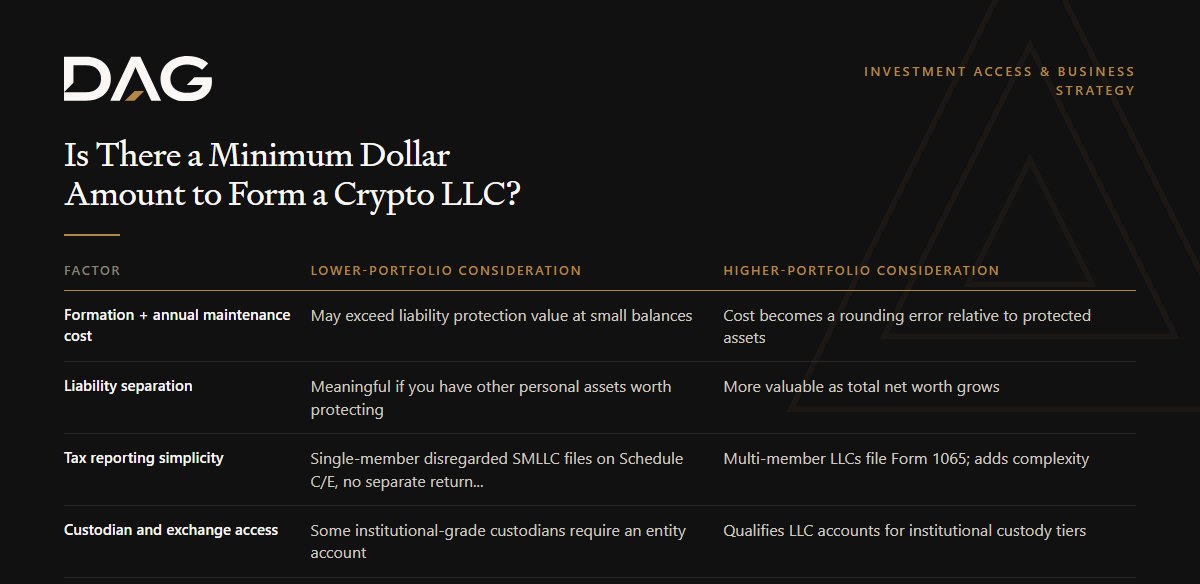
The formation decision turns on cost-benefit, not on hitting a magic dollar threshold. Consider these factors:
| Factor | Lower-Portfolio Consideration | Higher-Portfolio Consideration |
|---|---|---|
| Formation + annual maintenance cost | May exceed liability protection value at small balances | Cost becomes a rounding error relative to protected assets |
| Liability separation | Meaningful if you have other personal assets worth protecting | More valuable as total net worth grows |
| Tax reporting simplicity | Single-member disregarded SMLLC files on Schedule C/E, no separate return required | Multi-member LLCs file Form 1065; adds complexity |
| Custodian and exchange access | Some institutional-grade custodians require an entity account | Qualifies LLC accounts for institutional custody tiers |
| Operating agreement formality | Useful habit-forming discipline at any size | Essential for multi-member or trust-owned structures |
As an illustrative way to frame the trade-off only: if formation and annual costs (filing fee plus registered agent) run into the low hundreds of dollars per year, that carrying cost weighs more heavily on a very small portfolio than on a large one. This is an illustrative example to frame the cost-benefit question, not a legal or tax recommendation, and not a threshold endorsed by DAG Wealth. The right answer depends on your jurisdiction, asset mix, personal assets at risk, and growth expectations, verify current fees and consult qualified professionals.
Does Contributing Crypto to the LLC Trigger a Taxable Event?
Generally, no, if the LLC is structured and used correctly. A single-member LLC taxed as a disregarded entity is treated as the same taxpayer as the individual owner for federal tax purposes. Transferring crypto into a wholly-owned disregarded SMLLC is generally not a taxable event under this treatment.
Contributing crypto to a multi-member LLC in exchange for a membership interest is generally not taxable under IRC §721, which provides non-recognition treatment for contributions to a partnership (how multi-member LLCs are taxed by default) in exchange for a partnership interest.
Important caveat: tax treatment depends on the specific facts, the LLC's tax classification, and how the contribution is structured. Consult a qualified tax professional before contributing appreciated crypto to any entity. This is educational information, not tax advice.
How Should a Crypto LLC Document Contributions?
Even if the transfer is not taxable, proper documentation matters:
- Record the date of each contribution and the fair-market value of each asset contributed.
- Note your cost basis in the contributed crypto as of the contribution date.
- Update the LLC's books and operating agreement records to reflect the contribution.
- For on-chain assets, record the wallet address the LLC controls and the transaction hash.
- Keep this documentation with LLC records in case of an IRS inquiry or state audit.
See How Should a Crypto LLC Document Contributions? for a full checklist.
What Ongoing Costs Should I Budget?
Annual LLC maintenance typically includes:
- Registered agent fee, required in most states; typically $50–$200/year (verify current pricing)
- Annual report / franchise fee. Wyoming charges $60/year minimum as of this writing (verify)
- Accounting, if the LLC files its own return (multi-member structures)
- Operating agreement updates, recommended when ownership or asset mix changes materially
These costs are real carrying costs that should factor into your formation decision before you file.
Related Questions
Can I form a Wyoming LLC with just one Bitcoin or a small altcoin position?
Yes. Wyoming does not require you to contribute any assets to form the LLC. You file Articles of Organization, pay the state filing fee, and appoint a registered agent. The LLC is valid regardless of whether you have contributed any crypto to it yet.
Does the LLC need a bank account or exchange account before I contribute crypto?
No. You can form the LLC first, then open a dedicated exchange or custody account in the LLC's name, and then transfer crypto into it. This sequence is common. Opening an exchange account for an LLC typically requires the Articles of Organization, operating agreement, and an EIN (employer identification number) from the IRS.
If my crypto portfolio grows, can I contribute additional assets later?
Yes. Contributions to an existing LLC can happen at any time. Document each contribution with date, asset type, quantity, and fair-market value. If the LLC has multiple members, confirm contribution terms align with the operating agreement before transferring additional assets.
Does forming an LLC affect how crypto is taxed on sale?
For a single-member disregarded SMLLC, no, gains and losses still flow to your individual return and are reported on Schedule D / Form 8949 as if you held the assets personally. The LLC wrapper changes liability separation and organizational structure, not the federal tax character of gains for a disregarded entity. See Crypto Tax Reporting for LLCs for how this works in practice.
Internal Resources
- Should I Put My Crypto in a Wyoming LLC?, hub page for the full LLC decision framework
- How to Transfer Crypto Into an LLC, step-by-step process for moving assets into an LLC
- Crypto LLC vs Trust, compare LLC and trust structures for crypto holdings
- Should Crypto Be Held Personally, in an LLC, or in a Trust?, full comparison of all three holding structures
- Crypto Tax Reporting for LLCs, how LLC tax treatment affects crypto gains reporting
- What Records Should a Crypto LLC Keep?, recordkeeping requirements for LLC-held crypto
Sources
- Wyoming Secretary of State, LLC Formation Requirements: https://www.sos.wyo.gov/Business/LLCInfo.aspx (verify current fees)
- IRC §721, Nonrecognition of Gain or Loss on Contribution: https://www.law.cornell.edu/uscode/text/26/721
- IRS, Single Member Limited Liability Companies: https://www.irs.gov/businesses/small-businesses-self-employed/single-member-limited-liability-companies
- IRS, Limited Liability Company (LLC): https://www.irs.gov/businesses/small-businesses-self-employed/limited-liability-company-llc
Compliance Note
This page is for educational purposes only and does not constitute legal, tax, or investment advice. LLC formation, operating-agreement drafting, and related entity work are legal services; DAG coordinates these matters with qualified attorneys and tax professionals and does not itself provide legal advice. LLC formation requirements, state fees, and tax rules change, verify all figures with current sources. Any illustrative cost figures are examples to frame the cost-benefit question and are not thresholds recommended by DAG Wealth. Consult a qualified attorney and tax professional before forming an LLC or contributing assets to one.