
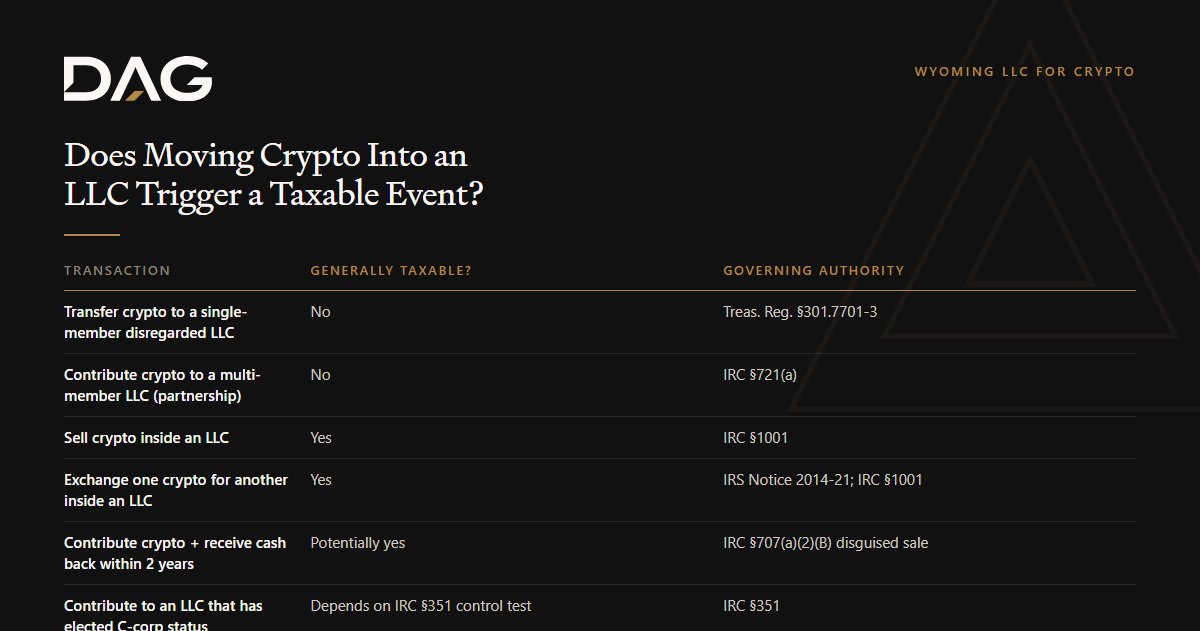
Transferring crypto into an LLC is generally not a taxable event. Contributing to a single-member LLC (a disregarded entity) is ignored for tax purposes, and contributing to a multi-member LLC taxed as a partnership is generally tax-free under IRC §721. The taxable event is selling or disposing of crypto, not contributing it, a key point in crypto LLC formation. Confirm your specifics with a CPA.
Key Definitions
Disregarded entity. A single-member LLC that has not elected corporate taxation is "disregarded" by the IRS, it does not exist separately from its owner for federal income tax purposes. Moving crypto into a disregarded LLC is treated the same as moving it between your own wallets: no sale, no taxable gain, no loss.
IRC §721 (partnership non-recognition rule). When a member contributes property, including cryptocurrency, to a partnership (which includes multi-member LLCs taxed as partnerships), neither the contributing member nor the partnership generally recognizes gain or loss at the time of contribution. The member's pre-contribution gain is preserved in the member's outside basis and the partnership's inside basis on the contributed property.
Realization event. Under IRC §1001, gain or loss is recognized when a taxpayer sells or otherwise "disposes" of property. Contributing crypto to a disregarded LLC or a §721-eligible partnership does not constitute a sale or disposition, the economic ownership has not changed hands for tax purposes.
When Is Contributing Crypto to an LLC Not Taxable?
Single-member LLC (disregarded entity)
If you own 100% of an LLC that has not elected S-corp or C-corp status, the LLC is disregarded under Treasury Regulation §301.7701-3. The transfer is invisible to the IRS. Your cost basis carries over unchanged.
Multi-member LLC taxed as a partnership
Under IRC §721(a), no gain or loss is recognized by a contributing partner or the partnership when property is contributed in exchange for a partnership interest. Your basis in the contributed crypto becomes your outside basis in the LLC interest. The LLC takes a carryover basis in the crypto (inside basis).
When the Contribution Could Be Taxable. Edge Cases to Review With a CPA
Disguised sale (IRC §707(a)(2)(B))
If you contribute crypto and receive a cash distribution from the LLC within two years, the IRS may recharacterize the transaction as a sale rather than a contribution. The disguised-sale rules can produce immediate gain recognition.
Contribution of encumbered crypto
If the crypto carries any associated liability and the assumed liability exceeds your basis in the contributed property, the excess may be treated as gain under IRC §731 and §752.
C-corp or S-corp elections
If the LLC has elected to be taxed as a corporation, different rules apply. A contribution to a C-corp may be tax-free under IRC §351 (if transferors control 80% immediately after), but the mechanics differ. Consult a tax attorney.
State-level taxes
Some states impose their own transfer or excise taxes on asset contributions to entities. Wyoming, for example, does not impose a personal income tax, but state-level nuances vary. Check with a CPA licensed in your state.
Taxable vs. Not Taxable: Quick Reference
| Transaction | Generally Taxable? | Governing Authority |
|---|---|---|
| Transfer crypto to a single-member disregarded LLC | No | Treas. Reg. §301.7701-3 |
| Contribute crypto to a multi-member LLC (partnership) | No | IRC §721(a) |
| Sell crypto inside an LLC | Yes | IRC §1001 |
| Exchange one crypto for another inside an LLC | Yes | IRS Notice 2014-21; IRC §1001 |
| Contribute crypto + receive cash back within 2 years | Potentially yes | IRC §707(a)(2)(B) disguised sale |
| Contribute to an LLC that has elected C-corp status | Depends on IRC §351 control test | IRC §351 |
| Receive staking rewards inside an LLC | Generally yes when received | IRS Rev. Rul. 2023-14 |
What Actually Triggers the Tax?
The taxable event is not moving crypto into an LLC, it is disposing of crypto. Disposals include:
- Selling crypto for cash
- Exchanging one cryptocurrency for another
- Using crypto to purchase goods or services
- Distributing crypto from an LLC to a member in excess of basis
None of these are triggered merely by contributing crypto to a properly structured LLC. Your holding period and original cost basis carry through to the LLC structure, preserving the tax position until an actual sale occurs.
For a step-by-step look at how contributions are documented, see how a crypto LLC should document contributions.
How to Transfer Crypto Into an LLC Without Creating a Taxable Event
- Confirm the LLC's tax classification before transferring. Single-member disregarded or partnership-taxed multi-member are the safe structures. C-corp elections require separate analysis.
- Record the transfer. Log the date, quantity, and fair market value of each asset at the time of contribution. This establishes inside basis for the LLC and outside basis for each member.
- Update the operating agreement to reflect contributions and resulting ownership percentages.
- Avoid same-year distributions that could trigger disguised-sale treatment.
- File correctly. Multi-member LLCs file Form 1065; the partnership reports contributed property on Schedule L and each member's capital account. Single-member LLCs report on Schedule C or Schedule E depending on activity.
For practical mechanics, see how to transfer crypto into an LLC and review crypto tax reporting for LLCs.
Related Questions
Are wallet-to-wallet transfers between my own accounts taxable?
No. Moving crypto between wallets you personally control, or between your personal wallet and a disregarded single-member LLC, is not a taxable event because no change of ownership occurs. See are crypto wallet transfers taxable for a full breakdown.
Does the LLC owe taxes when it sells the contributed crypto?
Yes. Once the LLC sells crypto, the gain or loss is recognized at that point. For a disregarded LLC, it flows directly onto your personal return. For a multi-member LLC, it flows to partners via Schedule K-1. The contribution merely deferred the tax; it did not eliminate it.
What if I contributed crypto that has already lost value?
You can contribute crypto at a loss to an LLC without recognizing that loss at the time of contribution, under §721 you preserve the basis. However, you cannot immediately harvest the loss via the contribution itself. The loss becomes available when the LLC later sells the asset or upon liquidation of your interest.
Should I hold crypto personally, in an LLC, or in a trust instead?
The right structure depends on your goals: liability protection, estate planning, multi-generational transfer, or operational control. See should crypto be held personally, in an LLC, or in a trust for a comparison of the three approaches. For the Wyoming LLC specifically, should I put my crypto in a Wyoming LLC covers the statutory protections and tradeoffs.
Sources
- IRC §721. Non-recognition of gain or loss on contribution to a partnership. https://www.law.cornell.edu/uscode/text/26/721
- IRC §1001. Determination of amount of and recognition of gain or loss. https://www.law.cornell.edu/uscode/text/26/1001
- Treasury Regulation §301.7701-3. Classification of certain business entities (disregarded entity elections). https://www.law.cornell.edu/cfr/text/26/301.7701-3
- IRS Notice 2014-21. IRS guidance on the tax treatment of virtual currency (cryptocurrency treated as property). https://www.irs.gov/pub/irs-drop/n-2014-21.pdf
- IRC §707(a)(2)(B). Disguised sale rules for partnerships. https://www.law.cornell.edu/uscode/text/26/707
- IRS Revenue Ruling 2023-14. Staking rewards includible in gross income when received. https://www.irs.gov/pub/irs-drop/rr-2023-14.pdf
Compliance Note
This page is for educational purposes only and does not constitute legal, tax, or investment advice. Tax treatment depends on your specific facts, LLC structure, jurisdiction, and holding period. The rules described reflect U.S. federal income tax law as of the updated date; state tax laws vary and are not covered here. The disguised-sale rules, corporate-election scenarios, and encumbered-asset edge cases can materially change the analysis. Consult a qualified CPA or tax attorney before transferring cryptocurrency into any legal entity.
Investment advisory services may be offered through DAG Wealth, a registered investment adviser. Registration does not imply a certain level of skill or training.