
Transferring digital assets to an LLC before price appreciation can offer creditor protection, ownership privacy, and easier banking access, often without a taxable sale at contribution if the transfer qualifies under IRC §721 or goes to a disregarded single-member entity. Once large gains accrue, these structural benefits become harder and more costly to establish. The formation mechanics, operating agreement requirements, and custody setup that make this work are covered in the crypto LLC formation hub.
What Does It Mean to Transfer Digital Assets to an LLC Before Appreciation?
A pre-appreciation transfer means contributing cryptocurrency or other digital assets to a limited liability company before a significant price increase occurs. At the time of transfer, the LLC receives the assets at the contributor's original cost basis, and the member receives an ownership interest in the LLC reflecting that same basis. If the transfer is treated as a contribution to a partnership or single-member LLC disregarded for tax, the transaction is generally not a taxable sale at the moment of transfer, though this treatment depends on specific facts and applicable IRS guidance.
The result is a structure that holds assets in a legal entity from an early stage, establishing the LLC's ownership history and banking relationships when asset values, and the complexity of transferring them, are lower.
What Are the Core Benefits of This Timing?
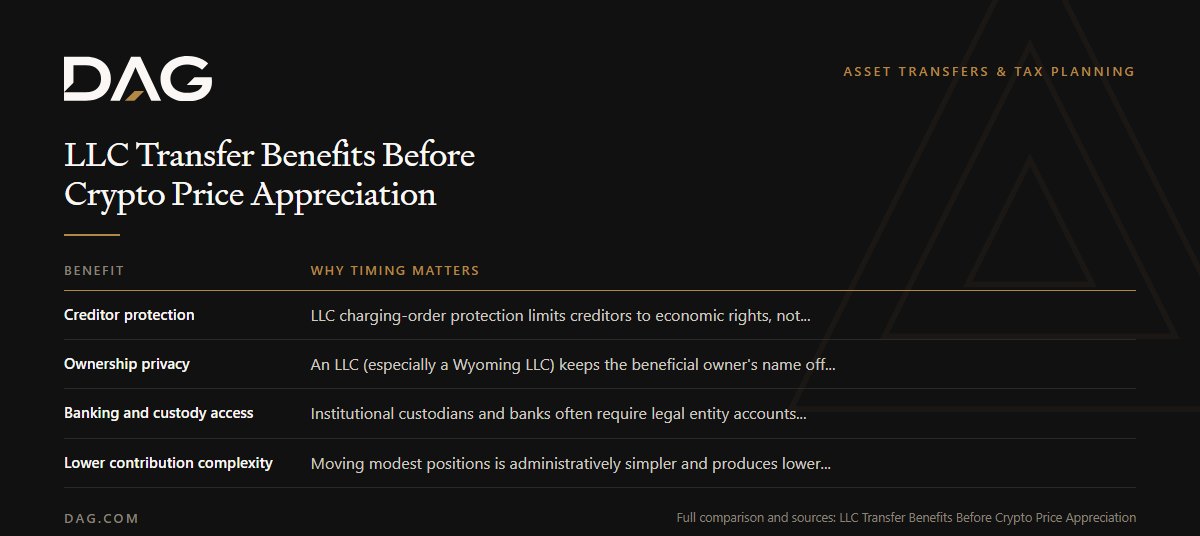
The four main structural advantages of transferring digital assets to an LLC before appreciation are:
| Benefit | Why Timing Matters |
|---|---|
| Creditor protection | LLC charging-order protection limits creditors to economic rights, not control. Established early, the structure is less likely to be challenged as a fraudulent transfer |
| Ownership privacy | An LLC (especially a Wyoming LLC) keeps the beneficial owner's name off exchange accounts and wallet records, replacing it with the entity name |
| Banking and custody access | Institutional custodians and banks often require legal entity accounts. Setting up the LLC early builds the account history lenders and partners want to see |
| Lower contribution complexity | Moving modest positions is administratively simpler and produces lower basis-tracking complexity than moving large, highly appreciated holdings |
Note: These are structural and administrative benefits, not guaranteed tax savings. Contribution treatment, basis carryover, and asset-protection effectiveness depend on state law, LLC formation documents, and IRS classification of the entity. Consult a tax attorney and CPA before transferring assets.
Does Transferring Crypto to an LLC Create a Taxable Event?
This is the central tax question, and the answer is fact-specific.
Single-member LLCs (disregarded entities): The IRS treats a single-member LLC with no separate tax election as a "disregarded entity." A transfer from the sole owner to their own disregarded LLC is generally not a taxable event, it is treated as a transfer between the owner and themselves for federal income tax purposes. The owner retains the original cost basis.
Multi-member LLCs (partnership tax treatment): Under IRC §721, contributions of property to a partnership in exchange for a partnership interest are generally not recognized as taxable events at the time of contribution. The partnership takes a carryover basis in the contributed property equal to the contributor's adjusted basis, and the contributor's basis in the partnership interest reflects the same amount. However, exceptions apply, including the "disguised sale" rules under IRC §707(a)(2)(B) if distributions follow the contribution within two years, and the "investment company" rules under IRC §721(b) if the LLC holds diversified assets and the transfer results in diversification of the contributor's holdings.
Exchange-level realization: Even if the transfer is not a federal taxable event, moving assets off an exchange (sell → send → re-deposit as entity) may generate a Form 1099 from the exchange treating the outbound transfer as a disposition. Keeping records of in-kind transfers and working with a crypto-specialized CPA is essential to avoid double-counting gains.
IRS Notice 2014-21 and subsequent guidance establish that cryptocurrency is property for federal tax purposes. There is currently no specific IRS ruling on whether a contribution of cryptocurrency to a partnership satisfies §721 in all cases. The general rule applies, but taxpayers should document the intent and structure of the transfer carefully.
How Does Pre-Appreciation Timing Affect Creditor Protection?
Fraudulent transfer law (now largely codified under the Uniform Voidable Transactions Act, adopted in most states) allows creditors to unwind transfers made with intent to hinder, delay, or defraud them, or made while the transferor was insolvent. A transfer made before appreciation, and before any legal dispute arises, is substantially more defensible than a transfer made in response to a known creditor claim.
The key principle: asset protection structures must be built before a creditor or legal claim exists, not in response to one. Transferring digital assets into an LLC early in the holding period, when no reasonably anticipated claims exist and the transferor is solvent, is the foundation of a defensible structure. Wyoming LLC charging-order protection further limits a judgment creditor's remedy to the economic interest in the LLC, they cannot seize the LLC's assets directly or force a distribution.
Wyoming is generally considered the strongest state for LLC asset protection because its statute explicitly provides charging-order protection as the exclusive remedy against a creditor of a member. See Wyoming LLC statute (Wyo. Stat. § 17-29-503).
For more on Wyoming LLC creditor protection for crypto and whether to use a trust-owned LLC structure, see those dedicated articles.
What Are the Banking and Custody Advantages of an LLC?
Institutional custodians and bank partners often require crypto holders to operate through a legal entity before they will open accounts or provide credit facilities. Reasons include:
- KYC/AML compliance: Entities with a registered address, EIN, and operating agreement are easier to onboard under institutional Know Your Customer procedures.
- Account longevity: An LLC account accumulates transaction history, statements, and counterparty relationships in the entity's name, this history follows the entity even if ownership changes.
- Borrowing eligibility: Crypto-collateralized loans are predominantly available to entities, not individuals, at institutional terms.
Establishing the entity account while the portfolio is smaller reduces friction: lower asset values mean fewer questions from compliance teams about source of funds, and simpler documentation of cost basis at the time of contribution.
See crypto custody for LLCs and how to transfer crypto into an LLC for operational detail.
What Are the Risks and Limitations?
Transferring digital assets to an LLC is not a cost-free decision. Material risks include:
- Complexity and ongoing compliance: The LLC requires a separate EIN, operating agreement, annual reports (in most states), and separate accounting records. Commingling personal and entity assets can pierce the corporate veil and eliminate asset protection.
- Self-employment and state tax considerations: Depending on the LLC's activities (trading, staking, DeFi), state taxes, franchise fees, or self-employment treatment may apply to income earned at the entity level.
- Potential for inadvertent taxable transfer: If the transfer is structured incorrectly, particularly if the LLC is a multi-member entity and the contribution is accompanied by distributions, the IRS may treat the transaction as a disguised sale under §707(a).
- Basis step-up at death is more complex: Under IRC §1014, a deceased owner's LLC membership interest can receive a step-up to fair market value, but whether the LLC's underlying assets also step up inside the entity depends on the entity type and elections (for example, a §754 election for a partnership). The interaction of membership interests, estate tax, and inside basis is fact-specific, confirm the result with a tax professional before relying on it.
The crypto tax planning resource and asset holding structure comparison cover these trade-offs in more detail.
Related Questions
Is transferring crypto to my LLC a taxable sale?
For a single-member LLC taxed as a disregarded entity, the transfer is generally not treated as a taxable disposition for federal income tax purposes, the owner is treated as transferring assets to themselves. For a multi-member LLC taxed as a partnership, IRC §721 generally provides non-recognition treatment, but exceptions apply. State tax treatment varies. Work with a CPA to document the transfer and confirm basis carryover.
When is the wrong time to transfer digital assets into an LLC?
A transfer made after a known legal claim arises, while the transferor is insolvent, or with the intent to hinder a creditor can be unwound under fraudulent transfer law regardless of how the LLC is structured. Transfers made during periods of high appreciation also produce larger, more complex basis-tracking obligations. The ideal window is early in the holding period, before significant gains and before any legal disputes.
Does a Wyoming LLC guarantee asset protection for crypto?
No. Wyoming's charging-order protection is among the strongest in the United States, but it is not absolute. Courts in other states may apply different rules if the debtor or assets have substantial connections to that state. Proper formation, ongoing compliance (separate accounts, minutes, operating agreement adherence), and the absence of fraudulent transfer issues are all required for the protection to hold.
Can a multi-member LLC contribute crypto without triggering gain?
Generally yes, under IRC §721, but the facts matter. The IRS may recharacterize the contribution as a taxable sale if (1) the LLC distributes other property to the contributor within two years (disguised sale rules), (2) the transfer results in diversification of the contributor's portfolio in an entity that resembles an investment company (§721(b)), or (3) the LLC assumed liabilities exceeding the contributor's basis (§752 rules). Document the transfer and obtain a qualified tax opinion for large contributions.
What records should the LLC keep after receiving digital assets?
The LLC should document: the date of contribution, the fair market value of each asset at the time of transfer (for non-recognition contributions, this establishes the LLC's book value), the contributor's adjusted cost basis (which carries over to the LLC), the identity of the contributing member, and any operating agreement provisions governing the treatment of contributed property.
Sources
- IRS Notice 2014-21, IRS Virtual Currency Guidance, https://www.irs.gov/pub/irs-drop/n-14-21.pdf (property treatment for cryptocurrency)
- IRC §721, Nonrecognition of Gain or Loss on Contribution, 26 U.S.C. § 721 (partnership contribution non-recognition rule)
- IRC §707(a)(2)(B), Disguised Sale Rules, 26 U.S.C. § 707 (when contributions + distributions are recast as sales)
- IRC §1014, Basis of Property Acquired from a Decedent, 26 U.S.C. § 1014 (step-up in basis at death)
- Uniform Voidable Transactions Act (2014), National Conference of Commissioners on Uniform State Laws, https://www.uniformlaws.org/committees/community-home?CommunityKey=a392b8c4-6a9e-4d13-8cf8-5bc97d63e5ab
- Wyoming Statute § 17-29-503 (charging-order protection), Wyoming Legislature, https://wyoleg.gov/statutes/compress/title17.pdf
- IRS Rev. Proc. 2019-44 (basis reporting for digital assets), https://www.irs.gov/pub/irs-drop/rp-19-44.pdf
Compliance Note
This article is for educational purposes only and does not constitute legal, tax, investment, or financial advice. The tax treatment of digital asset contributions to an LLC depends on specific facts, entity classification, and applicable IRS guidance, which continues to evolve. Asset-protection effectiveness depends on state law, proper LLC formation and maintenance, and the absence of fraudulent transfer issues. Consult a qualified tax attorney, CPA, and asset-protection specialist before transferring any digital assets to a legal entity. DAG Wealth services are provided by advisers associated with Digital Ascension Group; investment advisory services in connection with managed accounts are provided through DAG Wealth, an SEC-registered investment adviser. Registration does not imply a certain level of skill or training.