
Under IRC §195, up to $5,000 of LLC startup costs is generally deductible in the formation year, with amounts above $5,000 amortized over 180 months (15 years). Once the LLC operates, ordinary professional fees. CPA, legal, bookkeeping, compliance, are typically deductible under IRC §162. A CPA should confirm how these rules apply to your specific entity. Deductibility questions connect to the broader crypto tax records discipline required for any digital asset entity.
What Are LLC Startup Costs Under the Tax Code?
Startup costs are amounts you pay to investigate or create an active trade or business before the LLC begins operating. IRC §195 defines the treatment:
- You may deduct up to $5,000 of startup costs in the tax year the business begins.
- The $5,000 limit phases out dollar-for-dollar when total startup costs exceed $50,000. (At $55,000 or more, no first-year deduction is allowed.)
- Any startup costs not deducted immediately are amortized ratably over 180 months starting with the month the business begins.
What qualifies as a startup cost?
Costs incurred before the LLC is actively operating:
- State filing fees (Articles of Organization)
- Attorney fees for drafting the operating agreement and formation documents
- Initial accounting setup and chart-of-accounts configuration
- Regulatory pre-filing or compliance consulting tied to formation
- Investigation costs for assessing whether to form the entity
Costs incurred after the LLC begins operating are not startup costs, they are ordinary business expenses (discussed below).
How the $5,000 Deduction Works in Practice
Step-by-step deduction sequence
- Total your startup costs. Include all costs incurred before the business opened, regardless of when invoices were paid.
- Check the phase-out threshold. If total startup costs are $50,000 or less, your §195 deduction is up to $5,000 in year one. Above $50,000, the deduction reduces dollar-for-dollar until eliminated at $55,000.
- Deduct allowable amount in year one. Claim on the LLC's return (Schedule C for single-member, Form 1065 for partnerships, etc.) in the year operations begin.
- Amortize the remainder. Divide remaining startup costs by 180 months. Deduct that monthly amount beginning with the first month of operation.
- Document every item. Keep dated invoices that identify the service, provider, and business purpose.
Example: You spend $8,000 forming an LLC that begins operating in January.
- Year-one deduction: $5,000
- Amortized remainder: $3,000 ÷ 180 = $16.67/month ($200/year for 15 years)
Which Professional Fees Are Deductible After Formation?
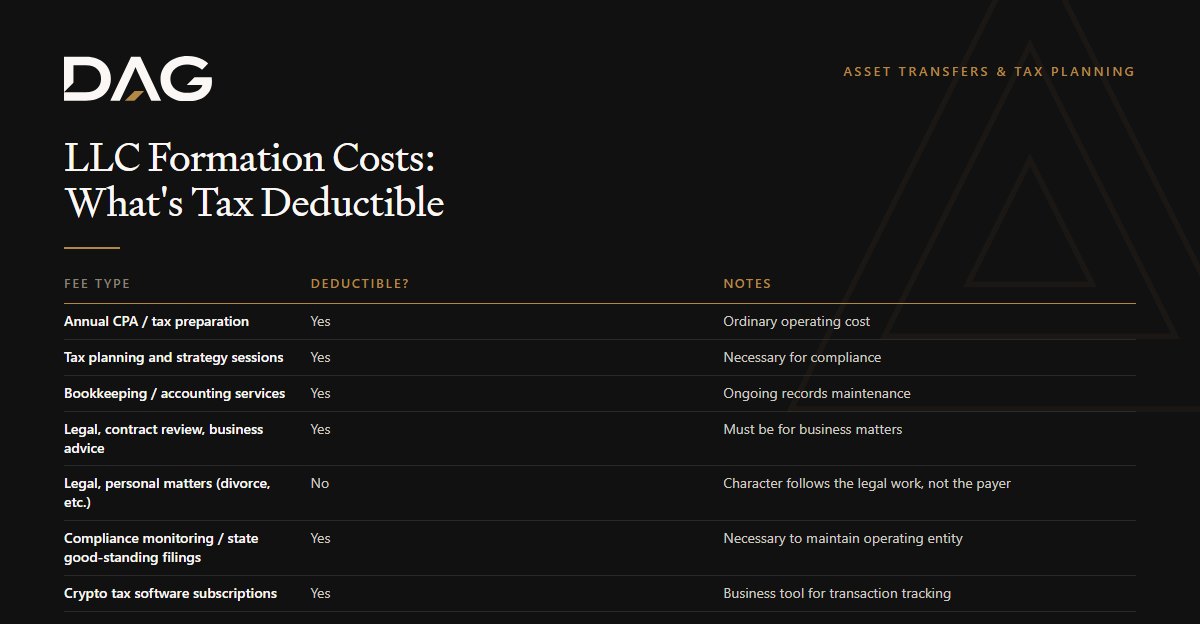
Once the LLC is operating, professional service fees shift from §195 startup treatment to ordinary and necessary business expenses under IRC §162, generally deductible in full in the year paid.
| Fee Type | Deductible? | Notes |
|---|---|---|
| Annual CPA / tax preparation | Yes | Ordinary operating cost |
| Tax planning and strategy sessions | Yes | Necessary for compliance |
| Bookkeeping / accounting services | Yes | Ongoing records maintenance |
| Legal, contract review, business advice | Yes | Must be for business matters |
| Legal, personal matters (divorce, etc.) | No | Character follows the legal work, not the payer |
| Compliance monitoring / state good-standing filings | Yes | Necessary to maintain operating entity |
| Crypto tax software subscriptions | Yes | Business tool for transaction tracking |
| Custody fees for LLC-held digital assets | Generally | Deductible if the LLC holds the assets for a genuine trade-or-business purpose; investment-only holding may be treated differently. Confirm with a CPA |
| Registered agent fees | Yes | Required to maintain LLC status |
The personal-versus-business line
The IRS looks at the character of the legal work, not which account you paid from. Fees for business contract review are deductible. Fees for a personal matter, even one discussed alongside business topics, are not. Document the specific business purpose on every invoice.
How Do LLC Startup Costs Connect to Digital Asset Structures?
High-net-worth investors forming LLCs to hold crypto assets often pay more in formation costs than a simple single-member LLC, particularly when the structure involves trust ownership, multi-sig custody policies, or coordinated tax planning across entities.
For entity structures that sit inside a broader crypto wealth plan, the deductibility of formation and professional fees is one piece of a larger picture that includes cost basis tracking, crypto tax reporting, and entity-level compliance. DAG coordinates that picture at the family office level, entity structuring, professional fee tracking, and multi-entity tax coordination, because the IRS rules interact across each layer.
Understanding how crypto is held inside an LLC versus a trust also affects which professional fees arise and how they are classified, a question best resolved before formation, not after.
For LLCs used specifically for crypto custody, annual custody fees, compliance services, and accounting for on-chain activity are generally ongoing operating expenses, typically deductible under §162 rather than amortized under §195, though custody-fee treatment depends on whether the LLC's activity rises to a trade or business. A CPA should confirm the classification for your facts.
Related Questions
Can I deduct LLC formation costs if the business never opens?
No. IRC §195 only permits deduction or amortization of startup costs if the business actually begins operations. If you pay formation costs but abandon the project before the LLC opens for business, the costs may be treated as a capital loss rather than a deductible expense. Consult a CPA if operations are delayed or uncertain.
Are organizational costs for a partnership or LLC different from startup costs?
Yes. Organizational costs, fees directly related to forming the entity itself (state filing fees, legal fees for drafting the operating agreement), are treated under IRC §709 for a partnership-taxed LLC (or §248 if the LLC elects corporate treatment), not §195. The mechanical treatment parallels §195 (up to $5,000 immediate deduction, remainder amortized over 180 months), but the categories are distinct. Startup costs cover pre-operating investigation and preparation; organizational costs cover entity formation. Most LLCs incur both. Document each category separately so the correct code section applies.
When does the 180-month amortization period start?
The amortization period begins with the month the business begins active operations, not the month you paid the startup costs or filed the Articles of Organization. If you incur formation costs in March but don't begin operating until September, amortization starts in September.
What if I paid professional fees from my personal account during formation?
The business purpose, not which account funds came from, determines deductibility. If a cost was legitimately incurred for the LLC, paid before operations began, and properly documented, it generally qualifies as a startup cost regardless of payment source. Keep records showing the business purpose and reimburse the business appropriately if funds were commingled.
Sources
- IRC §195. Start-Up Expenditures (Cornell LII)
- IRS Publication 535. Business Expenses (IRS.gov)
- IRS Publication 583. Starting a Business and Keeping Records (IRS.gov)
- IRC §162. Trade or Business Expenses (Cornell LII)
- IRC §709. Treatment of Organization Fees (Cornell LII)
Compliance Note
This page is for educational purposes only and does not constitute tax, legal, or investment advice. Tax treatment of LLC formation costs and professional fees depends on facts specific to each situation, entity type, state of formation, timing of operations, and the nature of each expense. The rules summarized here reflect general federal income tax principles under IRC §195 and §162 and may differ under state law. Consult a qualified CPA or tax attorney before making deduction decisions. DAG Wealth does not provide tax or legal advice; professional fee coordination is part of our integrated family office services offered alongside your independent tax advisors.