
Crypto tax records are the documents that let an investor or adviser substantiate digital asset reporting: cost basis, income events, transfers between wallets, entity ownership, and the tax forms filed each year. Good records turn a potentially complex filing into a defensible one; missing records usually become a reconstruction project under deadline pressure.
What "Crypto Tax Records" Means
A crypto tax record is any contemporaneous document that supports a number on a return. The IRS generally treats digital assets as property, so each disposition (a sale, a trade, or spending crypto) is a taxable event that needs an acquisition date, a cost basis, a disposition date, and proceeds. Records that establish those four data points, exchange statements, on-chain history, wallet inventories, and CPA workpapers, are what make a position reportable rather than estimated. The right standard depends on your facts, and a qualified tax professional should confirm how it applies to you.
This hub organizes the supporting pages below. For where tax records sit inside the broader picture, see crypto wealth management and the Crypto Wealth Management Hub.
Core Questions
- What records should crypto investors keep?
- How do I reconstruct crypto cost basis?
- Are wallet transfers taxable?
- How do I report crypto from multiple exchanges?
- What is Form 8949?
- What is Form 1099-DA?
- How should trusts, LLCs, and family offices report crypto?
Recordkeeping Framework
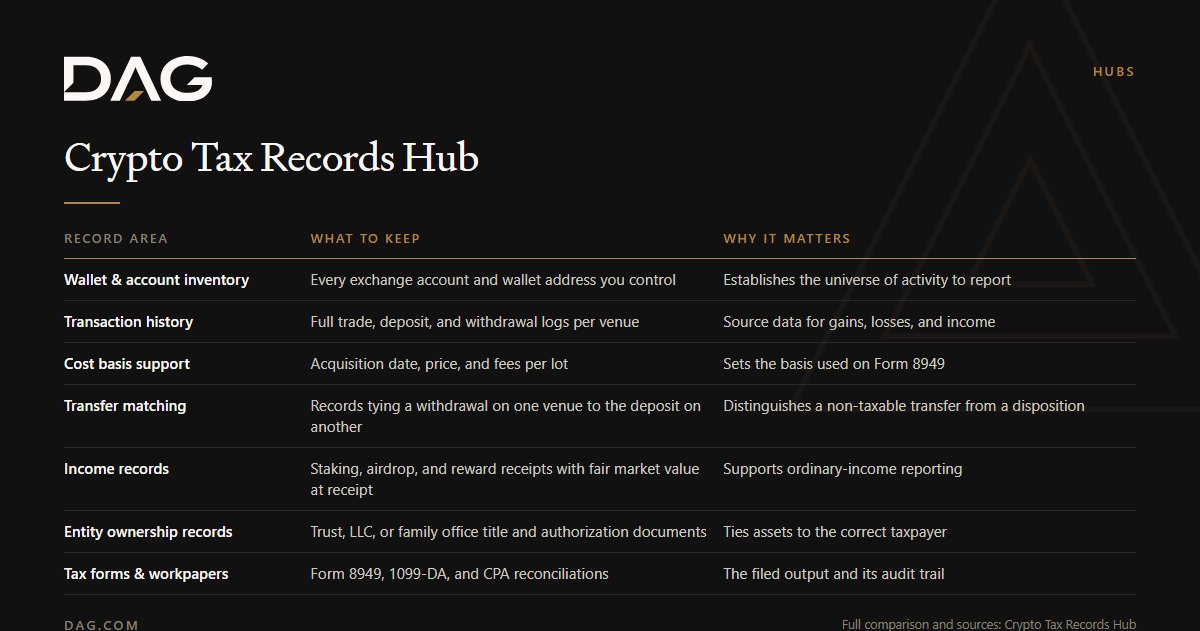
A working record set covers seven areas. Each line below maps to the document that proves it:
| Record area | What to keep | Why it matters |
|---|---|---|
| Wallet & account inventory | Every exchange account and wallet address you control | Establishes the universe of activity to report |
| Transaction history | Full trade, deposit, and withdrawal logs per venue | Source data for gains, losses, and income |
| Cost basis support | Acquisition date, price, and fees per lot | Sets the basis used on Form 8949 |
| Transfer matching | Records tying a withdrawal on one venue to the deposit on another | Distinguishes a non-taxable transfer from a disposition |
| Income records | Staking, airdrop, and reward receipts with fair market value at receipt | Supports ordinary-income reporting |
| Entity ownership records | Trust, LLC, or family office title and authorization documents | Ties assets to the correct taxpayer |
| Tax forms & workpapers | Form 8949, 1099-DA, and CPA reconciliations | The filed output and its audit trail |
Cost Basis and Reporting
How you establish and identify basis drives most of the reporting work.
- Comparing the accounting methods that decide which lot you sell: crypto cost basis methods.
- Reconstructing basis from incomplete history: how to reconstruct crypto cost basis.
- Choosing which lots you sell: what is specific identification for crypto.
- Whether harvesting a loss and rebuying triggers a disallowance: the current, dated state of the wash sale rules for crypto.
- Picking a tool to compute all of this: a neutral guide to crypto tax software for family offices.
- The broker reporting form: what is Form 1099-DA.
Planning and Trust Reporting
Records also feed planning and entity-level filings.
- For larger portfolios: crypto tax planning for HNW investors.
- For assets held in trust: crypto tax reporting for trusts.
- When transferring coins to children or a spouse: the gift tax rules for crypto, including annual exclusion and carryover basis.
- How your home state taxes a gain: the state tax treatment of crypto gains across high-tax and no-income-tax states.
- A standing document set to maintain: the crypto tax records checklist.
Related Questions
Are wallet-to-wallet transfers taxable?
Moving crypto between wallets you own is generally not a taxable disposition, but you still need records matching the withdrawal to the deposit so the movement is not mistaken for a sale. Treatment depends on your facts; confirm with a qualified tax professional.
How long should crypto tax records be kept?
Records should generally be kept long enough to support every open tax year, and basis records often need to survive until the asset is sold and that year's return closes. Retention periods vary by situation, so check with your tax adviser.
Does a 1099-DA replace keeping my own records?
No. Broker reporting on Form 1099-DA supplements your records but may not capture full cost basis across venues or self-custodied wallets, so independent records remain necessary. See what is Form 1099-DA.
Sources
Compliance Note
This hub is educational and does not provide legal, tax, accounting, investment, or custody advice. Crypto tax records should be reviewed with qualified tax professionals. Tax outcomes depend on your specific facts and on current law, which can change.