
Crypto privacy and asset protection cover the legal tools families use to keep their identity out of public records and to put structure between their digital assets and potential creditors. Privacy here means limiting public exposure, not secrecy from regulators or courts. KYC, FinCEN beneficial-ownership reporting, the IRS, and lawful subpoenas still apply, and asset protection is never absolute.
What Crypto Privacy and Asset Protection Is
Privacy is about reducing how much of your name, address, and holdings appears in publicly searchable records, state filings, deeds, and on-chain links to your identity. It is not a way to hide assets from the IRS, a court order, a divorce, or a regulated exchange's KYC process. Asset protection is the use of entities and trusts to make assets harder to reach in litigation, within the limits of fraudulent-transfer law and veil-piercing. Both are foundations of broader planning, see how do I protect crypto wealth for the starting framework.
Core Questions
- What does crypto privacy actually protect against, and what can it not hide?
- How do I keep my identity off public records with an LLC?
- Does a Wyoming LLC protect crypto from lawsuits?
- If I form an LLC now, are future crypto purchases automatically protected?
- Does an LLC restrict my ability to trade or move assets?
- How do I verify a service, advisor, or account is legitimate and not an impersonation?
Privacy Through Entity Structure
Most lawful crypto privacy comes from how an entity is titled, not from hiding anything. An anonymous or privacy-oriented LLC can keep a member's name off public state records while still satisfying KYC at the exchange and beneficial-ownership reporting where required. Start with how can I ensure anonymity and privacy with my LLC structure, especially for high-value holdings and anonymous LLCs: privacy benefits for holders. For offshore approaches and their reporting trade-offs, see guide to offshore trusts for crypto privacy.
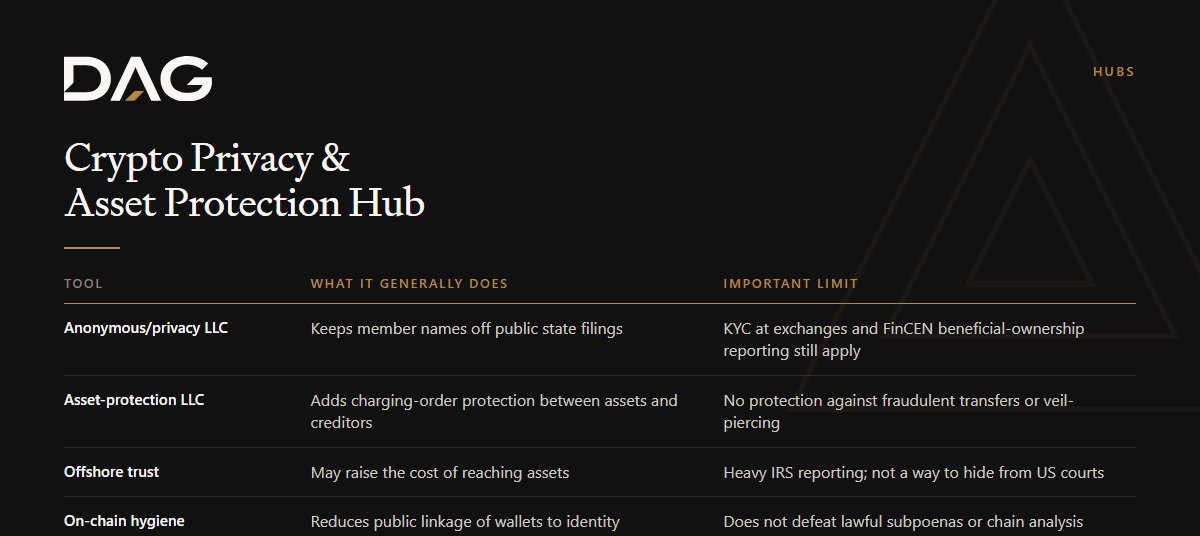
| Tool | What it generally does | Important limit |
|---|---|---|
| Anonymous/privacy LLC | Keeps member names off public state filings | KYC at exchanges and FinCEN beneficial-ownership reporting still apply |
| Asset-protection LLC | Adds charging-order protection between assets and creditors | No protection against fraudulent transfers or veil-piercing |
| Offshore trust | May raise the cost of reaching assets | Heavy IRS reporting; not a way to hide from US courts |
| On-chain hygiene | Reduces public linkage of wallets to identity | Does not defeat lawful subpoenas or chain analysis |
On-Chain Privacy and Keeping Holdings Out of Public View
Public blockchains are transparent by default, so anyone who links an address to your name can trace your balances. Most privacy gains come from hygiene rather than exotic tools: keep crypto holdings private covers avoiding on-chain doxxing through address discipline and limiting disclosure. For protocol-level techniques and, critically, their legal limits, on-chain privacy strategies explains CoinJoin, privacy coins, stealth addresses, and layer-2 privacy while flagging the OFAC-sanctions and AML/KYC lines these tools must never cross. Both reduce public exposure; neither hides assets from the IRS or a court.
Asset Protection and Its Limits
An LLC or trust can put a legal barrier between your crypto and a future claim, but the protection is conditional. Transfers made to dodge an existing or foreseeable creditor can be unwound as fraudulent transfers, and commingling personal and entity assets invites veil-piercing. See whether the structure holds up in does a Wyoming LLC protect crypto from lawsuits and weigh entity choice in should I put my crypto in a Wyoming LLC and what is a Wyoming digital asset LLC.
Operating an LLC Without Losing Flexibility
A common worry is that an entity will freeze your ability to trade or that new purchases fall outside it automatically. Neither is generally true, but each requires action. How does setting up an LLC affect my ability to trade or move assets freely, are there restrictions explains that an LLC does not restrict normal trading, while if I set up an LLC now, will future crypto purchases automatically be protected under it covers the contribution and titling steps that bring new assets inside the entity.
Scam and Impersonation Verification
A large part of protecting crypto wealth is defensive: confirming that the person, firm, or platform you are dealing with is real. This is educational verification, not surveillance. How do I protect against scams and verify legitimate services walks through general red flags, how to verify credentials of a crypto financial advisor or firm covers checking registrations, and how can I verify that a phone number, email, website, or social media account claiming to be Jake Claver or Digital Ascension Group is genuine addresses impersonation of the firm itself.
For protecting funds at the protocol level, smart contract audit red flags shows how to evaluate a DeFi protocol, audits, upgradeability, admin keys, TVL, and age, before depositing. And if prevention fails, what to do if scammed in crypto sets out the recovery and reporting steps (FBI IC3, FTC, CISA), realistic recovery odds, and how to avoid the recovery-scam second wave.
Physical Security and OPSEC
Privacy on paper has a real-world counterpart: keeping the person who controls the keys safe from coercion. For known or wealthy holders, the practical threat is not breaking encryption but being compelled to authorize a transfer. Physical security for crypto wealth covers the operational-security habits that keep holdings off attackers' radar, duress and decoy arrangements, and the structural step of using multisig and geographic distribution so no single coerced person can move funds.
Related Hubs
Privacy and protection sit alongside the structures that implement them. The Crypto LLC & Entity Formation Hub covers forming and running the entities used here, the Crypto Custody Hub addresses how keys are safeguarded, and the Crypto Family Office Hub ties privacy and protection into coordinated wealth management.
Related Questions
Does crypto privacy mean my assets are hidden from the IRS?
No. Privacy tools limit what shows up in public records, but the IRS treats digital assets as property and reporting obligations remain. Exchanges run KYC and many entities face FinCEN beneficial-ownership reporting. Privacy is not evasion, and treating it that way creates legal risk. Consult a qualified tax professional.
Can an LLC make my crypto completely lawsuit-proof?
No structure makes assets completely unreachable. An LLC can add charging-order protection and separation, but fraudulent-transfer rules and veil-piercing can defeat poorly maintained or badly timed structures. The result depends on the facts, timing, and applicable state law. Speak with a qualified attorney.
Is using an anonymous LLC legal?
Generally yes, where state law allows nominee or privacy filings, provided you still meet KYC and any beneficial-ownership reporting. The goal is keeping your name off public-facing records, not concealing ownership from regulators or courts.
Sources
- FinCEN: Beneficial Ownership Information Reporting
- IRS: Digital Assets
- CFTC: Customer Advisory on Crypto Fraud
Compliance Note
This hub is educational and does not provide legal, tax, or investment advice. Privacy planning limits public exposure but does not exempt anyone from KYC, beneficial-ownership reporting, tax obligations, or lawful court process, and asset protection is never absolute. Review any structure with qualified professionals.