
LLC anonymity for crypto holdings means keeping your name out of public state filings, not hiding assets from the IRS, courts, or banks. A Wyoming LLC using a registered agent, manager-managed structure, and clean account separation can shield your identity from public-records searches while you stay fully compliant with federal tax reporting and bank KYC rules. This is one layer in a broader approach to crypto privacy and asset protection.
What does "LLC anonymity" actually mean?
Anonymity in this context is about public records, not secrecy from government or financial institutions. Wyoming does not require member names in its public LLC filings. A registered agent's address appears instead of yours. That makes it harder for a plaintiff's attorney, a journalist, or an opportunistic lawsuit to connect a public filing to your name before any legal action begins.
What anonymity does not mean:
- The IRS does not know who you are, they do (EIN application, tax returns, Schedule K-1 flow-through)
- Banks do not know who you are. KYC/AML rules require identity verification to open any business account
- Courts cannot pierce the structure, asset protection is real but not absolute; courts can and do pierce LLCs for fraud, commingling, or failure to maintain formalities
- Federal beneficial-ownership rules never apply, the Corporate Transparency Act (CTA) is in flux; under a March 2025 FinCEN interim final rule, U.S.-formed ("domestic") companies and U.S. persons are currently exempt from filing beneficial-ownership information (BOI), while foreign companies registered to do business in the U.S. still report. This is interim and subject to a pending final rule and litigation, verify current status with counsel (see Sources)
Privacy = shielding your identity from public record searches. It is not tax evasion, and structuring for privacy does not relieve any reporting obligation.
How does a Wyoming LLC create privacy for public records?
Wyoming's statutes do not require member names in the Articles of Organization or annual reports. The privacy mechanism rests on three elements working together:
1. Registered agent instead of your home address
A professional registered agent's address appears in all public filings. Your residential address stays off state databases entirely.
2. Manager-managed structure
In a member-managed LLC, members may appear in operating documents filed or referenced publicly. A manager-managed structure puts a manager (which can be an entity you control) on record instead. See Should a Crypto LLC Be Manager-Managed? for how this choice affects governance.
3. Operating address separation
The LLC's business address, used for banking, correspondence, and filings, should be distinct from your personal residence. Many holders use the registered agent address or a commercial mailbox.
Step-by-step: structuring an LLC for privacy with crypto holdings
- Form the LLC in Wyoming. File Articles of Organization naming only a registered agent; do not list member names.
- Designate a professional registered agent. Use a licensed Wyoming registered agent service. Do not use your home address.
- Elect manager-managed governance. Name a manager (yourself or a management entity) in the operating agreement; do not list beneficial members in any public document.
- Open a dedicated business bank account. Banks require KYC documentation, your identity is known to the bank, but this is not a public record.
- Check current FinCEN BOI status. The CTA's beneficial-ownership reporting regime is in flux. Under FinCEN's March 2025 interim final rule, domestic LLCs and U.S. persons are currently exempt from filing BOI; only foreign-formed companies registered in the U.S. report. A final rule is pending and the rule has been the subject of litigation, confirm whether any filing obligation applies to you with legal counsel before relying on the exemption.
- Obtain an EIN. Required for banking and tax filing; your SSN or ITIN links to it in IRS records.
- Transfer digital assets into the LLC's wallet or custody account. The LLC, not you personally, becomes the account holder. See How to Transfer Crypto Into an LLC for mechanics and documentation.
- Maintain strict separation. Never use the LLC wallet for personal transactions. Commingling is the primary ground courts use to pierce the corporate veil. See What Happens If I Mix Personal and LLC Crypto?
- Keep records. Wyoming LLCs must maintain an operating agreement and basic financial records. See What Records Should a Crypto LLC Keep?.
- Consider a trust as the LLC's member. Holding the LLC membership interest inside a trust adds a further layer: the trust, not your name, appears as the member in private operating documents. See Should a Trust Own a Wyoming LLC for Crypto Assets?.
Wyoming vs. other states for crypto privacy
| Factor | Wyoming | Delaware | New Mexico |
|---|---|---|---|
| Member names in public filings | Not required | Not required | Not required |
| Annual report | Required (minimal) | Required + franchise fee | Not required |
| Digital-asset-specific statutes | Yes (digital assets classified as property, WY Stat. § 34-29-101; DAO LLC supplement, § 17-31) | No specific statute | No specific statute |
| Registered agent required | Yes | Yes | Yes |
| Asset protection charging-order exclusivity | Yes | Limited | Yes |
| State income tax | None | None (for out-of-state LLCs) | None |
Wyoming is unusual in addressing digital assets by statute: it classifies digital assets as property under WY Stat. § 34-29-101, and its Decentralized Autonomous Organization Supplement (§ 17-31) provides a dedicated LLC framework for on-chain organizations. These statutes do not themselves create anonymity, but they give digital-asset holders a clearer legal footing than states with no specific framework. Confirm current statute text and section numbers with counsel, as Wyoming revisits this area frequently.
What privacy a Wyoming LLC does NOT provide
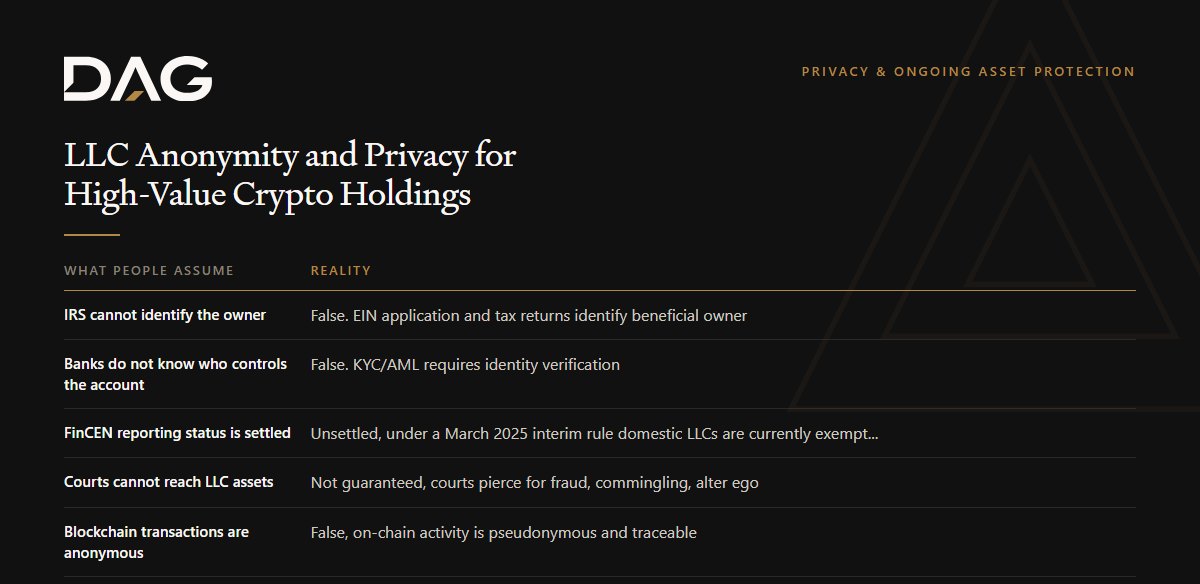
| What people assume | Reality |
|---|---|
| IRS cannot identify the owner | False. EIN application and tax returns identify beneficial owner |
| Banks do not know who controls the account | False. KYC/AML requires identity verification |
| FinCEN reporting status is settled | Unsettled, under a March 2025 interim rule domestic LLCs are currently exempt from CTA BOI filing, but a final rule is pending; verify current status |
| Courts cannot reach LLC assets | Not guaranteed, courts pierce for fraud, commingling, alter ego |
| Blockchain transactions are anonymous | False, on-chain activity is pseudonymous and traceable |
For a broader view of how LLC structure interacts with asset protection, see Does a Wyoming LLC Protect Crypto From Lawsuits?.
How does custody choice affect privacy?
Custody is a separate decision from entity structure, and it has its own privacy implications:
- Exchange custody (major crypto exchanges) places your name, and the LLC's name, in an exchange's KYC database. That database can be subpoenaed, hacked, or subject to data requests.
- Qualified institutional custody (institutional crypto custodians) also requires KYC, but assets are held in the LLC's name under an institutional custody agreement rather than a retail account. See Crypto Custody for LLCs.
- Self-custody (hardware wallet held by the LLC) keeps transactions off exchange databases, though on-chain activity remains publicly visible on the blockchain. The LLC controls the keys; no third-party custodian holds identity-linked records beyond what the LLC creates internally.
Related Questions
Does forming an LLC mean I don't have to report crypto to the IRS?
No. LLC formation does not change federal tax obligations. A single-member LLC is disregarded for federal tax purposes, income and gains flow to your personal return. A multi-member LLC files a partnership return (Form 1065). All reportable crypto transactions, sales, swaps, staking income, remain taxable regardless of entity structure.
Can a state court or plaintiff discover my identity despite the LLC?
Yes, through discovery. If litigation is filed against the LLC, opposing counsel can subpoena the bank, the registered agent's records, any FinCEN BOI filing that exists, and EIN records. Privacy structures delay and complicate public identification, they do not prevent court-compelled disclosure.
Does a trust over the Wyoming LLC add meaningful privacy?
A trust as the LLC's sole member removes your name from the LLC's private operating agreement and any documents that might be filed or subpoenaed in the LLC's name. The trust itself has its own formation documents, but in many states those are not publicly filed. This layering can meaningfully reduce exposure in public-records searches and some litigation scenarios, but courts can still compel disclosure through discovery. An attorney should evaluate whether the structure withstands scrutiny in your jurisdiction.
What is FinCEN BOI reporting and does it undermine LLC privacy?
The Corporate Transparency Act created a federal beneficial-ownership reporting regime, name, date of birth, address, and ID number filed with FinCEN, but its scope is currently in flux. Under FinCEN's March 2025 interim final rule, domestic (U.S.-formed) companies and U.S. persons are exempt from filing, and only foreign companies registered to do business in the U.S. report. Where a BOI filing does exist, it is not publicly searchable, it is accessible only to law enforcement, financial institutions conducting due diligence, and certain government agencies, and does not appear in state public records. A final rule is pending and the regime has been litigated, so verify current deadlines and exemptions with qualified legal counsel before relying on any exemption.
Sources
- Wyoming Statutes Title 17, Chapter 31 (Decentralized Autonomous Organization Supplement): https://law.justia.com/codes/wyoming/title-17/chapter-31/
- Wyoming Statutes Title 17, Chapter 29 (Wyoming Limited Liability Company Act): https://law.justia.com/codes/wyoming/title-17/chapter-29/
- Corporate Transparency Act, 31 U.S.C. § 5336 (statutory basis for FinCEN BOI reporting): https://www.govinfo.gov/content/pkg/USCODE-2022-title31/pdf/USCODE-2022-title31-subtitle4-chapter53-subchapterII-sec5336.pdf
- FinCEN, Beneficial Ownership Information Reporting Requirement Revision and Deadline Extension (interim final rule, Mar. 26, 2025): https://www.federalregister.gov/documents/2025/03/26/2025-05199/beneficial-ownership-information-reporting-requirement-revision-and-deadline-extension
- FinCEN. Beneficial Ownership Information (current guidance): https://www.fincen.gov/boi
- IRS. Single Member Limited Liability Companies: https://www.irs.gov/businesses/small-businesses-self-employed/single-member-limited-liability-companies
- IRS. Limited Liability Company (LLC): https://www.irs.gov/businesses/small-businesses-self-employed/limited-liability-company-llc
Compliance Note
This page is educational only and does not constitute legal, tax, or investment advice. LLC structure, state statutes, FinCEN reporting requirements, and asset-protection outcomes vary by jurisdiction and individual circumstances, and asset protection is never absolute. Corporate Transparency Act beneficial-ownership reporting is in flux: under FinCEN's March 2025 interim final rule, domestic companies and U.S. persons are currently exempt, but a final rule is pending and the regime has been litigated, verify current requirements with a qualified attorney before relying on any exemption. Privacy structures do not eliminate reporting obligations to the IRS or identity-verification (KYC) obligations at financial institutions, and they do not shield assets from courts. Consult a qualified attorney, CPA, and fiduciary financial advisor before establishing any entity structure for high-value holdings. DAG coordinates this planning across your professional team but does not provide legal or tax advice directly.