
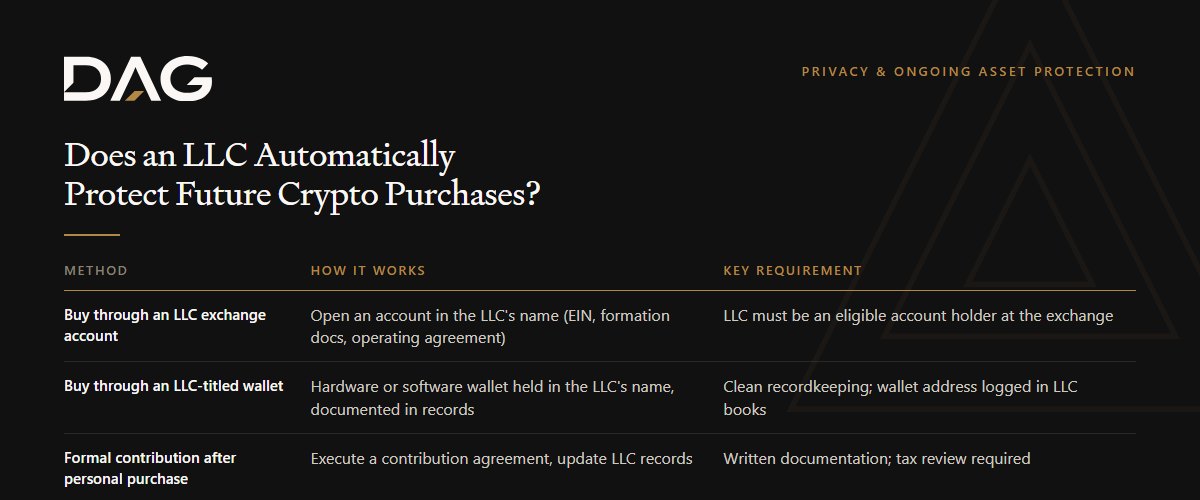
No. LLC crypto asset protection does not extend automatically to coins you buy after forming the entity. Crypto is only inside the LLC if it is acquired through an LLC exchange account, held in an LLC-titled wallet, or formally contributed in writing. Crypto bought personally stays personal, whenever you formed the LLC. Titling is one of the most misunderstood mechanics in crypto privacy and asset protection.
What "Protected by an LLC" Actually Means
An LLC is a legal container, not a force field. Formation creates the entity. Titling puts assets inside it.
A creditor challenging a personal asset won't ask when you formed your LLC. They'll ask what the records show. If the exchange account, the wallet, and the transaction history are all in your name, the asset is yours personally, and the LLC is irrelevant to that claim.
The same gap catches real estate investors: an LLC formed before a property purchase does nothing if the deed remains in the owner's personal name. Crypto works identically. Ownership follows titling, not intent.
Why Future Purchases Do NOT Transfer Automatically
The LLC is a separate legal person
Your LLC and you are legally distinct. When you buy crypto from a personal bank account into a personal exchange account, the purchaser is you, not the LLC. The asset never enters the entity.
Exchange accounts and wallets are titled to whoever opened them
If your exchange account is registered under your personal name and Social Security number, every asset in it is yours personally. Opening a new LLC account and moving assets across is a separate, deliberate act, it doesn't happen by default.
Contribution requires documentation
If you buy crypto personally and later want to transfer it into the LLC, that is a capital contribution, a formal transfer of ownership. It generally requires:
- A written contribution agreement or resolution signed by the member(s)
- An entry in the LLC's records (operating agreement ledger or cap table)
- Tax coordination, contributing crypto to a disregarded single-member LLC, or to a multi-member LLC taxed as a partnership under §721, is generally not itself a taxable event; the taxable event is selling or disposing of the crypto. Treatment depends on the structure, so confirm with a qualified tax advisor
Simply moving tokens from one wallet to another, without documentation, does not legally transfer ownership from you to the LLC.
How to Keep Future Crypto Inside the LLC
| Method | How it works | Key requirement |
|---|---|---|
| Buy through an LLC exchange account | Open an account in the LLC's name (EIN, formation docs, operating agreement) | LLC must be an eligible account holder at the exchange |
| Buy through an LLC-titled wallet | Hardware or software wallet held in the LLC's name, documented in records | Clean recordkeeping; wallet address logged in LLC books |
| Formal contribution after personal purchase | Execute a contribution agreement, update LLC records | Written documentation; tax review required |
The cleanest path is to use an LLC exchange account from the start so each purchase is made by the entity. Retroactive contributions work but require documentation discipline and tax review on each batch.
What about hardware wallets?
A hardware wallet does not carry its own legal title. The protection comes from the records establishing that the wallet and its contents belong to the LLC, not from the device itself. Maintain a wallet inventory that names the LLC as owner, keep a copy in the LLC's books, and document any transfers in or out.
For more on how custody interacts with LLC ownership, see crypto custody for LLCs.
Three Mistakes That Leave Crypto Exposed
- Continuing to use a personal exchange account after forming the LLC. Every purchase made through that account stays personal.
- Moving tokens to a new wallet without a contribution agreement. A wallet transfer is not a legal transfer of ownership.
- Mixing personal and LLC assets in the same wallet or account. This can blur the ownership line in a dispute and potentially undermine the LLC's liability shield. See what happens if I mix personal and LLC crypto.
LLC Protection Is Not Absolute
Even when assets are properly titled to the LLC, protection is not guaranteed in every scenario:
- Charging order protection (the primary LLC shield) varies by state and is never absolute. Wyoming and Nevada are often described as having charging-order statutes that are favorable relative to many states, but outcomes depend on the specific facts, the court, and how the structure is maintained.
- Alter ego / piercing the veil: Courts can disregard the LLC if the owner and the entity are treated as one, commingled funds, no separate records, no operating formality.
- Personal guarantees can expose you regardless of entity structure.
- Tax obligations follow you personally even when assets are held in a pass-through LLC.
An LLC is one layer in a broader structure. For higher asset levels, it is commonly paired with a trust as the LLC's parent. See should a trust own a Wyoming LLC for crypto assets and should crypto be held personally, in an LLC, or in a trust.
Related Questions
Does forming a Wyoming LLC protect crypto I already own?
Not automatically. Crypto you already own personally needs to be formally contributed to the LLC through a written contribution agreement with appropriate tax review. Formation alone does not move existing assets inside the entity. See how to transfer crypto into an LLC for the process.
What documentation does an LLC need for each crypto purchase?
At minimum: the exchange or wallet account should be registered to the LLC, and each material transaction should appear in the LLC's financial records. For formal contributions from personal holdings, a written contribution agreement and cap-table entry are standard. See what records should a crypto LLC keep.
What if I use a hardware wallet held in the LLC's name?
You can document a hardware wallet as an LLC asset, include the wallet address, acquisition date, and a statement of ownership in the LLC's books. When you acquire new crypto into that wallet, the transaction record should reflect the LLC as the beneficial owner. The key is consistent documentation, not the device itself.
Can the LLC hold crypto staking rewards automatically?
Only if the staking is conducted through an LLC account or wallet. Rewards earned in a personal staking account stay personal. If the LLC stakes crypto held in its own wallet or exchange account, the rewards accrue to the LLC, but keep records showing which wallet received them and confirm the tax treatment with a qualified CPA. See crypto tax reporting for LLCs.
Sources
- Internal Revenue Service, Publication 3402: Taxation of Limited Liability Companies, https://www.irs.gov/pub/irs-pdf/p3402.pdf
- Wyoming Statutes §17-29-101 et seq. (Wyoming Limited Liability Company Act), https://law.justia.com/codes/wyoming/title-17/chapter-29/
- Wyoming Statutes §17-29-503 (Charging order as exclusive remedy) with Wyoming Secretary of State or qualified Wyoming counsel
- Uniform Limited Liability Company Act (ULLCA 2006), Sections 503–504 (charging order), https://www.uniformlaws.org/committees/community-home?CommunityKey=b8e7c400-c76d-4027-aefb-78ee2b4e04df
Compliance Note
This page is educational only and does not constitute legal, tax, or investment advice. LLC asset protection law varies by state, and the strength of any structure depends on how it is implemented and maintained. Consult a qualified attorney and tax professional before making decisions about entity formation, asset titling, or capital contributions. DAG coordinates these matters with licensed attorneys and tax professionals and does not itself provide legal advice or draft entity, trust, or operating-agreement documents.