
Crypto custody for LLCs means holding digital assets in a way that matches the LLC's ownership, operating agreement, manager authority, and recordkeeping. The account or wallet should be titled in the LLC's legal name, controlled by documented managers, and supported by written transfer and tax-record procedures so the entity can prove who owns the assets and who is authorized to move them.
What Crypto Custody for LLCs Means
Custody is the control of the keys that move digital assets. For an LLC, custody is not only a technical question but a governance one: the structure has to line up with the operating agreement and the people authorized to act for the entity. Whether the LLC self-custodies, uses a business account at a crypto platform, or works through a qualified crypto custodian, the goal is the same, a clear, documented chain from the entity to the keys. These choices sit within the broader practice of digital asset custody for wealth-holding entities.
Custody Options for LLCs
An LLC generally has several paths, each with different control, cost, and recordkeeping trade-offs. None of them removes market, custody, or operational risk on its own.
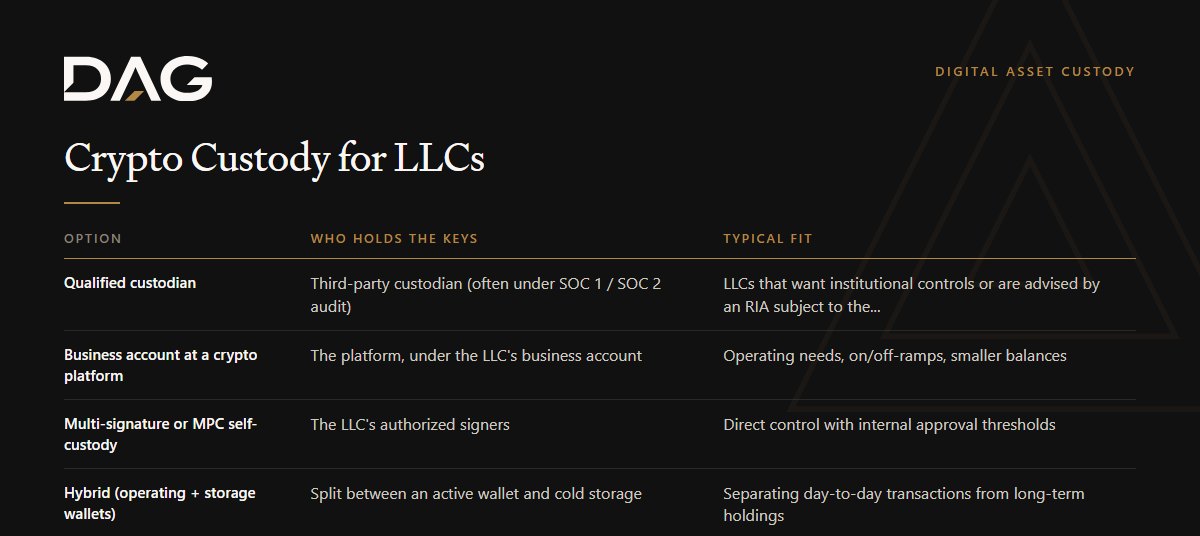
| Option | Who holds the keys | Typical fit |
|---|---|---|
| Qualified custodian | Third-party custodian (often under SOC 1 / SOC 2 audit) | LLCs that want institutional controls or are advised by an RIA subject to the SEC custody rule |
| Business account at a crypto platform | The platform, under the LLC's business account | Operating needs, on/off-ramps, smaller balances |
| Multi-signature or MPC self-custody | The LLC's authorized signers | Direct control with internal approval thresholds |
| Hybrid (operating + storage wallets) | Split between an active wallet and cold storage | Separating day-to-day transactions from long-term holdings |
Deciding between holding your own keys and using a custodian is a substantial choice on its own; see qualified custody vs self-custody for crypto wealth and, more specifically, crypto custody for LLCs vs trusts and other entities where structure drives the answer.
LLC Custody Checklist
Use this checklist when setting up or reviewing how an LLC holds crypto:
- Account or wallet is opened and titled in the LLC's legal name, not an individual's.
- Authorized managers and signers are documented, with approval thresholds (for example, multi-sig or MPC quorum).
- The operating agreement permits digital-asset activity and names who may transact.
- A written transfer-approval policy governs who can move assets and how requests are approved.
- Every wallet address the LLC controls is recorded in a maintained inventory.
- Tax records are retained; digital assets are generally treated as property by the IRS, so cost basis and disposals matter.
- Personal and LLC assets are kept strictly separate to preserve the entity's formalities.
For the broader account-opening sequence, the crypto account opening checklist for trusts and LLCs walks through the documents a custodian or platform usually asks for.
Why Entity Formalities Matter
Mixing personal and LLC crypto activity can make it harder to prove ownership, prepare accurate tax records, maintain internal controls, or explain transactions to advisors and auditors. Keeping the entity's wallets, signers, and records separate is part of what supports charging-order protection and a clean audit trail. Recording every address the entity controls, using something like a crypto wallet inventory template, is one of the simplest ways to keep that separation visible.
Related Questions
Does an LLC need a qualified custodian for crypto?
It depends on the facts. An LLC is not automatically required to use a qualified custodian, but one may be appropriate, or required, if the LLC is advised by an RIA subject to the SEC custody rule, or if the members want third-party controls and audited reporting. Consult a qualified professional before deciding.
How should an LLC title a crypto account?
Generally in the LLC's full legal name, matching its formation documents, with authorized managers or signers named per the operating agreement. Titling assets to an individual rather than the entity can undermine the separation that gives an LLC its legal benefits.
Is self-custody allowed for an LLC?
Self-custody is generally permitted, often using multi-signature or MPC controls so that no single person can move funds alone. The trade-off is that the LLC bears full responsibility for key management, succession, and incident response. Whether self-custody or a custodian is appropriate depends on the entity's facts and goals.
Sources
Compliance Note
This article is educational and does not provide legal, tax, investment, entity, or custody advice. LLC custody structures should be reviewed with qualified professionals. Custody and registration arrangements do not by themselves guarantee outcomes, eliminate risk of loss, or imply any government or insurance protection (such as FDIC or SIPC coverage) for digital assets.