
Whether a family office should use more than one crypto custodian depends on asset size, operational complexity, reporting needs, risk tolerance, and governance policy. A second custodian can reduce concentration with a single counterparty, but it also adds accounts, reconciliation, and review work. There is no single right answer; the decision turns on the facts of each family.
What "Multiple Custodians" Means Here
Using multiple custodians means holding digital assets across two or more separate qualified custodians rather than concentrating everything with one. The aim is usually to spread counterparty risk, segregate assets by legal entity, or match different mandates to different providers. It is distinct from holding multiple wallets at the same custodian, and from mixing self-custody with custodial accounts. For background on how qualified custody differs from self-custody, see qualified custody vs. self-custody for crypto wealth.
One Custodian vs. Multiple Custodians
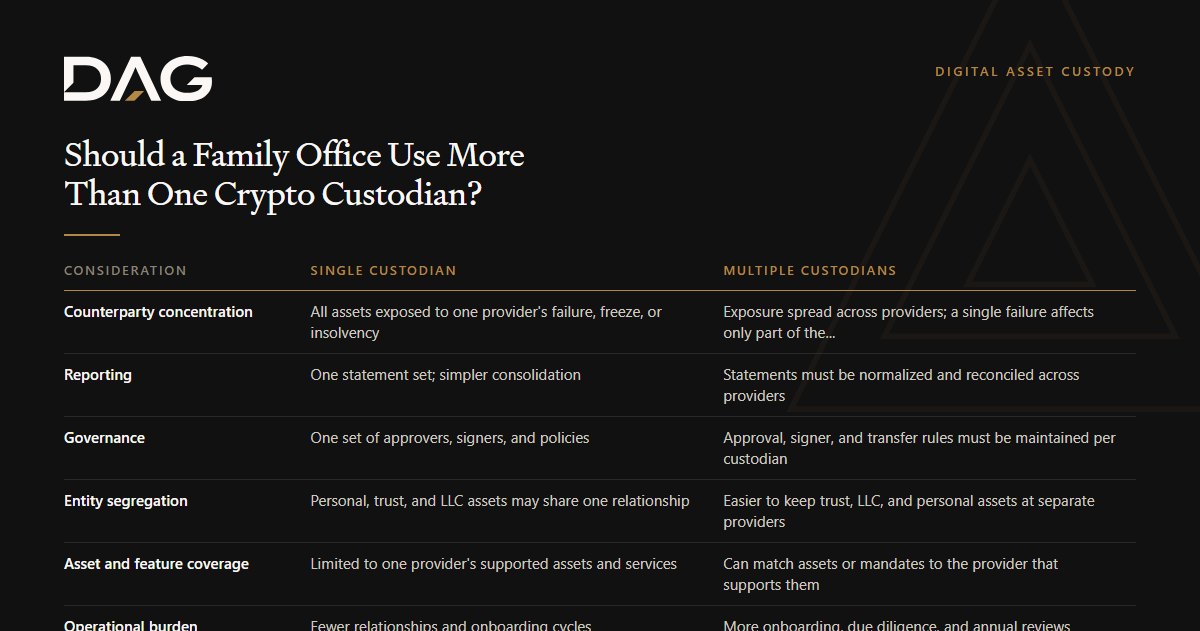
| Consideration | Single custodian | Multiple custodians |
|---|---|---|
| Counterparty concentration | All assets exposed to one provider's failure, freeze, or insolvency | Exposure spread across providers; a single failure affects only part of the holdings |
| Reporting | One statement set; simpler consolidation | Statements must be normalized and reconciled across providers |
| Governance | One set of approvers, signers, and policies | Approval, signer, and transfer rules must be maintained per custodian |
| Entity segregation | Personal, trust, and LLC assets may share one relationship | Easier to keep trust, LLC, and personal assets at separate providers |
| Asset and feature coverage | Limited to one provider's supported assets and services | Can match assets or mandates to the provider that supports them |
| Operational burden | Fewer relationships and onboarding cycles | More onboarding, due diligence, and annual reviews |
| Fees | One fee schedule to negotiate and monitor | Fees compared and tracked across providers |
Reasons to Use Multiple Custodians
- Reduce concentration with a single counterparty.
- Keep personal, trust, and LLC assets in separate relationships.
- Access different supported assets or services.
- Separate long-term cold storage from operating wallets.
- Support different advisors or mandates.
A second custodian does not by itself remove market risk, custody risk, or tax exposure. It changes how those risks are distributed, and adds operational risk of its own. Whether the trade-off is worth it depends on the size and complexity of the portfolio.
Reasons to Use One Custodian
- Simpler reporting and consolidation.
- Easier governance and fewer approval paths.
- Lower operational complexity.
- Fewer account relationships to maintain.
- Easier tax-data collection at year end.
For smaller or less complex holdings, a single well-reviewed provider may be enough. The factors that drive the choice are the same ones you should weigh when choosing a crypto custodian for a family office.
Policy Questions to Settle First
Before adding a custodian, a family office generally documents answers to these in its custody policy:
- What is the maximum exposure permitted to any one custodian?
- Who approves adding or removing a custodian?
- How are records consolidated across providers?
- How are fees compared and monitored?
- How often is each custodian reviewed, and against what standard (for example, SOC 1 / SOC 2 reports, insurance, and qualified-custodian status)?
These belong in a written policy rather than ad hoc practice. See how to build a crypto custody policy for the broader framework this fits into.
Related Questions
How many crypto custodians does a family office need?
There is no fixed number. The right count depends on portfolio size, how many legal entities hold assets, and the office's risk tolerance. Smaller holdings often work with one reviewed provider; larger or multi-entity portfolios may justify more. Discuss the trade-offs with a qualified professional.
Does using two custodians double the diligence work?
Generally each custodian requires its own onboarding, due diligence, and periodic review, so adding one increases that work. Many offices treat the reduced concentration as worth the added effort above a certain asset level, but that judgment depends on the facts.
Does splitting assets across custodians remove custody risk?
No. Spreading assets changes how counterparty risk is distributed but does not eliminate custody, market, or tax risk, and it adds operational complexity. No arrangement guarantees against loss, and custodial accounts are not FDIC- or SIPC-insured the way bank or brokerage cash can be.
Sources
Compliance Note
This article is educational and does not provide legal, tax, investment, fiduciary, family office, or custody advice. Custodian diversification should be reviewed with qualified professionals.