
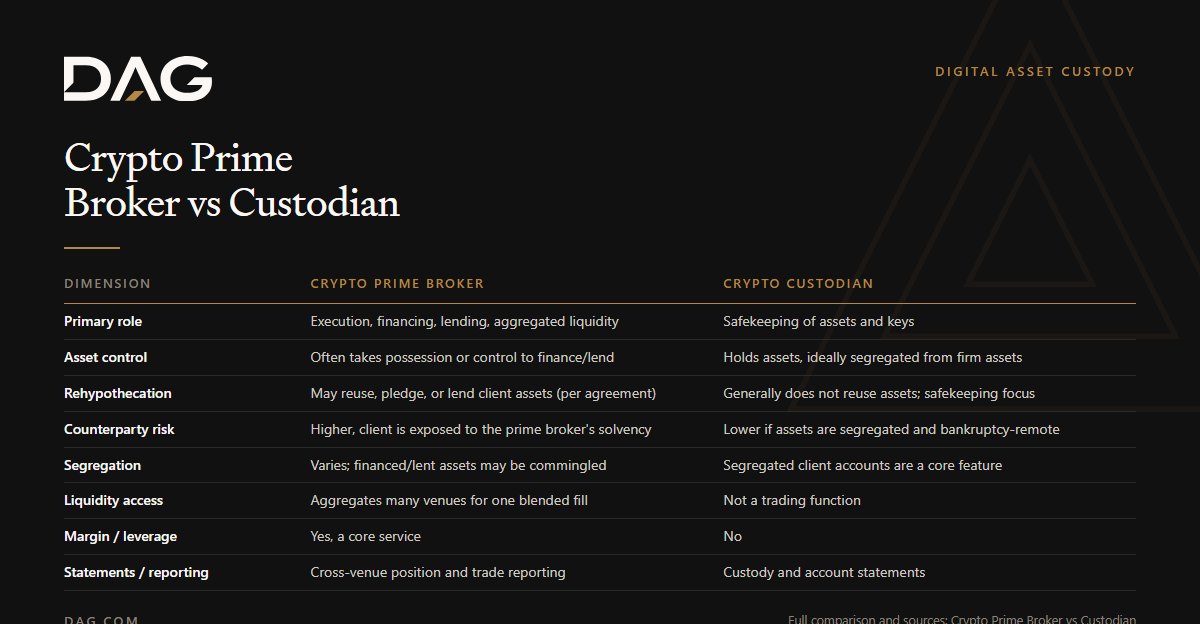
A crypto prime broker provides execution, margin and financing, lending, and aggregated liquidity across multiple trading venues, while a crypto custodian safeguards assets and holds the keys. In the crypto prime broker vs custodian question, the prime broker moves and finances assets to get a trade done; the custodian keeps them segregated and secure. The roles solve different problems, the counterparty risk differs sharply, and some firms offer both under separate legal entities.
What Is a Crypto Prime Broker?
A crypto prime broker is a trading and financing intermediary. It routes orders to multiple exchanges and liquidity providers so an institutional client can fill a large order at a blended price, extends margin or financing so the client can trade or borrow against holdings, runs securities-lending-style programs, and consolidates positions and reporting across venues. The model is borrowed from traditional prime brokerage, where a single counterparty sits between an institution and the broader market.
To deliver financing and lending, a prime broker generally needs to take possession or control of client assets, or the right to use them. That is the central distinction from custody: the prime broker's business often depends on being able to move, pledge, or lend the assets it holds.
What Is a Crypto Custodian?
A crypto custodian safeguards digital assets and controls the private keys on a client's behalf, typically under a defined legal and regulatory framework. A custodian focused on safekeeping does not trade for you, finance positions, or lend out your assets as part of its core function; it holds them, ideally segregated from the firm's own assets, and produces statements. For how that category is defined and what tests it must meet, see what is a qualified crypto custodian. This page sits under the crypto custody hub.
The functional split: a prime broker answers "how do I execute, finance, and source liquidity?" A custodian answers "where and how are the assets held and secured?"
Crypto Prime Broker vs Custodian: Comparison Table
| Dimension | Crypto Prime Broker | Crypto Custodian |
|---|---|---|
| Primary role | Execution, financing, lending, aggregated liquidity | Safekeeping of assets and keys |
| Asset control | Often takes possession or control to finance/lend | Holds assets, ideally segregated from firm assets |
| Rehypothecation | May reuse, pledge, or lend client assets (per agreement) | Generally does not reuse assets; safekeeping focus |
| Counterparty risk | Higher, client is exposed to the prime broker's solvency | Lower if assets are segregated and bankruptcy-remote |
| Segregation | Varies; financed/lent assets may be commingled | Segregated client accounts are a core feature |
| Liquidity access | Aggregates many venues for one blended fill | Not a trading function |
| Margin / leverage | Yes, a core service | No |
| Statements / reporting | Cross-venue position and trade reporting | Custody and account statements |
| Regulatory posture | Varies by entity and service; may not be a qualified custodian | May be a qualified custodian, depending on registration and facts |
Services, terms, registrations, and whether assets can be reused all vary by provider and by the specific account agreement. Verify each against the provider's current disclosures and contract.
The Risk That Most Often Gets Missed: Rehypothecation and Segregation
The sharpest difference between the two is what the firm is allowed to do with your assets. A pure custodian's job is to hold assets apart and not touch them. A prime broker, to provide margin and lending, often holds the right to rehypothecate, to reuse, pledge, or lend client assets. That right is usually spelled out in the account agreement.
Rehypothecation introduces counterparty risk that custody is designed to avoid. If a prime broker becomes insolvent while holding or having lent your assets, recovery can depend on whether the assets were segregated, whether they were bankruptcy-remote, and how the bankruptcy estate treats them. Digital assets held this way are generally not covered by FDIC or SIPC insurance. Several high-profile crypto failures turned on exactly this point: clients believed assets were merely held when, under the agreement, they could be moved or lent.
Before signing, read the agreement for whether assets can be rehypothecated, whether they are segregated, and how they would be treated in insolvency. For a deeper treatment of failure scenarios, see what happens if a crypto custodian fails, and for the underlying safekeeping comparison, qualified custody vs self-custody for crypto wealth.
When You Need Which
- You hold long-term and want assets simply secured and segregated: a custodian focused on safekeeping fits.
- You actively trade large size, need margin or financing, or want one blended fill across venues: a prime broker addresses that need, with added counterparty exposure.
- You want both, active execution and secure long-term holdings, many institutions split the portfolio, keeping core holdings in segregated custody and a working balance with a prime broker.
An RIA weighing these against the SEC custody rule should note that using a prime broker that takes control of client assets is not the same as placing them with a qualified custodian. Whether an arrangement satisfies the rule is a legal and compliance question. For how custody and advice interact more broadly, see crypto custodian vs crypto wealth manager, and for the trading-venue distinction, qualified custodian vs crypto exchange. Advisers managing client digital assets can also review qualified custody for RIAs managing digital assets within the crypto services for RIAs hub.
Where the Two Overlap
Some firms offer both prime brokerage and custody, usually through separate legal entities or product lines. That can be convenient, but it does not collapse the distinction. The relevant question is which legal entity holds a given asset, under which agreement, and whether that agreement permits reuse. Confirm the entity and the segregation terms for each balance rather than assuming a single brand name means a single risk profile.
Related Questions
Can one firm be both a crypto prime broker and a custodian?
Yes, some firms offer both, typically through distinct legal entities or service agreements. The convenience does not erase the difference in how assets are treated. Identify which entity holds each balance and whether the governing agreement permits the firm to reuse, pledge, or lend those assets, and confirm it in current disclosures.
Does using a crypto prime broker satisfy an RIA's custody-rule obligations?
Not automatically. A prime broker that takes possession or control of client assets to finance or lend them is not necessarily a qualified custodian, and the SEC custody rule generally requires advisers with custody to hold client assets with a qualified custodian. Whether a specific arrangement complies is a legal and compliance question that should be reviewed with qualified counsel.
What is rehypothecation, and why does it matter for crypto?
Rehypothecation is the reuse of client assets by the firm holding them, for example, lending or pledging them. It is common in financing and prime-brokerage arrangements and is generally absent from pure custody. It matters because it converts safekeeping into a counterparty relationship: if the firm fails while reusing your assets, recovery can depend on segregation, bankruptcy treatment, and contract terms, and the assets are generally not FDIC- or SIPC-insured.
Is a custodian always safer than a prime broker?
Not as a blanket rule. A custodian focused on segregated safekeeping generally carries lower counterparty risk, but no model removes market, operational, or counterparty risk entirely, and registration or a charter alone does not guarantee safety or skill. A prime broker provides services a custodian does not. The appropriate choice depends on your trading needs, hold horizon, and tolerance for counterparty exposure.
Sources
- SEC: Custody rule compliance guide (small entity compliance guide). https://www.sec.gov/files/custody_rule-secg.htm
- SEC: Investor Bulletin, Custody of Your Investment Assets. https://www.investor.gov/introduction-investing/general-resources/news-alerts/alerts-bulletins/investor-bulletins-73
- Office of the Comptroller of the Currency, Interpretive Letter 1170. National Banks and Trust Companies May Provide Cryptocurrency Custody Services for Customers (July 22, 2020). https://www.occ.gov/topics/charters-and-licensing/interpretations-and-actions/2020/int1170.pdf
Compliance Note
This article is for educational purposes only and does not constitute legal, tax, investment, fiduciary, compliance, or custody advice. Digital assets carry risk, including the potential loss of principal; nothing here implies guaranteed returns, a stable value, or protection by FDIC or SIPC insurance. Prime-brokerage and financing arrangements can permit reuse of client assets and carry counterparty risk that safekeeping custody is designed to avoid; review each provider's agreement and segregation terms directly. Where a firm is described as registered or chartered, that status alone does not guarantee skill, performance, or results. Provider roles, fees, and services should be verified against current disclosures. Advisory services are provided by DAG Wealth, an SEC-registered investment adviser. Consult a qualified professional about your specific facts. Registration does not imply a certain level of skill or training.