
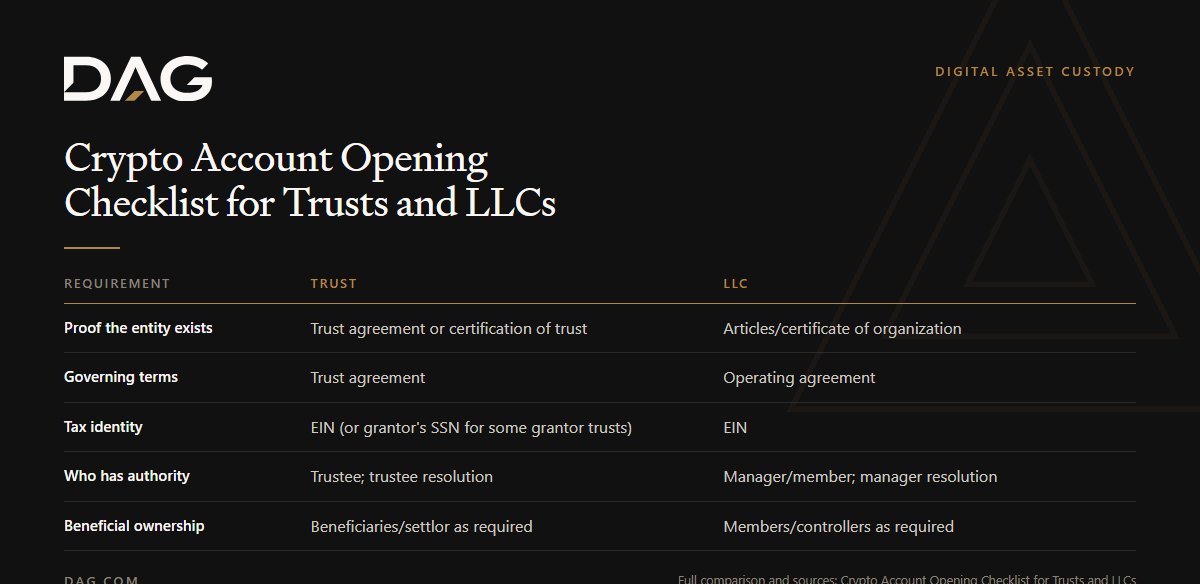
The crypto account opening checklist for trusts and LLCs covers the documents and controls a provider generally requires: the entity's formation and authority records, an EIN, beneficial ownership information, named authorized signers, source-of-funds support, and written transfer-approval procedures. Exact requirements vary by provider and by the facts of each entity.
A trust or LLC opens a crypto account in the entity's name rather than an individual's, so the onboarding paperwork has to prove two things: that the entity legally exists and that the person signing has authority to act for it. A qualified custodian or exchange uses these records to satisfy its own know-your-customer and anti-money-laundering obligations before it will hold or move assets. For how account opening fits the broader picture, see the Digital Asset Custody Hub.
Documents to Prepare
Gather these before you apply. Missing authority documents are the most common reason an entity application stalls.
- Trust agreement or certification of trust (a certification of trust often limits how much of the full agreement you disclose).
- LLC operating agreement.
- Articles or certificate of organization.
- EIN or tax identification records.
- Authorized signer information, with government ID for each signer.
- Manager or trustee resolutions authorizing the account and naming who may act.
- Beneficial ownership information for individuals who own or control the entity, if required.
- Source-of-funds support (the records that show where the assets originated).
- Investment or custody policy. If you do not have one, see how to build a crypto custody policy.
- Transfer-approval procedures, including any multi-approver or whitelisting rules you intend to enforce.
For deeper, entity-specific guidance, see crypto custody for trusts and the companion material on crypto custody for LLCs.
Questions to Ask the Provider
Ask these before you commit, because onboarding is easier to scope correctly than to unwind:
- Do you support this entity type (some providers onboard trusts but not single-member LLCs, or vice versa)?
- Who can trade or transfer assets, and can you require more than one approver for a withdrawal?
- What statements and reports are available, and at what frequency?
- Can the account support multiple authorized approvers and address whitelisting?
- How are tax records exported, and do they support the forms your accountant needs (for example, gain/loss reports and the records behind Form 1099-DA)?
- Is the account held under a qualified custody arrangement, and can you provide a current SOC 1 or SOC 2 report?
Entity Documents at a Glance
| Requirement | Trust | LLC |
|---|---|---|
| Proof the entity exists | Trust agreement or certification of trust | Articles/certificate of organization |
| Governing terms | Trust agreement | Operating agreement |
| Tax identity | EIN (or grantor's SSN for some grantor trusts) | EIN |
| Who has authority | Trustee; trustee resolution | Manager/member; manager resolution |
| Beneficial ownership | Beneficiaries/settlor as required | Members/controllers as required |
This table summarizes common patterns; the specific documents a given provider accepts depend on the facts and the provider's policy.
Related Questions
Can a trust or LLC open a crypto custody account directly?
Generally yes. Many qualified custodians and institutional platforms onboard legal entities, though support varies by provider and entity type. The application is opened in the entity's name and signed by the trustee or manager who holds authority under the governing documents.
Why does a provider ask for beneficial ownership information?
Custodians and exchanges are generally subject to know-your-customer and anti-money-laundering rules that require them to identify the individuals who ultimately own or control an entity. Expect to disclose beneficiaries, settlors, members, or managers as the provider's policy requires.
Does opening an entity account remove custody or market risk?
No. Holding crypto through a trust or LLC can support governance, recordkeeping, and (for some structures) liability or charging-order considerations, but it does not remove market, custody, or tax risk, and it does not create any FDIC or SIPC coverage. Consult a qualified legal and tax professional for your situation.
Sources
Compliance Note
This article is educational and does not provide legal, tax, fiduciary, entity, investment, compliance, or custody advice. Account opening should be reviewed with qualified professionals.