
Crypto custody for trusts is the decision about how trust-owned digital assets are held, accessed, reported, and protected so the arrangement matches the trust document and the trustee's fiduciary duties. The right model depends on the facts: who may approve transfers, how records are delivered, how keys are secured, and what happens when a trustee changes.
What Crypto Custody for Trusts Means
Custody is the function of safekeeping an asset and controlling who can move it. For a trust, that function has to sit inside a legal and operational structure the trust document authorizes, not in a trustee's personal wallet or personal exchange login. A qualified custodian is generally a regulated entity (such as a bank, trust company, or registered broker-dealer) that holds client assets under the SEC custody framework; how those rules apply to a given trust depends on the facts and should be confirmed with counsel. Choosing among models is closely tied to the broader questions covered in the Digital Asset Custody Hub.
Custody Options
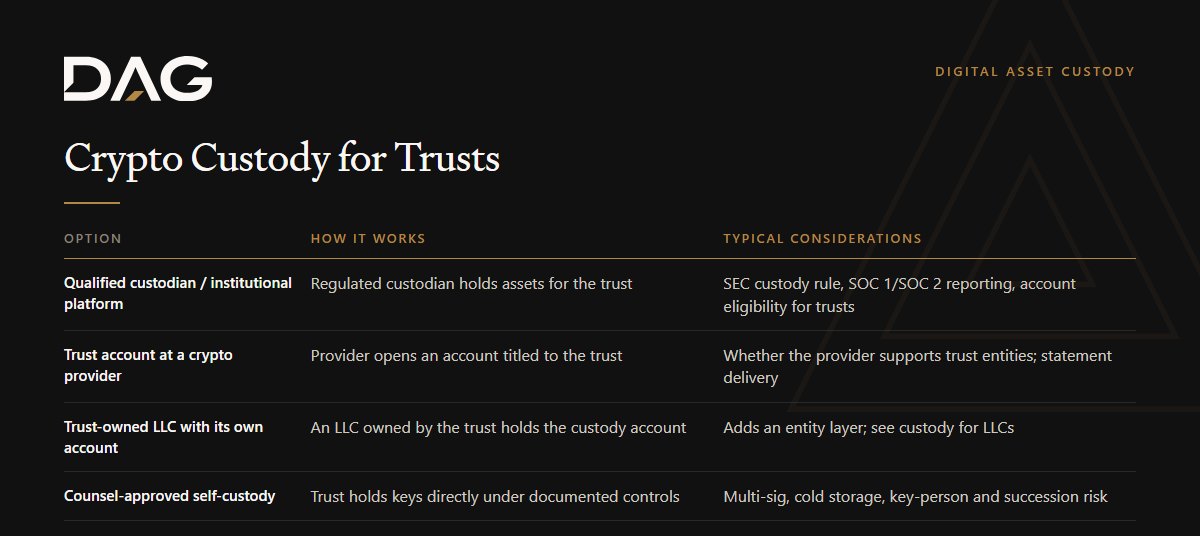
Trust-owned crypto is generally held through one of these structures:
| Option | How it works | Typical considerations |
|---|---|---|
| Qualified custodian / institutional platform | Regulated custodian holds assets for the trust | SEC custody rule, SOC 1/SOC 2 reporting, account eligibility for trusts |
| Trust account at a crypto provider | Provider opens an account titled to the trust | Whether the provider supports trust entities; statement delivery |
| Trust-owned LLC with its own account | An LLC owned by the trust holds the custody account | Adds an entity layer; see custody for LLCs |
| Counsel-approved self-custody | Trust holds keys directly under documented controls | Multi-sig, cold storage, key-person and succession risk |
A common comparison for trustees is qualified custody versus self-custody for crypto wealth; where an entity layer is used, crypto custody for LLCs covers how the LLC account interacts with the trust.
Trustee Questions to Resolve First
Work through a specific checklist before opening any account:
- Does the trust document authorize digital asset ownership and storage?
- Can the custodian open and title accounts for trusts (not just individuals)?
- Who may approve a transfer, and does it require more than one signer?
- How are statements, tax records, and audit trails delivered?
- What is the process if the trustee resigns, dies, or is replaced?
- How are private keys or access credentials protected (cold storage, multi-sig, MPC)?
- Does the custodian publish SOC 1/SOC 2 reports and carry insurance?
Several of these map to dedicated checklists, including the crypto account opening checklist for trusts and LLCs and a structured crypto custody due diligence checklist.
Why Custody Must Be Documented
Trustees should avoid informal arrangements where crypto is legally trust property but is controlled through a personal wallet or personal exchange account. That mismatch can blur title, weaken the records a fiduciary is expected to keep, and create succession risk if the person holding the keys becomes unavailable. Documented signer authority and a written succession plan address this; see the crypto signer succession policy for how trusts handle trustee changes without losing access.
No custody model removes market, custody, or tax risk. A qualified custodian reduces certain operational and access risks, but digital assets remain volatile, are not deposits, and are not covered by FDIC or SIPC insurance in the way bank or brokerage cash is. The IRS generally treats digital assets as property, so transfers and dispositions can carry tax consequences regardless of how the asset is held. Registration of an adviser or custodian does not by itself guarantee performance or skill.
Related Questions
Can a trust hold cryptocurrency?
Generally yes, if the trust document authorizes digital asset ownership and a custodian or platform supports trust-titled accounts. Whether a specific trust may do so depends on its terms and applicable state law, and should be confirmed with counsel.
Does a trust need a qualified custodian for crypto?
It depends on the facts, including whether an investment adviser is involved and how the assets are titled. The SEC custody framework drives much of this analysis, so trustees should review the arrangement with a qualified professional rather than assume a single answer applies.
What happens to trust crypto when the trustee changes?
Access should pass to the successor trustee through a documented signer-succession process rather than through informal key handoffs. A written policy and an account titled to the trust (not an individual) help avoid lost access; the crypto key person risk policy covers this in more detail.
Sources
Compliance Note
This article is educational and does not provide legal, tax, fiduciary, investment, or custody advice. Trust custody should be reviewed with qualified professionals.