
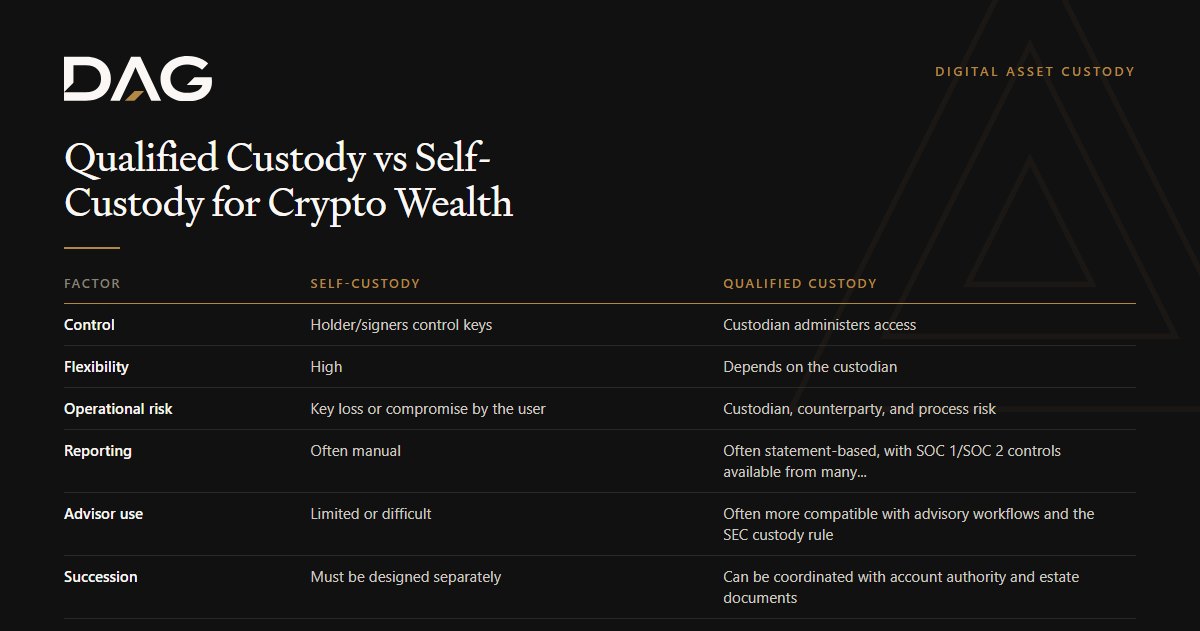
In the choice between qualified custody vs self-custody for crypto wealth, self-custody means the holder controls the private keys directly, while qualified custody places assets with a regulated qualified custodian that maintains policies, account agreements, and reporting. The right answer depends on your facts: it is a governance, compliance, succession, and reporting question, not only a security one.
What Qualified Custody and Self-Custody Mean
Self-custody is direct control of the private keys behind a digital asset, held through a seed phrase, hardware wallet, or multi-signature setup. Whoever holds the keys can move the asset.
Qualified custody generally refers to holding assets with a qualified custodian under the SEC custody framework that applies to registered investment advisers. A qualified custodian administers access through account agreements, internal controls, and reporting rather than handing keys to the client. Not every firm that holds crypto meets that definition, so the distinction between a qualified custodian and a crypto exchange matters.
Why This Matters
Crypto custody determines who can move the asset. In self-custody, control may sit with a private key, seed phrase, or multi-signature arrangement. In qualified custody, control is administered through a custodian with policies, account agreements, reporting, and regulatory obligations.
For someone managing modest holdings, self-custody can feel aligned with the asset class. For high-net-worth families, family offices, and investment advisers, the questions are broader: fiduciary oversight, insurance, audit trails, beneficiary access, tax records, cyber risk, and succession. This is the core of the broader digital asset custody decision.
How They Compare
| Factor | Self-Custody | Qualified Custody |
|---|---|---|
| Control | Holder/signers control keys | Custodian administers access |
| Flexibility | High | Depends on the custodian |
| Operational risk | Key loss or compromise by the user | Custodian, counterparty, and process risk |
| Reporting | Often manual | Often statement-based, with SOC 1/SOC 2 controls available from many custodians |
| Advisor use | Limited or difficult | Often more compatible with advisory workflows and the SEC custody rule |
| Succession | Must be designed separately | Can be coordinated with account authority and estate documents |
| Oversight evidence | Self-documented | Form ADV disclosures, audited controls, account agreements |
Evidence Standard
No client scenario is used in this draft. Any custody failure story should be cited to a public report or clearly labeled as hypothetical. Naming a custodian or exchange does not imply it is deficient or superior; status and controls should be verified case by case.
When Qualified Custody May Help
Qualified custody may matter when assets are managed by a registered adviser, held by a family office, subject to institutional review, or part of a multi-generational plan. A few situations where it tends to fit:
- A registered investment adviser has custody of client crypto and must satisfy the SEC custody rule.
- A family wants third-party statements and audited controls (such as SOC 1 or SOC 2 reports) instead of self-prepared records.
- Holdings sit inside a trust or LLC and need account authority that maps to the governing documents, see the crypto account opening checklist for trusts and LLCs.
Self-custody may still be part of a structure, but it needs documented governance, signing rules, backup plans, and succession procedures.
When It May Not Be Enough
Qualified custody does not eliminate all risk. Self-custody does not automatically mean better security. Either model can fail if procedures are weak, authority is unclear, or the family cannot act during incapacity or death. No custody model removes market, custody, counterparty, or tax risk, and none carries FDIC or SIPC coverage for the underlying crypto. If you are weighing a move between models, the path from self-custody to qualified custody is worth mapping deliberately.
Related Questions
Is exchange custody the same as qualified custody?
Not necessarily. A crypto company holding assets is not automatically a qualified custodian. The regulatory status and account structure determine whether the custody rule is satisfied, and that generally needs to be confirmed for the specific provider.
Can a family use both qualified custody and self-custody?
Often, yes. Some families use a regulated custodian for core holdings and carefully documented self-custody or multi-signature arrangements for other assets. The key is written governance: who can sign, how transfers are approved, and what happens on incapacity.
Why do RIAs care about qualified custody?
Registered investment advisers may have custody rule obligations when they have custody of client assets, and digital assets require careful review under the applicable rules and guidance. Registration alone does not guarantee skill or outcomes; it sets baseline obligations, not a performance promise.
Does qualified custody guarantee my crypto is safe?
No. Qualified custody adds professional controls and reporting, but it does not guarantee safety, yield, or recovery of lost assets, and it does not remove market or counterparty risk. Custody choices should be reviewed with qualified professionals.
Bottom Line
Custody is the control layer of crypto wealth. For serious digital asset holdings, the custody decision should be integrated with entity structure, trust planning, tax records, and advisor oversight rather than treated as a standalone security setting.
Sources
- SEC: What is a qualified custodian?
- SEC statement on custody of crypto assets with state trust companies
Compliance Note
This article is for general educational purposes and is not legal, tax, custody, or investment advice. Custody decisions should be reviewed with qualified legal, compliance, and investment professionals. Registration does not imply a certain level of skill or training.